
Canada’s job market has been far stronger than expected, but with the trade challenges ahead, the Bank of Canada’s decision to hold interest rates is a balanced call, economists say.
The central bank held its key rate at 2.25 per cent on Wednesday.
Governor Tiff Macklem said the policy is at the right level for keeping inflation near two per cent and helping the economy adjust to changes, which he calls a “structural adjustment”.
“I think what they’re saying as well is that, look, we’re still watching inflation here, and underlying inflation, to be frank, in the last couple of months, hasn’t exactly gone the way they would want,” Warren Lovely, managing director with National Bank Financial, told BNN Bloomberg.
He said three straight reports of “exceptional” job gains have surprised the central bank and Gross Domestic Product (GDP) data has also been stronger but inflation remains sticky.
“Can’t really declare victory fully when you still have inflation at the upper end of your target band,” said Lovely.
He said the Canada-United States-Mexico Agreement (CUSMA) plays a vital role in future decisions.
“That, more than anything, is the most significant risk factor for us to be thinking about as we move into 2026,” said Lovely.
“Sure, those job reports that I mentioned have been very, very strong, but companies aren’t exactly telling us there’s a lot of urgency to add new hires.”
Job optimism is overhyped
The bank is also trying to push back against “excitable interpretations” of the recent jobs data, Andrew Kelvin, head of Canadian and global rates strategy at TD Securities told BNN Bloomberg.
He pointed out that after the last report, some investors were already talking about rate hikes in 2026.
“I think what the bank was trying to do while signaling that the economy does remain resilient—perhaps a little bit better than expected—there are challenges ahead with the CUSMA renegotiation next year,” said Kelvin.
He said the optimism around the job numbers was likely overdone because Canadian labour data is “notoriously volatile.”
Kelvin also pointed out that while GDP in the third quarter came in around 2.6 per cent annualized, consumption activity was still soft, and the unemployment rate at 6.5 per cent is higher than the bank would like.
Weak investment is still Canada’s biggest problem
Kelvin said weak business investment is a long-standing issue holding back productivity.
He said investment outside the energy sector has been low for decades and the manufacturing sector has seen limited growth regardless of whether the currency was strong or weak.
Lovely said that even though job gains look strong, companies are not acting like they want to hire aggressively or spend more.
And businesses have held back.
“They’re still on the sidelines. And the Bank of Canada has made it clear in the past, we have a productivity crisis, problem dilemma in this country. Fixing it will require businesses to be investing in machinery and equipment, and that’s going to take a lot of time,” said Lovely.
Kelvin also highlights Canada’s major housing crisis.
“We haven’t done a good enough job at building housing. We haven’t done a good enough job promoting business investment,” said Kelvin adding that just looking at those two things alone, one can conclude that Canada is not a friendly environment for investing.
Macklem has said the CUSMA trade deal review creates uncertainty for businesses.
While the federal government plans to spend billions of dollars in heavy infrastructure and defence, Macklem said the impact on government spending plans will slowly filter through the economy.
“I think the task of governments in the future…should be to try and make it a bit more of an attractive place to invest,” said Kelvin.
Why the dollar slipped after the announcement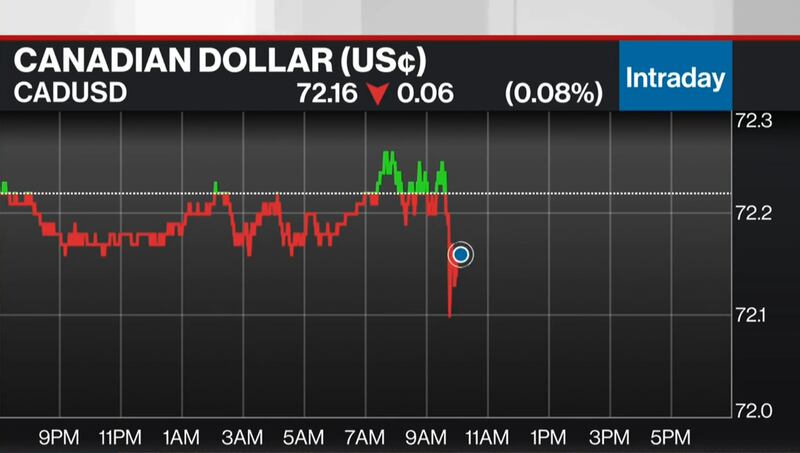 Canadian dollar dropped
The Canadian dollar slipped by approximately 0.13 per cent against the U.S. dollar immediately after the Bank of Canada announced its decision to hold its interest rate.
Kelvin said the currency dipped because some investors had been positioned for the idea that the bank might need to raise rates sooner than expected.
Because markets are sort of an opinion weighting machine, he said some individuals would position themselves for news more quickly.
“Those individuals would have found themselves disappointed by the fact that the Bank of Canada is not panicking after one or two months of very strong data,” said Kelvin.