
Published on
10/12/2025 – 13:19 GMT+1
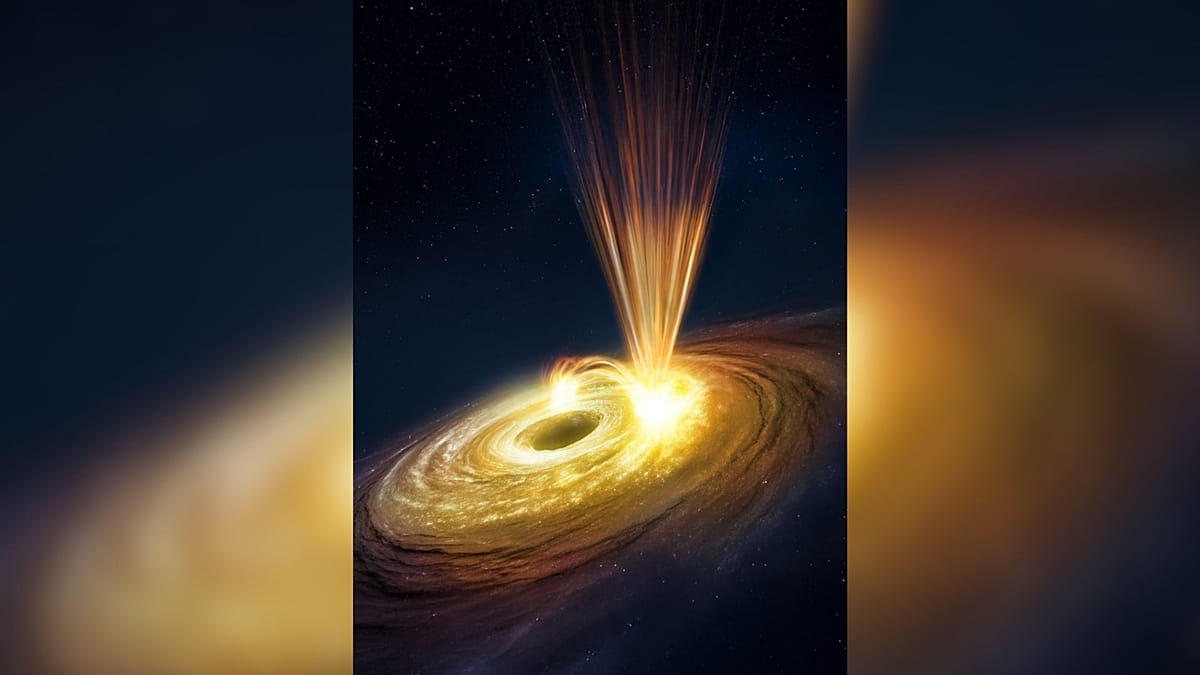
In a galaxy far, far away, a black hole is whipping up winds so powerful that human minds back on Earth can hardly fathom their scale. For the first time, a team of global astronomers has been able to directly observe this phenomenon.
The gigantic black hole – as big as 30 million of our galaxy’s Suns – is located in the NGC 3783, a spiral galaxy about 130 million light-years from Earth.
Using two leading X-ray space telescopes, astronomers spotted the black hole devouring everything around it in order to power an extremely bright and active region at the centre of the galaxy – known as an Active Galactic Nucleus (AGN).
As it sucked up this material, the black hole emitted a bright, fleeting X-ray flare that quickly gave way to ultra-fast winds – some of which clocked in at nearly 60,000 kilometres per second, or 20 per cent the speed of light.
“We’ve not watched a black hole create winds this speedily before,” Liyi Gu from the Space Research Organisation Netherlands (SRON) said in a statement.
“For the first time, we’ve seen how a rapid burst of X-ray light from a black hole immediately triggers ultra-fast winds, with these winds forming in just a single day,” Gu, who led the team of researchers, added.
The team’s research was published this week in the international journal Astronomy & Astrophysics.
Two powerful deep space telescopes
To study this phenomenon, which is one of the most elusive in the Universe, Gu and colleagues used two powerful telescopes – the European Space Agency’s (ESA) XMM-Newton and the X-Ray Imaging and Spectroscopy Mission (XRISM).
XMM-Newton tracked the initial flare’s evolution and assessed the extent of the winds, while XRISM spotted the flare and winds, studying their speed and structure.
“Their discovery stems from successful collaboration, something that’s a core part of all ESA missions,” Erik Kuulkers, a scientist on the ESA XMM-Newton project, said in a statement.
The study’s authors believe the winds were created as the black hole’s tangled magnetic field “untwisted.” They said this process resembles large solar eruptions in our own galaxy, known as coronal mass ejections.
It is “similar to the flares that erupt from the Sun, but on a scale almost too big to imagine,” said the study’s co-author Matteo Guainazzi, a scientist on the ESA XRISM project.
These similarities are reassuring, researchers said, showing that supermassive black holes can sometimes act like our own local star, and therefore cutting through some of the mystery around these objects.
Scientists recorded coronal mass ejections from our own Sun as recently as November 11, with wind speeds of 1,500 kilometres per second.