
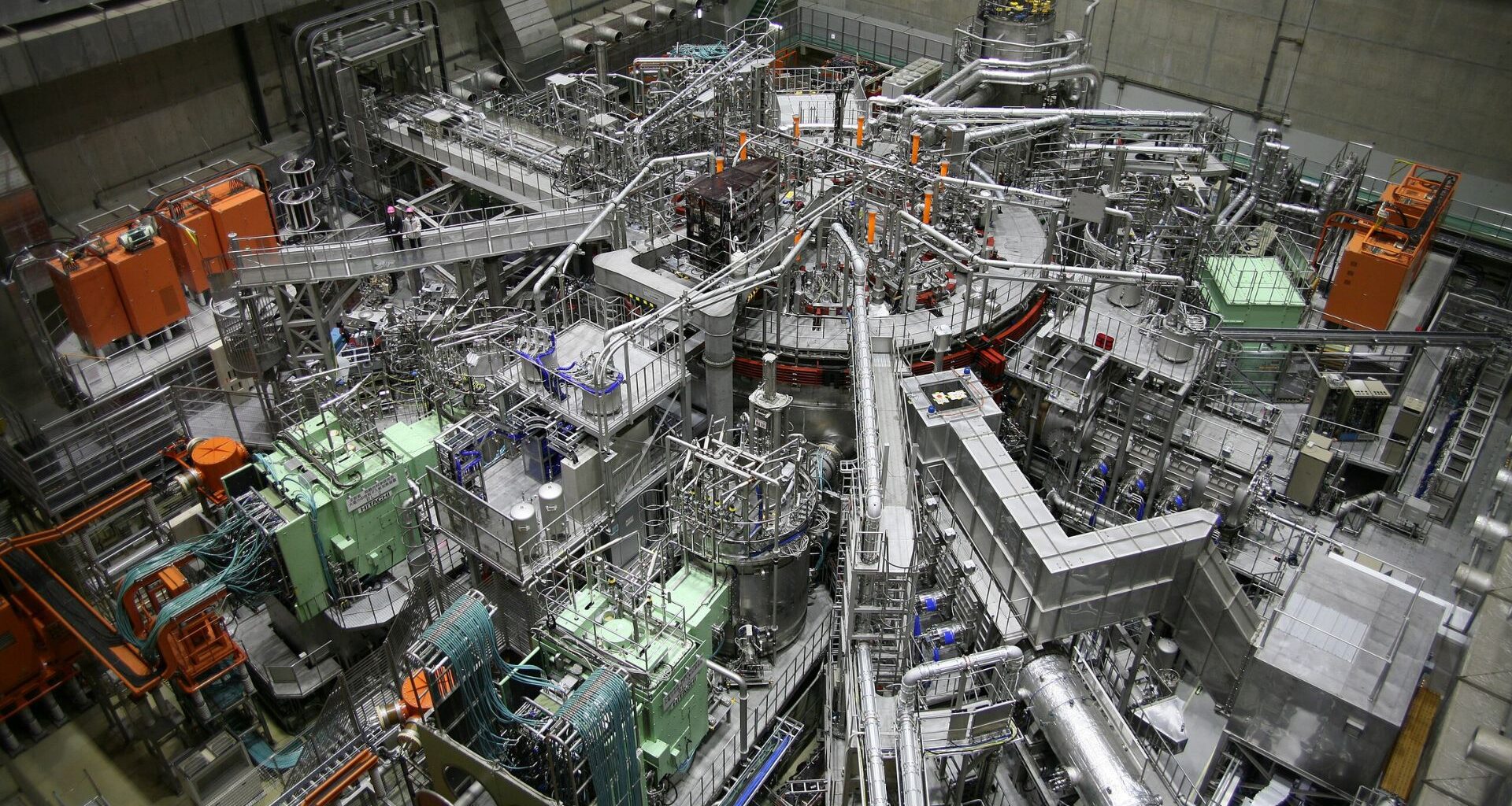
For decades, physicists have been puzzled by a phenomenon inside fusion reactors that defies conventional theory: heat escaping from the core to the edge at impossible speeds.
Now, a team at Japan’s National Institute for Fusion Science (NIFS) has cracked the code, discovering that plasma turbulence behaves less like a slow-moving fluid and more like an American football team executing a perfectly timed long pass.
This discovery helps explain why keeping plasma hot enough for fusion—requires temperatures exceeding 100 million degrees—is notoriously difficult. The findings offer a new insight for stabilizing future reactors.
Rewriting the playbook on heat loss
Conventional physics suggests that heat in a reactor should diffuse slowly, inching its way from the hot center to the cooler edge. But experiments have repeatedly shown that heat can jump across the containment field almost instantly, a “spooky action” that weakens the magnetic confinement required for energy production.
The NIFS researchers, working with the Large Helical Device (LHD), have now identified the main issue: a specific type of “mediator” turbulence.
Using a sports analogy to explain the physics, the team describes the plasma’s behavior as having two distinct modes. In the past, scientists accounted only for the “running game,” in which turbulence carries heat gradually, like a player tucking the ball and running forward.
The new study reveals that plasma also has a “passing game.” Immediately after the core is heated, this mediator turbulence links distant regions of the reactor in less than one ten-thousandth of a second, effectively executing a long-range bullet pass that allows heat to bypass the space in between and affect the edge instantly.
Catching the action
To observe this split-second behavior, the research team had to move beyond standard observation methods.
They subjected the plasma to short, intense heating pulses and used high-precision diagnostic tools capable of measuring changes at the microsecond level.
The data showed a clear cause-and-effect relationship: shorter heating pulses actually strengthened the mediator turbulence, accelerating heat loss.
This confirms that turbulence isn’t just a chaotic mess; it is a complex system performing two roles simultaneously—transporting heat locally while also connecting distant areas.
A new strategy for fusion
This breakthrough moves the field from simply observing rapid heat loss to understanding its mechanism. By identifying the specific turbulence responsible for the “long pass,” scientists now have a target for control.
If engineers can dampen this mediator turbulence, they could force the plasma back into a slower, more manageable “running game,” keeping the heat confined in the core for longer periods.
This level of control is a critical step toward making fusion a viable, limitless energy source.
“This research provides the first unambiguous experimental evidence for the long-hypothesized mediator pathways, validating key theoretical predictions in plasma physics,” said the researchers in a new study.
Because this simultaneous long-range reaction occurs in other natural systems—such as ocean currents and atmospheric patterns—the discovery may ripple into climate science and material engineering.