
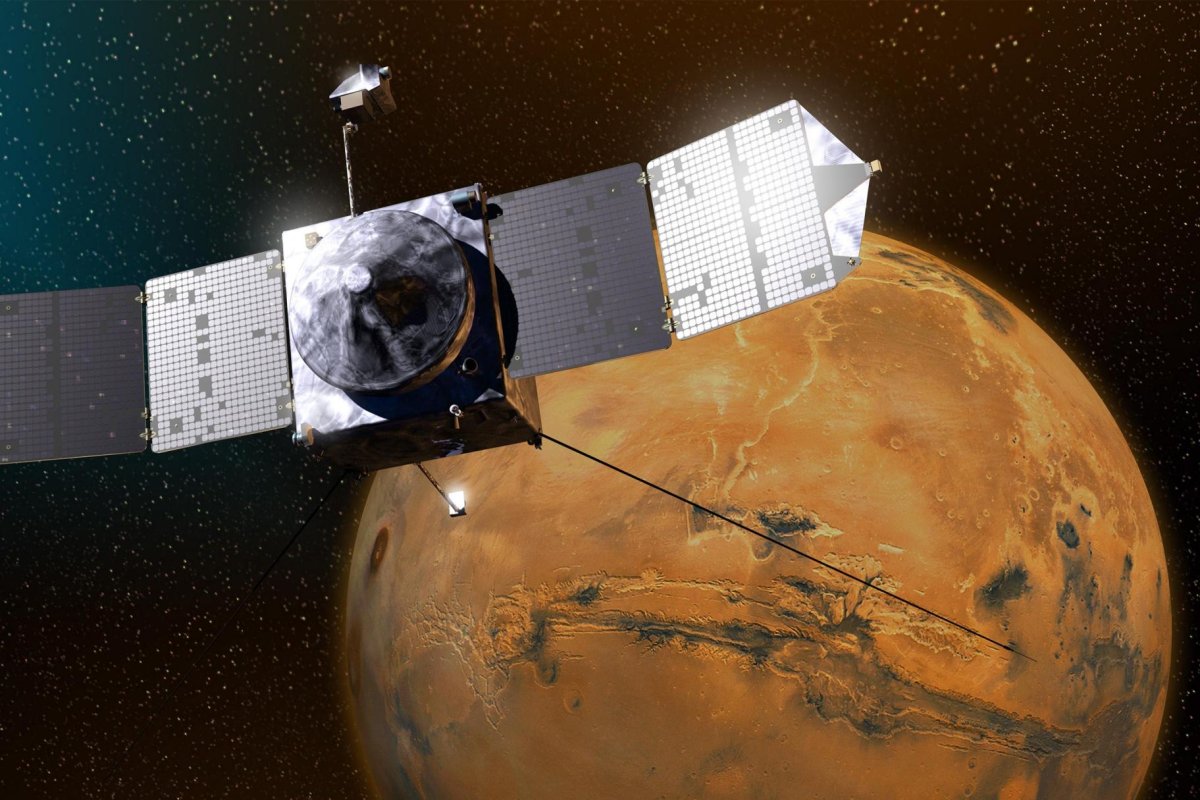
Dec. 10 (UPI) — NASA has lost contact with MAVEN, a spacecraft that has been orbiting Mars for more than 11 years and one of only three circling the red planet.
On Tuesday, NASA said it lost contact with the Mars Atmosphere and Volatile EvolutioN spacecraft on Sunday.
According to telemetry, MAVEN was working normally before passing behind Mars as seen from Earth. Communications didn’t resume after the orbiter emerged from behind the planet.
“The spacecraft and operations teams are investigating the anomaly to address the situation,” NASA said. “More information will be shared once it becomes available.”
NASA, along with Deep Space Network operators at the Jet Propulsion Laboratory in California, can still ping the spacecraft along its predicted orbit while determining a cause and subsequent solution, Space.com reported.
In 2022, MAVEN switched to an “all-stellar” navigation system to minimize the use of the inertial measurement units.
MAVEN has enough propellant to orbit through at least the end of the decade, though it’s “operating well past the end of prime mission,” NASA said. MAVEN cost $22.6 million to operate in 2024.
MAVEN, weighing 5,410 pounds, launched on Nov. 18, 2013, from Cape Canaveral Air Force Station in Florida atop a United Launch Alliance Atlas V rocket. Without fuel, it weighed 1,784 pounds.
Objects weigh only about 38% of their Earth weight due to Mars’ lower gravity.
After a 442 million-mile mission, it began orbiting the red planet on Sept. 21, 2014.
“The mission’s goal is to explore the planet’s upper atmosphere, ionosphere and interactions with the Sun and solar wind to explore the loss of the Martian atmosphere to space,” NASA said. “Understanding atmospheric loss gives scientists insight into the history of the Red Planet’s atmosphere and climate, liquid water, and planetary habitability.”
Scientists have wanted to learn how the planet changed from early in its history when it had a much thicker atmosphere and was warm enough to support liquid water on its surface, Space News reported.
MAVEN also serves as a communications relay to link to NASA’s Curiosity and Perseverance rovers on the Martian surface. NASA’s Curiosity landed on Mars on Aug. 6, 2012, and Perseverance on Feb. 2021.
NASA’s Mars Odyssey and Mars Reconnaissance Orbiter spacecraft also serve as communications relays for the rovers.
They are older. Odyssey has been orbiting since Oct. 24, 2001, and MRO on March 10, 2006.
Four other non-U.S. spacecraft are going around Mars: the European Space Agency’s Mars Express, starting on Dec. 25, 2003; ExoMars Trace Gas Orbiter, a collaboration between the ESA and Russia’s Roscosmos, on Oct. 19, 2016; United Arab Emirates Space Agency’s Mission Hope on Feb. 9, 2021; and China’s Tianwen-1, one days later on Feb. 10, 2021.
On Nov. 13, Blue Origin’s New Glenn rocket launched two NASA ESCAPADE satellites that are bound for Mars in September 2027. This is a longer trajectory than other missions to Mars.