
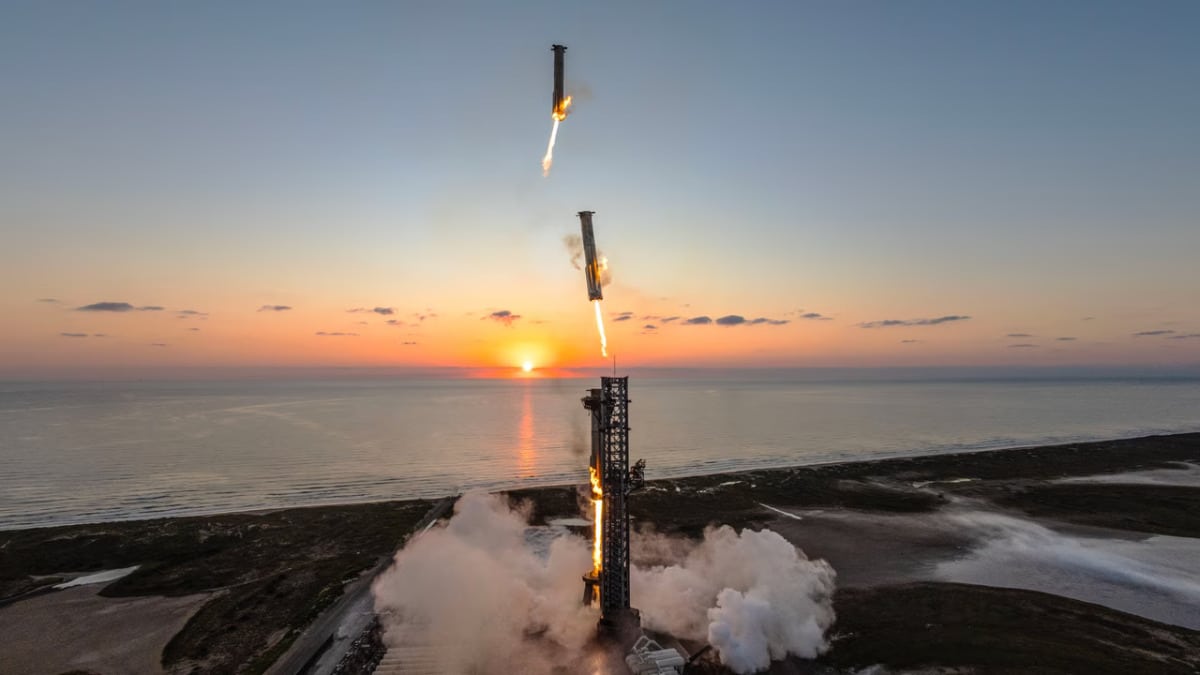
The latest Starship 5 test flight may have been hailed as a success, but an unexpected audio leak — whether accidental or strategic — suggests SpaceX came frighteningly close to catastrophe.
The mission was celebrated for its triumphs, especially the remarkable recovery of the booster stage. Yet behind that success, the reality was far more precarious: a single wrong move, or a one-second delay, could have ended with a crash right next to the launch tower.
A near miss caught on tape
The leaked recording reveals that SpaceX engineers were seconds away from ordering the Super Heavy to crash deliberately into the ground, just short of the tower, to prevent structural damage. The emergency scenario unfolded during the final moments of descent, when the massive booster entered its automated landing sequence.
By that point, an ocean splashdown — the backup option — was no longer feasible. The booster had only two possible outcomes: either it would be caught by the Mechazilla tower’s dual “chopsticks,” which act like giant clamps, or it would crash near the pad in a controlled sacrifice.
According to the recording, a problem surfaced during the landing phase due to either a misconfigured setting or a fault in one of the Raptor engine systems. “It came down to a single second,” a SpaceX engineer can be heard saying. “If the system had paused any longer, the rocket would’ve aborted and slammed into the ground beside the tower instead of attempting the landing.”
What went wrong?
Experts now suspect the culprit may have been the cold-gas actuators, which control the roll of the booster during descent. These actuators depend on maintaining exact gas pressure levels to steer properly. A drop in that pressure could drastically reduce their ability to stabilize the vehicle, leading to loss of control during a critical moment in flight.
If that’s what happened, SpaceX narrowly avoided a major setback — and a potentially devastating blow to the company’s ongoing Starship testing program.
A success that revealed deeper risks
Despite the tense landing sequence, SpaceX still considers the flight a success. But the near miss highlights just how complex and unforgiving aerospace engineering can be. The company continues to study the data, aiming to identify and eliminate the small but dangerous flaws that separate triumph from tragedy.
For all its precision and automation, even a split-second miscalculation during a landing attempt can turn a flawless mission into a fireball — and this time, SpaceX escaped by the narrowest of margins.

Rémy Decourt
Journalist
Born shortly after Neil Armstrong’s first steps on the Moon in 1969, my journey into space exploration has been entirely self-taught. A military stay in Mururoa sparked my formal education in space sciences, and early sky-watching experiences in an astronomy club ignited my passion. I founded flashespace.com, transitioning from sky observation to a deep interest in space missions, satellites, and human and robotic exploration. Since 2010, I’ve been part of Futura’s editorial team, covering space news and working as a freelance writer with extensive international field experience in space-related sites.