
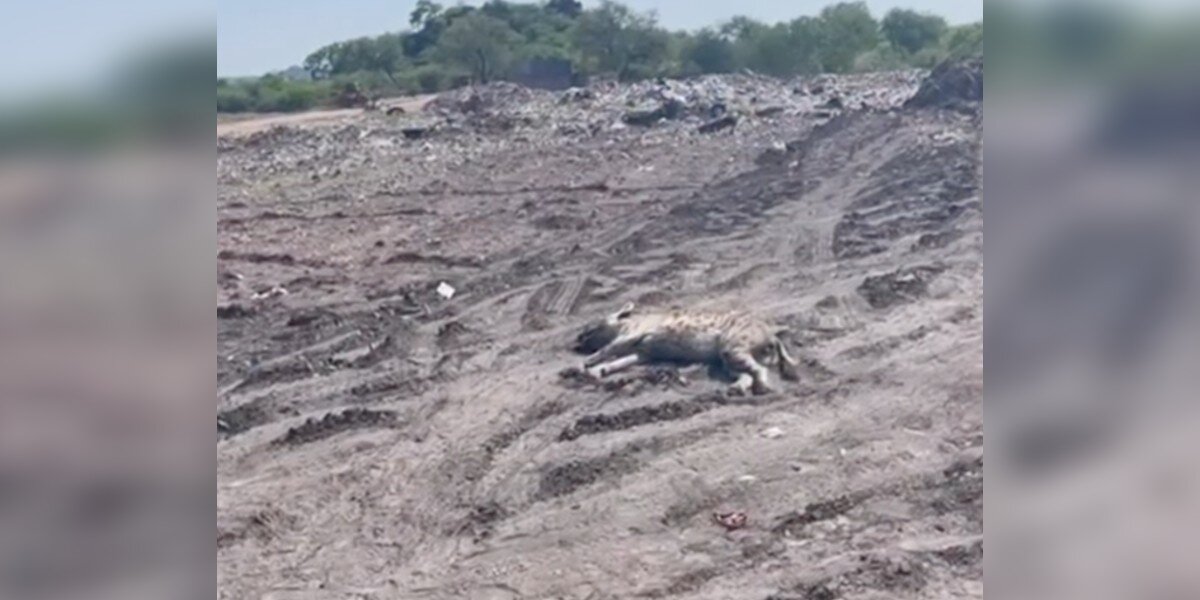
Last month, employees at a South African landfill came upon a grim scene when they arrived at work one morning. Sprawled in the dirt, unmoving, was a spotted hyena.
 Phalaborwa Natural Heritage Foundation
The workers called Limpopo Department of Economic Development, Environment and Tourism (LEDET) for assistance. A LEDET conservation official notified the Phalaborwa Natural Heritage Foundation (PNHF), which sent volunteers and a veterinarian to the site.
“The hyena was lying in the open, in full sun and breathing rapidly,” Eugene Troskie, managing director at PNHF, told The Dodo. “[He] was already in a comatose state.”
The animal had a snare around his neck and wasn’t conscious, but he was alive, which meant he had a chance.
 Phalaborwa Natural Heritage Foundation
The vet sedated him for everyone’s safety, then the team moved the hyena out of the sun and into the back of a truck.
The hyena’s dangerously high body temperature of 107 degrees Fahrenheit meant they had to act quickly. They placed ice packs on his legs and feet, and every 15 minutes they doused him in cold water.
 Phalaborwa Natural Heritage Foundation
“We were all doubtful about the animal’s recovery,” Troskie said. “He didn’t even show signs of having a blinking reflex when touching his eyes.”
The vet believed the animal had ingested poison of some kind.
 Phalaborwa Natural Heritage Foundation
Over the course of a day, the vet administered several medications, and volunteers poured more than 15 gallons of water onto the hyena’s body, hoping to cool him down and pull him out of his coma.
 Phalaborwa Natural Heritage Foundation
Miraculously, around 6 p.m., the hyena opened his eyes.
To everyone’s disbelief, several hours later, the hyena stood up. He looked a little uncertain about his surroundings.
 Phalaborwa Natural Heritage Foundation
Around 1 a.m., after nearly 20 hours of care, the PNHF team opened the cage door.
“We didn’t want to keep him in the cage any longer than necessary,” Troskie said, “due to hyenas often breaking their teeth on cages.”
 Phalaborwa Natural Heritage Foundation
The hyena slowly poked his head out, sniffed the ground, then trotted off into the trees.
Phalaborwa Natural Heritage Foundation
Since that night, the team hasn’t seen the hyena again — which is great news. They’re confident he found his clan and will make a full recovery.
The Phalaborwa Natural Heritage Foundation is an all-volunteer nonprofit organization. Its anti-poaching, research and snare removal work is crucial to conservation efforts in South Africa. To support this work, you can donate here. Couple Can’t Figure Out Why Wild Donkey Is So Still — Then They Move CloserHe was stuck out in the heat 🥵