
The study used pre-existing data from 103 human societies and 34 non-human mammal species to produce a “monogamy league table” comparing the percentage of siblings that were born to the same parents.
On top was the California deermouse – a tiny creature that forms lifelong pair bonds – which had a 100% rate of full siblings. That was followed by the African wild dog (85%) and the Damaraland mole rat (79.5%).
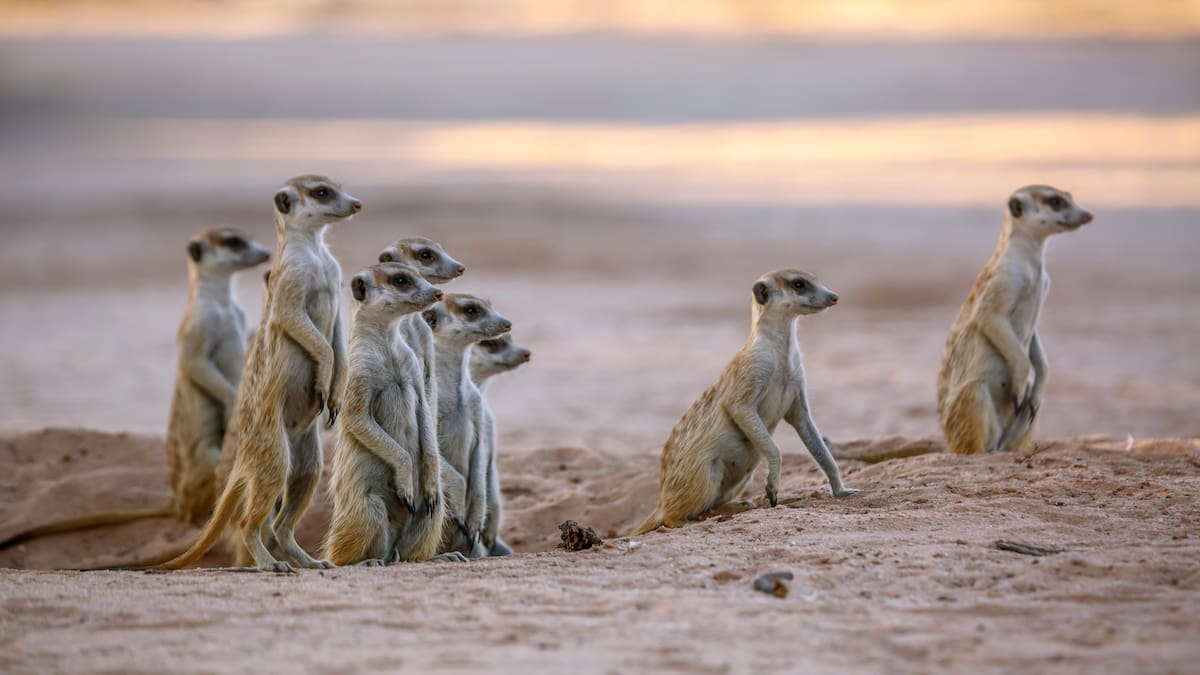
Humans ranked seventh among those analysed with 66% full siblings, making us slightly less monogamous than the Eurasian beaver but more so than the Lar gibbon, meerkat and red fox.
Least monogamous was the Soay sheep, a breed that lives in Scotland, which had just 0.6% full siblings.
Human relatives such as the mountain gorilla and common chimpanzee also lived in much less monogamous societies. Other mammals in the bottom ranks included three types of macaques, the black bear and the Antarctic fur seal.
The extent to which humans are monogamous and have been throughout their evolutionary history is the subject of debate and fascination for scientists, relationship counsellors and anyone with a glancing interest in pop culture.
Evidence from birds, mammals and insects suggests that the transition to co-operative societies is more likely to occur in monogamous species – as families are seen as more likely to look after their own.
Though the extent to which monogamy is a “species-typical mating system” for humans has been questioned, Dyble wrote.
Some sociologists have argued that humans are not meant to be monogamous, though scientists say social monogamy – forming a pair to care for a child – has been critical in human evolution.
The importance of grandmothers and paternal care has also been hypothesised as an influential force in how humans have evolved.
“When we look at really highly co-operative animal species in birds and mammals and insects, the leading hypothesis is called the ‘monogamy hypothesis,’ which is that transitions to super co-operative animal societies are preceded by evolution of monogamous mating,” Dyble said in a phone interview.
“The evolutionary implications as it were aren’t necessarily always about monogamy as such, but pair-bond stability in terms of forming long-term reproductive relationships.”
Dyble said he was interested in comparing humans to mammals other than chimpanzees and gorillas, our closest ancestors, because he believes it is a neglected area “fundamental to human evolution”.
Previous work on the role of monogamy in human society has relied on fossil records or comparison of marriage norms across cultures, Dyble said.
His research studied the data from human populations and non-human mammal species to find rates of full siblings, meaning those born to the same mother and father.
For the human sample, Dyble used archaeological or ethnographic data from several societies, including Bronze Age burial grounds and Neolithic settlements. For the mammals, he conducted a review of existing scientific data.
Analysis of nearly two million human sibling relationships and more than 60,000 mammal relationships showed that the proportion of full siblings in the human groups “clusters closely” with rates seen in socially monogamous animals and “consistently exceeds rates seen in non-monogamous mammals”, Dyble wrote.
He said the data showed there was a stark difference between groups that were considered socially monogamous and non-monogamous, based on definitions from a 2013 study by Cambridge researchers.
“How surprising it is that humans sit with other monogamous species probably depends on your starting assumptions,” Dyble said.
“Some people think that humans are a very monogamous species, and they’re perhaps surprised to see actually how much variation there is, and other people’s starting point is that we’re not really a very monogamous species … But actually, the data suggest that we are.”
Dyble said limitations of the study include that some of the human data is collected through self-reporting rather than genetic analysis, meaning there could be some mistaken assumptions about parentage – though he said it wouldn’t be significant enough to change the overall results.
He said he would also like to use genetic data based on modern populations as a point of comparison.
The results raise further questions about how social monogamy among humans evolved, Dyble said, given that the mammals with the most similar rates of monogamy – such as meerkats – are different from humans in that they have a breeding pair within a group, rather than multiple males and females breeding.
“That suggests that the evolution of monogamy in humans probably was through quite a different sort of evolutionary trajectory compared to any of these other species,” he said.
“For humans to have done that is quite an unusual thing, and it’s quite unclear how and why.”
Julia Schroeder, an associate professor in evolution, behaviour and biodiversity at Imperial College London, who was not involved with the study, said in an email that it was not surprising humans cluster towards the monogamous end of the spectrum, but “any binary classification will always be an oversimplification of the variation we see”.
Kit Opie, a senior lecturer in evolutionary anthropology at the University of Bristol who was also not connected to the research, said he was “not impressed” with the findings and called it a mistake to compare humans to other mammals rather than our primate ancestors.
“The interesting question is not whether humans are monogamous. We know humans are monogamous, they have been for the last 200,000 years, that’s pretty clear,” he said in a phone interview.
“The real interesting question from my point of view is ‘why are humans monogamous’, and the paper doesn’t engage with that at all.”
Sign up to Herald Premium Editor’s Picks, delivered straight to your inbox every Friday. Editor-in-Chief Murray Kirkness picks the week’s best features, interviews and investigations. Sign up for Herald Premium here.