
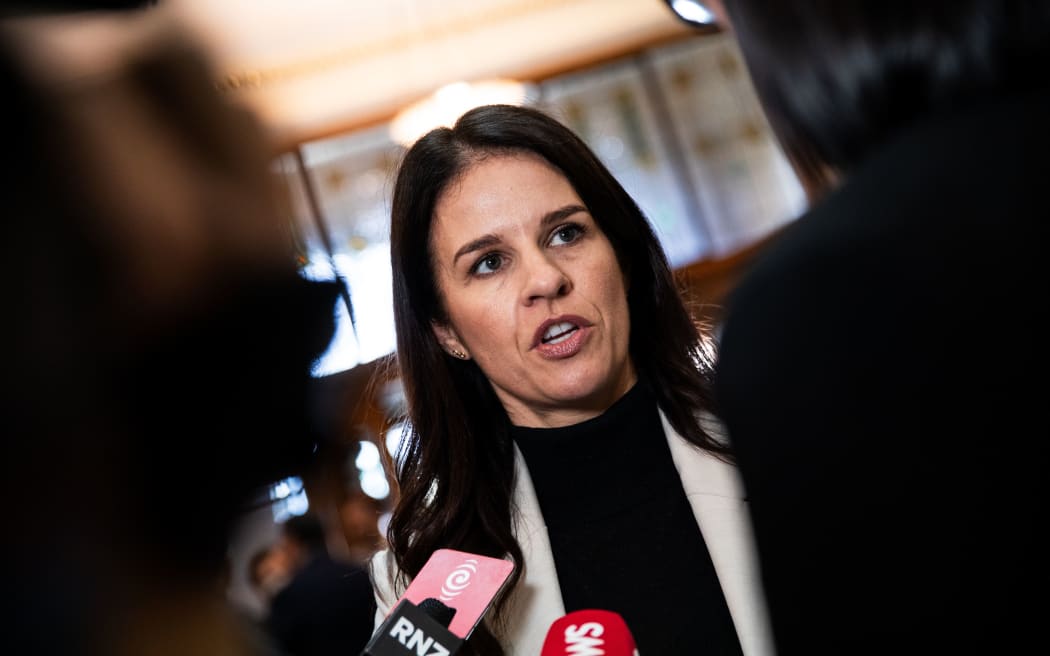
Immigration Minister Erica Stanford
Photo: RNZ / Samuel Rillstone
A chronological processing queue is among options being considered to replace the existing ballot system used to allocate parent resident visas, according to a spokesperson for Immigration Minister Erica Stanford.
Under current legislation, up to 2500 parent resident visas can be granted annually to applicants who have filed expressions of interest and have been selected by ballot.
Migrants have complained the ballot system was unfair, [https://www.rnz.co.nz/news/chinese/565161/torturous-parent-resident-visa-ballots-leave-families-in-limbo leaving them with little hope of reuniting with their parents in New Zealand.
Some have been waiting for several years to be selected but believe there is little chance of being selected due to the annual quota limit and the number of people currently in the pool.
A spokesperson from Immigration Minister Erica Stanford’s office said the review currently underway followed “significant feedback about the unfairness” of the ballot system.
“The review is considering alternate options to allocate the 2500 annual places under the Parent Category Resident Visa, including consideration of returning to a chronological queue,” the spokesperson said.
“The minister is expecting to receive advice in early 2026 before decisions are made.”
The spokesperson said the new Parent Boost visitor visa provided a pathway for parents to join migrants in New Zealand for up to five years while awaiting a place for residency.
There are currently 9260 expressions of interest for parent resident visas covering 14,017 applicants, according to latest Immigration New Zealand data.
Separately, Immigration New Zealand has received 511 Parent Boost visitor visa applications as of 10 December.
Of those, 107 applications have been approved, and a further 88 applications have been approved-in-principle, pending the receipt of acceptable insurance documentation, according to the department’s visa director, Jock Gilray.
Three applications have been rejected because they did not meet the visa requirements, Gilray said.
“The average age of Parent Boost applicants is 64 years old, and the top three nationalities are India, China and South Africa,” he said.
“India counts for 32 percent of all applications received (161 applications).”