
By Nick Campton, ABC
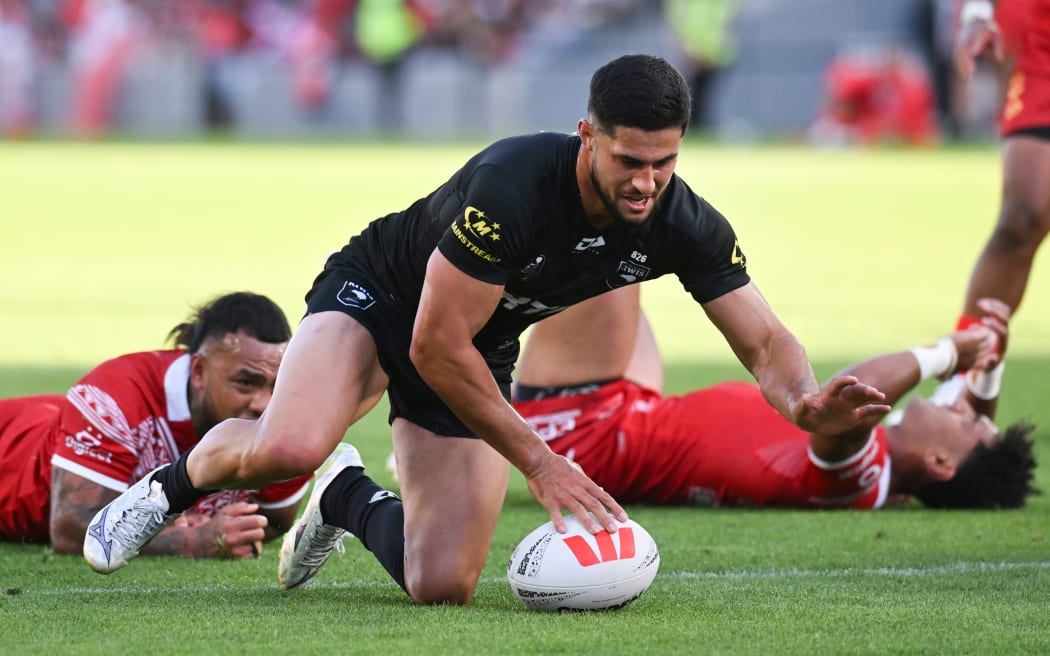
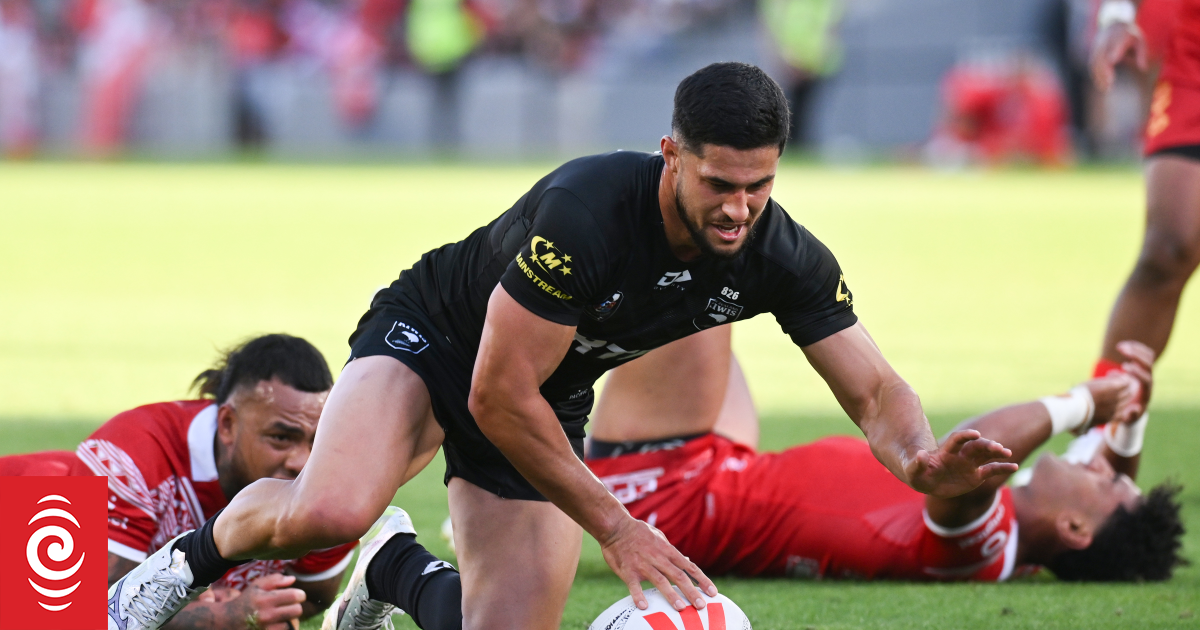
Dylan Brown scores a try for the Kiwis against Tonga in round 3 of the Pacific Championships rugby league tournament at Eden Park, Auckland, 2 November 2025.
Photo: Photosport
Analysis: After a year during which he signed the most lucrative contract in the history of rugby league, it would have been fitting if Dylan Brown ended 2025 in gold.
The future New Zealand playmaker was overlooked for the Golden Boot as the year’s best player in Test football but with due respect to Harry Grant it’s baffling that the award won’t be sitting on Brown’s mantelpiece once he makes his move to Newcastle.
Head-scratching selections for individual awards are par for the course in rugby league and this one gets worse the more you examine it. Grant was his usual self in Australia’s 3-0 series win, but his only man-of-the-match award came in the dead-rubber third Test, and he missed out on player-of-the-series honours to Cameron Munster.
Perhaps you can tie yourself in difficult knots trying to justify Grant’s win, but there’s a reason the headline in the aftermath is universal shock that Brown didn’t take the prize home.
The football Brown played speaks for itself, and ahead of the NZ$15 million contract he’s about to take up with the Knights, it was a window into how player and club can make the most of what shapes as the biggest contract in rugby league history.
He was best on the ground in all three of their wins as they claimed the Pacific Championship and looked a class above opponents like Samoa’s Jarome Luai and Tonga’s Isaiya Katoa, setting up seven tries and scoring three himself across the tournament.
After his showing in the final against Samoa, where he set up three tries, saved another with a tackle on Deine Mariner and ran for more metres than every single opposition player, Brown seemed a player both in total command of his own skills and certain of his place within the wider structures of the team.
He was getting the ball wide and in space and seemed lighter on his feet than everybody else. He played to his strengths and reminded people after an uneven year with Parramatta that they are considerable.
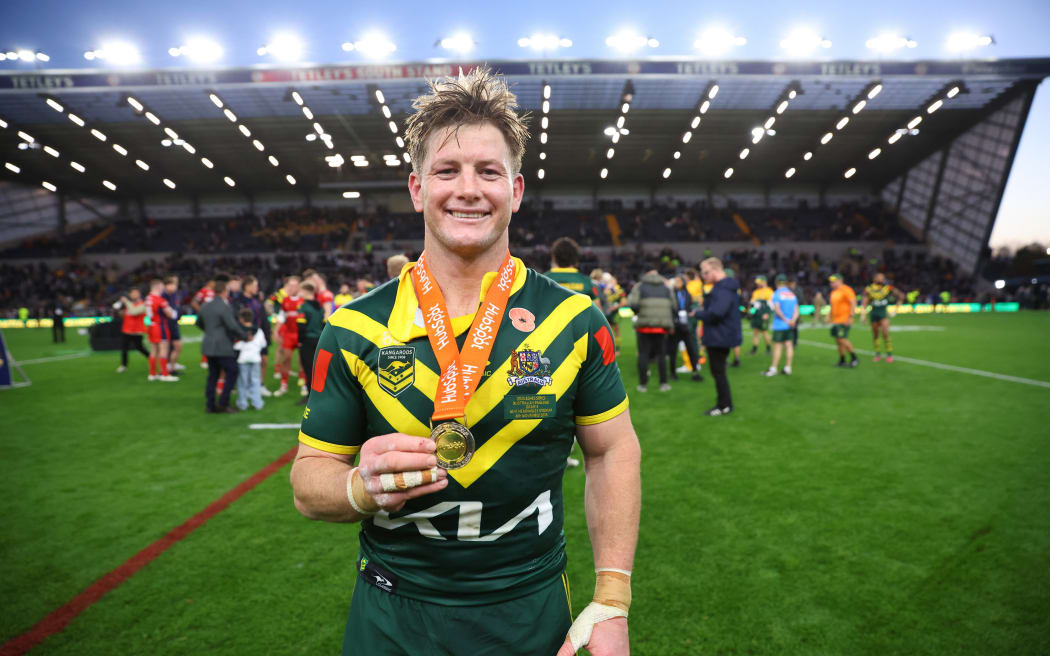
Harry Grant of Australia wins player of the match after the third rugby league test against England at Headingley Stadium in Leeds, 8 November, 2025.
Photo: PHOTOSPORT
Brown did not seem to be choosing the correct attacking options because, through his creation, the correct option felt more like a natural conclusion to what was happening than a choice between right and wrong.
Such clarity was in short supply for Brown during a difficult 2025 campaign. Once Brown signed his deal with the Knights in March, his long goodbye to the Eels wasn’t easy.
He spent time out of Parramatta’s top 17, and when he returned, it was in the centres.
His strong combination with Mitchell Moses, which helped spur the Eels to the 2022 grand final, lived more in memory than the moment, and the history-making nature of the deal with the Knights made him an easy and juicy target for frustrations – whenever Brown stumbled, there were 15 million reasons why even if the riches hadn’t started coming in yet.
It was the taste of things to come and the beginning of a new world for the 25-year-old, one where he’ll play under pressure and scrutiny few players have ever had to bear.
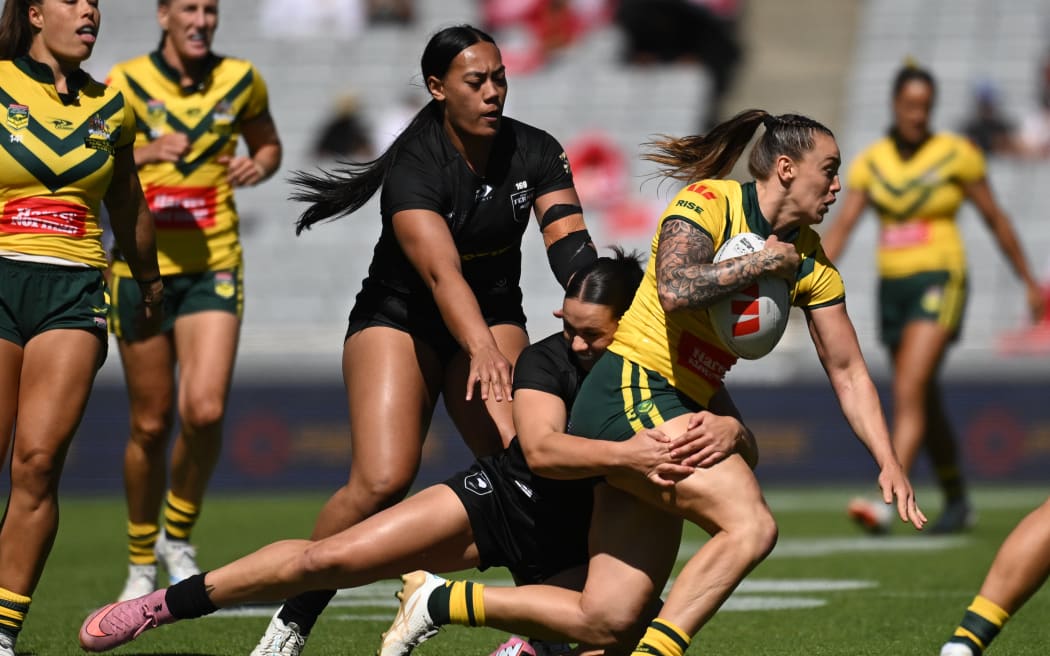
Australian Julia Robinson has won the women’s Golden Boot award.
Photo: Photosport
All playmakers need a thick skin and a goldfish’s memory when it comes to criticism, but few of them have to carry the weight of the biggest contract in rugby league history and like a pirate looting gold from a sinking ship those riches are heavy enough to drag anyone into the murky depths.
But for New Zealand, Brown looked like a saviour and the exact kind of hero Newcastle have been holding out for – strong and fast and fresh from the fight.
The Knights have been spinning their wheels in the halves for years now – since the start of 2022, they’ve changed their combination 38 times.
Sometimes it was due to injury, or suspension, or ill-form, or tactical switches, but at some point, when the only constant becomes the changes themselves, the reasons stopped mattering.
Even in 2023, when they made the second week of the finals for the first time in a decade, they switched up their halves combo eight times.
Newcastle are betting $15 million and ten full years that Brown, in one form or another, can be the primary part of the answer, and the way he played for New Zealand could be the blueprint to getting their money’s worth
It’s less what Brown did himself than what happened around him, because the latter is what led to the former.
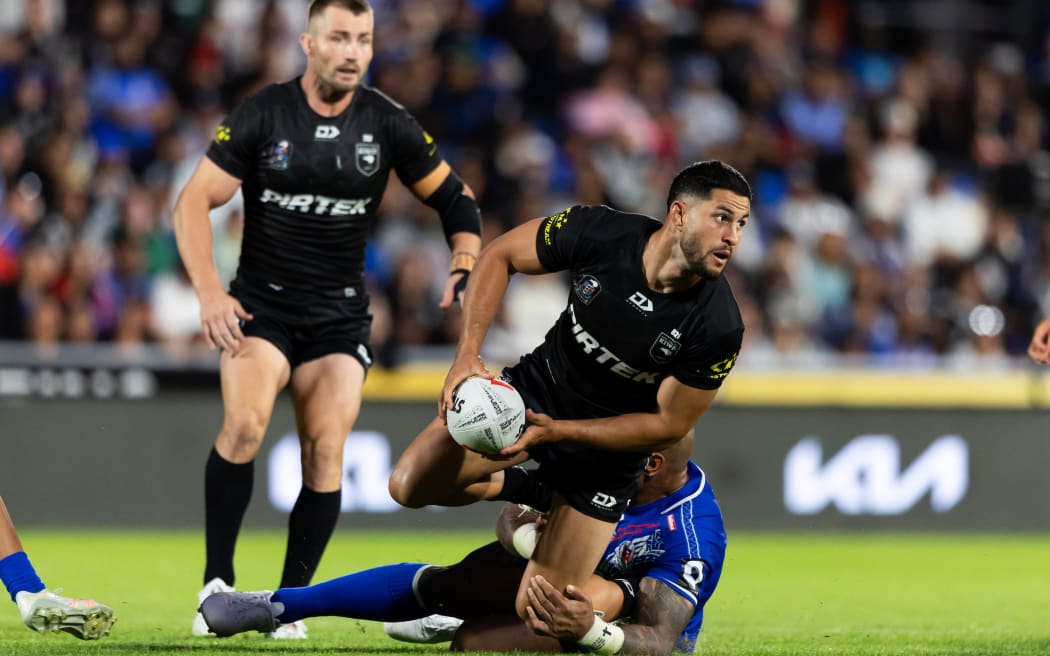
Kiwis Dylan Brown, right, and Kieran Foran during the Pacific Championships rugby league test between New Zealand and Toa Samoa at Mt Smart Stadium, Auckland, 19 October 2025.
Photo: Photosport
His halves partner was Kieran Foran, who used up the last of his toughness and cunning for the Kiwis in the final games of his remarkable career.
Through those peaks and valleys, Foran has never spent more than a few weeks at halfback, and alongside Brown he was not the organising, on-ball presence we imagine a classic halfback to be.
Neither player was totally dominant – in the final against Samoa, Brown had just one more touch than Foran – but they found a give-and-take that best suited both their skills.
For the most part, Foran stuck closer to the ruck, played straight and in the line and did most of the kicking, which gave Brown the space to play so well his boots should have been gilded.
But each also had the versatility to change it up if needed – Brown’s first try against Tonga came at first receiver, as did three of his assists through the tournament.
Foran’s swansong turned out to be the best football he played all through his retirement year because what he found with Brown was more of a supplementary relationship than a complementary one.
In some halves combinations, the best attributes of one player cover the weaknesses of another but Brown and Foran found a way to enhance each other’s strengths.
That’s the task before Brown in Newcastle, and in his potential halves partners Sandon Smith and Fletcher Sharpe.
None of the three are halfbacks in the traditional sense. Asking any one of them, including Brown, to be the kind of organising playmaker around which the whole world turns is asking for disappointment.
But once the focus shifts from what they’re not to what they are, the possibilities tantalise.
In a strong year for the Roosters, Smith showed an ability to play into the line and a versatility in switching between first and second receiver that could pair him well with Brown.
The give and take he showed with Hugo Savala before Sam Walker’s return from injury was impressive and heading into the summer he seems the better fit alongside Brown, regardless of who wears six or seven.
Sharpe is the wildcard, given still learning to play in the halves at the top level, but he has a speed so blinding it shapes as the foundation on which much can be built.
Playing towards Brown’s strengths is the only way to make all this worthwhile but it’s a mistake to think what New Zealand did is easily replicable in Newcastle.
The Kiwis have the best forward pack of any team in the world, not just on size and strength but on the skill of Erin Clark, who’s passing was just as vital as Foran and Brown’s.
Even against Samoa and Tonga, who both had packs mean enough to skin crocodiles, they were a class above.
That kind of platform is not easily found anywhere in the NRL, let alone at a Newcastle side who only had one middle forward average over 100 metres a game last season.
The Knights have things to like about them outside of the new money, especially when you entertain the prospect of Kalyn Ponga, Dylan Lucas and Bradman Best linking down the left side with Brown.
Ponga’s prospects especially fascinate given, for the first time in his Knights career, he has a teammate who can truly take the pressure off him.
Outside of Brown, the recruitment of Smith is a nice piece of business and landing rising prop Trey Mooney from Canberra is one of the more underrated moves of the summer.
But this is a team in transition, trying to rise up from the depths of a horror season that was desolate and despondent well before the wooden spoon was confirmed on the final day of the season when Brown himself helped carve them up.
From that low and the performances that were to come, the Knights caught a vision of their own salvation.
They’re receiving the best version of Brown, off three of the best games of his career, and his move is the beginning, the rock on which they are looking to rebuild their church.
For that to happen, they need the $15m gamble to work so well it never looked like a gamble at all.
Brown’s work for New Zealand showed it can be possible and while he might have been denied the Golden Boot he deserved the football he played could be an avenue to even greater treasures.
Kiwis forward Joseph Tapine finished third in the Golden Boot count. The judges comprised former Kiwis star Ruben Wiki, Australian greats Darren Lockyer, Cameron Smith and Petero Civoniceva, who also played for Fiji, and Englishman James Graham.
Julia Robinson wins women’s Golden Boot
Australia’s Julia Robinson was a unanimous choice for the women’s Golden Boot, beating out four other finalists, including New Zealand’s Apii Nicholls.
Robinson had a big impact in all four of the Jillaroos’ matches in 2025, with the winger scoring an amazingly athletic try against Samoa.
“Julia was another who confirmed her status as one of the truly great outside backs of the women’s game with standout performances against England in Las Vegas, Samoa at Suncorp Stadium and New Zealand at Eden Park and in the Pacific Cup final at CommBank Stadium,” said International Rugby League chair Troy Grant.
“Her try against Samoa elevated women’s rugby league to another level, as fans around the world marvelled at Julia’s ability to time her run perfectly and fly through the air like a superhero to catch Jesse Southwell’s cross-field kick and score.”
Rob Hawkins, who spearheaded back-to-back England comebacks to beat Australia 2-0 in the Wheelchair Ashes, became the first player in any discipline to win the Golden Boot in consecutive years.
2025 IRL Golden Boot finalists:
Men
Dylan Brown (New Zealand)
Harry Grant (Australia) WINNER
Payne Haas (Samoa)
Cameron Munster (Australia)
Joseph Tapine (New Zealand)
Women
Yasmin Clydsdale (Australia)
Chantay Kiria-Ratu (Cook Islands)
Apii Nicholls (New Zealand)
Julia Robinson (Australia) WINNER
Tamika Upton (Australia)
Wheelchair
Jack Brown (England)
Joseph Calcott (Ireland)
Nathan Collins (England)
Rob Hawkins (England) WINNER
Bayley McKenna (Australia)
Zac Schumacher (Australia)
– ABC/ RNZ Sport