
Hills Real Estate, led by director Rickhil Prakash, has previously been named as one of New Zealand’s largest property traders.
Earlier this year, the Herald analysed 71 deals linked to the Hills team, finding it made an estimated $5.4 million gain buying and selling 71 homes in recent years at an average profit of $76,242 per property.
However, Prakash told the Herald at the time that trading was a “very risky” business which he didn’t readily recommend to others.
“You can lose lots of money if you don’t know the market,” he said in May.
The two recent homes listed for mortgagee sales appeared to have been bought by the team in 2021 and 2024.
Prakash didn’t respond to a request for comment.
It comes as the Herald last month reported on a rise in recent mortgagee sales, with specialist agent Philip Davis of Barfoot & Thompson having dozens of such properties listed at the time.
He said the number of mortgagee sales had been slowly increasing from very low levels after Covid.
Andrew Chambers, co-founder and chief executive at Tella Mortgages, told Herald Now recently that hundreds of South Auckland property owners had sold because of financial pressure, with many taking a loss.
“It’s been a long, protracted recession so we’ve been seeing stress in households for quite a while.”
Risk v reward for property flipping firm
The Herald analysis of trades linked to the Hills team found it had bought homes for about $54m and resold them for nearly $60m in 2021 and 2024.
Some of the flipped homes involved trading companies selling the same property to each other up to nine times in quick succession – sometimes on the same day.
Critics say the practice drives house prices up.
Two South Auckland first-home buyers told the Herald it had been “heartbreaking” to watch a Hills Real Estate-linked trader relist homes they tried to buy in 2021 for prices up to $100,000 higher.
However, Prakash said his team risked making losses on every deal and that his customers were happy.
Knowledge of the South Auckland market, relationships with real estate agents to help identify home sellers and buyers, and moving fast were all keys to successful deals, he told the Herald.
The aim was to buy the right homes – typically at prices under $1m – and then quickly find a new buyer for them before the settlement date arrived.
Selling before settlement meant traders typically only put up a deposit, without also paying so-called holding costs, such as interest rates on a mortgage.
Back in 2021, it was easier to use this technique to net a profit because Auckland house prices were skyrocketing.
However, making a profit in 2024 and early 2025, when prices had been growing much slower or remained flat, had been much harder, Prakash said.
Sometimes, it was not possible to on-sell the homes before the settlement date arrived – often a period of about three months.
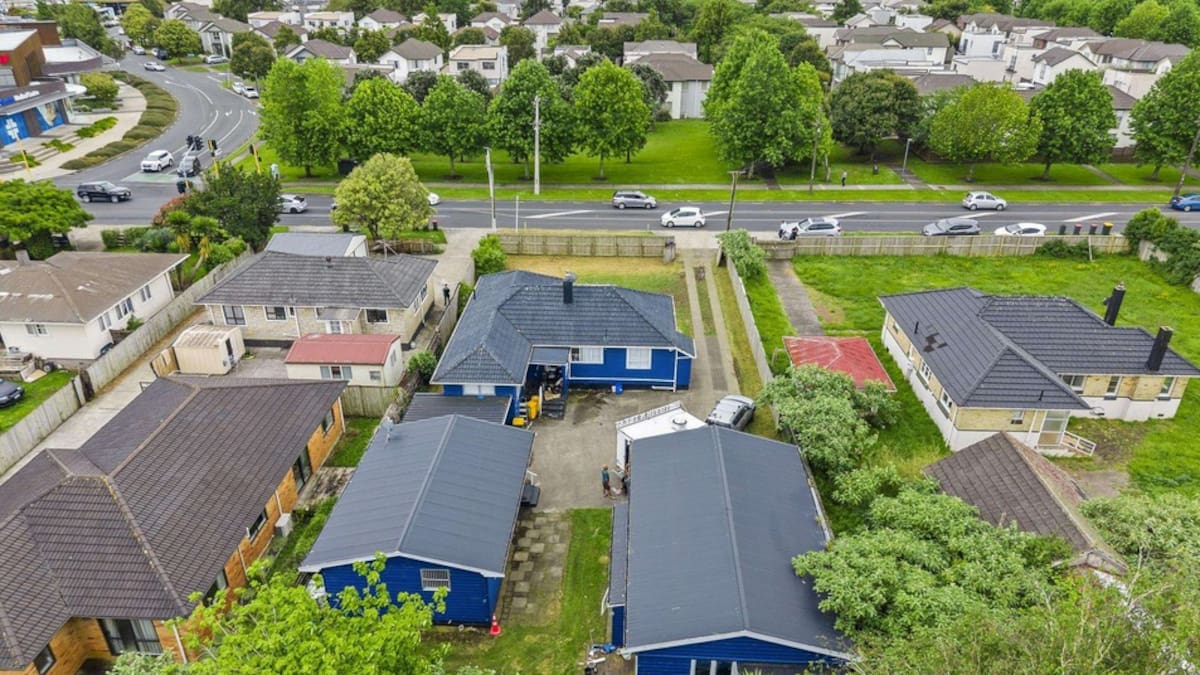
The first home at 53 Burundi Ave, Clendon Park that had been owned by property traders Hills Real Estate and was repossessed by lenders sold at auction earlier this month. Photo / Supplied
That typically led the traders to pass ownership of the home to another investor, who took out a mortgage on the property.
That investor then held the home until the Hills traders could find an end buyer.
The Hills team had to pay a substantial fee to the investor for this service, Prakash said.
“Once that happens, it’s a big loss. They will say: ‘Hey, give us $10,000-$20,000 a month just for holding’,” Prakash said.
Notable recent mortgagee sales
This home at 110 Bolton St in Blockhouse Bay has gone up for mortgagee sale with a tennis court and swimming pool. Photo / Supplied
Several notable properties have hit the market through mortgagee sales.
One forced sale was the 115-year-old Ellerslie Bowls Club at 20 Kalmia St.
The “rare offering” hit the market after a 56-apartment development attempted by the club failed.
Meanwhile, a Blockhouse Bay home at 110 Bolton St gives buyers a rare chance to score a “full-sized tennis court” and swimming pool via a mortgagee sale.