
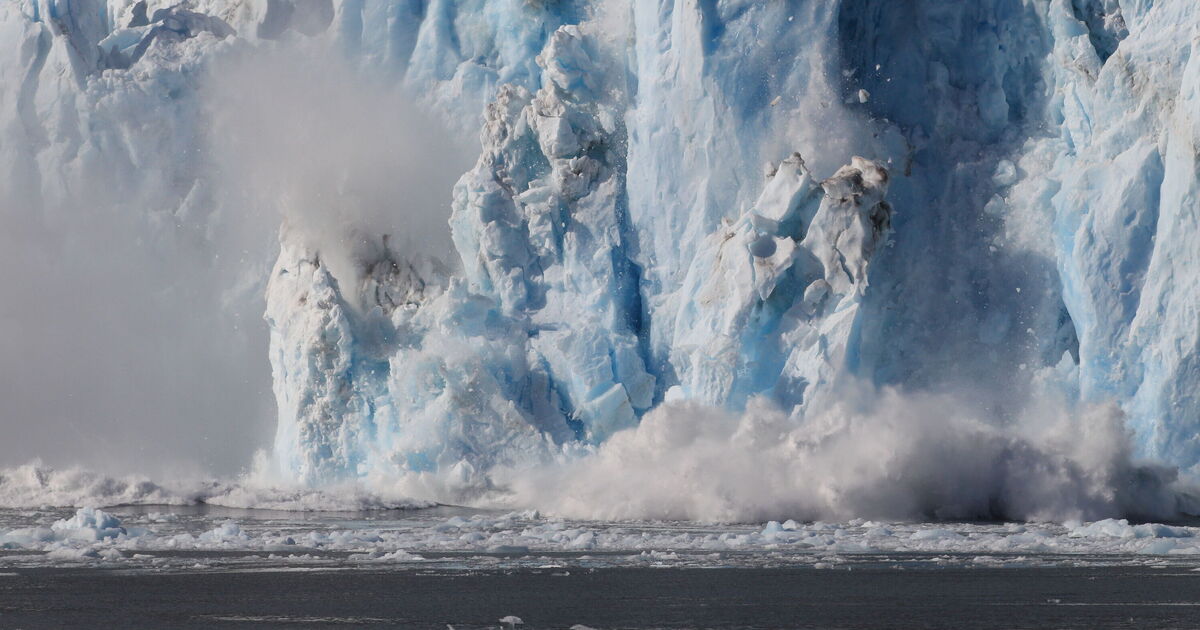
Fears are growing about the potential collapse of Antarctica’s “Doomsday Glacier”, a massive ice sheet that is melting rapidly. The glacier’s collapse could severely impact coastal cities worldwide due to rising sea levels. Scientists have recently detected hundreds of earthquakes on the continent. According to a new study, a vast number of tremors were recorded in Antarctica between 2010 and 2023, mostly at the ocean end of the Thwaites Glacier, which is roughly the size of Great Britain.
Glacial earthquakes are a unique type of earthquake that occurs in cold, icy regions. First discovered in the Northern Hemisphere over two decades ago, these tremors occur when huge chunks of ice break off from glaciers and fall into the sea. Until now, only a very few have been found in Antarctica. When these icebergs capsize, they collide violently with the “mother” glacier, generating strong mechanical ground vibrations, or seismic waves, that spread thousands of miles from their origin. Scientists are becoming increasingly concerned that human-caused climate change is putting this critical glacier at risk of total collapse.
Considered the most unstable glacier in Antarctica, the Thwaites Glacier, located in the west of the continent, already accounts for approximately 4% of global sea-level rise, losing around 50 billion tons of ice annually. The concern lies in the fact that warm water is eroding its underside at the grounding line, where it meets the seabed. Its destabilisation could allow the entire West Antarctic Ice Sheet to slide into the ocean, causing a significant rise in sea levels.
According to the author of the paper, Dr Than-Son Pham, of the Australian National University: “If [the Thwaites Glacier] were to collapse completely, it would raise global sea levels by three metres, and it also has the potential to fall apart rapidly”.
Crucially, glacial earthquakes do not generate any high-frequency seismic waves, which play a vital role in the detection and location of typical seismic sources, such as earthquakes, volcanoes and nuclear explosions. Due to this difference, glacial earthquakes were only discovered relatively recently, with the most notable examples having been recorded near the ends of glaciers in Greenland, the largest ice cap in the Northern Hemisphere.
While their intensity varies, the largest are comparable to shockwaves produced during North Korea’s recent nuclear weapons tests.
Although Antarctica is the largest ice sheet on Earth, direct evidence of glacial earthquakes caused by capsizing icebergs here has been inaccessible. However, Dr Pham’s study, which utilised seismic stations in Antarctica, has uncovered more than 360 glacier seismic events, most of which are not yet included in any earthquake catalogue.
“The events I detected were in two clusters, near Thwaites and Pine Island glaciers. These glaciers have been the largest sources of sea-level rise from Antarctica,” he wrote in The Conversation. “About two-thirds of the events I detected – 245 out of 362 – were located near the marine end of Thwaites. Most of these events are likely glacial earthquakes due to capsizing icebergs.”
However, unlike Greenland’s glacial earthquakes, these tremors were not associated with seasonal changes in air temperature. Instead, the most active period of earthquakes occurred between 2018 and 2020, when the glacier’s flow towards the sea was accelerating. Scientists are still unsure why this occurred, although they have proposed that it was caused by ocean conditions.
If the Thwaites and Pine Island Glaciers were to collapse, the resulting 10-foot sea level rise could destroy cities worldwide, displacing millions of people and forcing huge numbers of climate refugees to migrate to drier inland regions. Recent studies suggest that sea level rises of just 1.6 feet would flood three million buildings in the global south alone.
A projection map from the National Oceanic and Atmospheric Administration (NOAA) suggests that if sea levels rise by the estimated amount, numerous US states would be affected. In Florida, a large, southern portion of the state would be swallowed by seawater, including some of the state’s most famous areas, such as the city of Miami and Everglades National Park.
A large portion of Louisiana would be engulfed, as would parts of the Texas coastline. On the West Coast, coastal areas, including those in Los Angeles, such as Huntington Beach and Sunset Beach, as well as portions of San Francisco, are expected to be affected by rising sea levels.
“Better understanding may hold the key to resolving the current large uncertainty in the projected sea-level rise over the next couple of centuries,” Dr Pham concluded.