
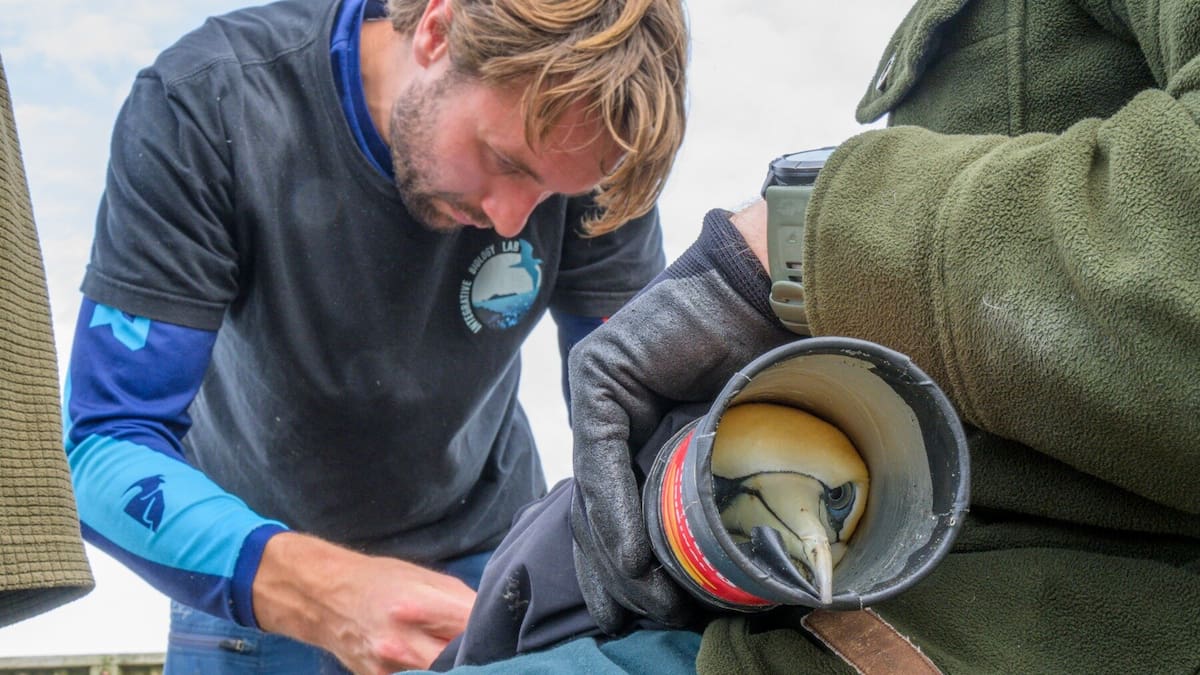
In October, 15 gannets from the colony in West Auckland had a small tag carefully taped to their central tail feathers.
The solar-powered tags transmit their GPS location data every two minutes through the mobile network.
DoC principal science adviser on marine issues Graeme Taylor said the tracking data gathered revealed the birds were travelling 40-60 kilometres offshore to find food, and could venture as far south as Port Waikato and north to Dargaville Beach for a meal.
Over 1000 gannet pairs breed each year at Muriwai Beach. Photo / Michael Craig
He said before this study they did not know anything about the movements of gannets from Muriwai and it was eye-opening to discover their activity.
It was important to know how far New Zealand’s gannet colonies moved in terms of distance to weigh up the risk of a bird flu outbreak, as overseas in the North Atlantic, tens of thousands of gannets had been wiped out by the sudden emergence of bird flu, he said.
Bird flu is a contagious viral disease that causes mild to severe illness or sudden death in birds.
Last year, a strain of bird flu on an Otago free-range chicken farm led to 80,000 chickens being killed.
“It’s still a long way away. We’re hopeful the longer it stays away, or if it never gets here, that’d be great,” he said.
A gannet with a tag departing from the Muriwai colony. Photo / Erin Whitehead
DoC has further concerns for how gannets might be impacted by offshore windfarm proposals across the country.
The birds are known to circle up high over the ocean to locate shoals of fish in the distance, and this could put them within the zone where wind turbines are operating.
“The classic gannet behaviour is they’re up quite high circling around, they see a fish below, and do that really powerful dive plunging down to 15 plus metres deep,” he said.
When gannets shoot underwater they briefly shut their eyes and fold their wings right back over their tail, before swimming back up to the surface to consume the fish above the water.
In foggy or stormy weather the gannets may be unable to see the wind turbine blades because of poor visibility.
DoC workers carry out the delicate process of attaching a tag to a gannet’s tail feathers. Photo / Erin Whitehead
However, Taylor said it’s not yet known if they will be smart enough to avoid the wind turbines completely.
Scientists conducted a similar study on the gannet colony at Farewell Spit last summer and found the birds flew as far north as Kawhia Harbour off Waikato’s west coast and as far south as Ōkarito on the South Island’s West Coast.
These long-distance foraging trips were a surprise to the research team, who thought the birds would mainly stay in the Cook Strait area.
The tracking of these 15 chosen gannets from Muriwai will continue until they moult their tail feathers in 2026.
Sign up to The Daily H, a free newsletter curated by our editors and delivered straight to your inbox every weekday.