
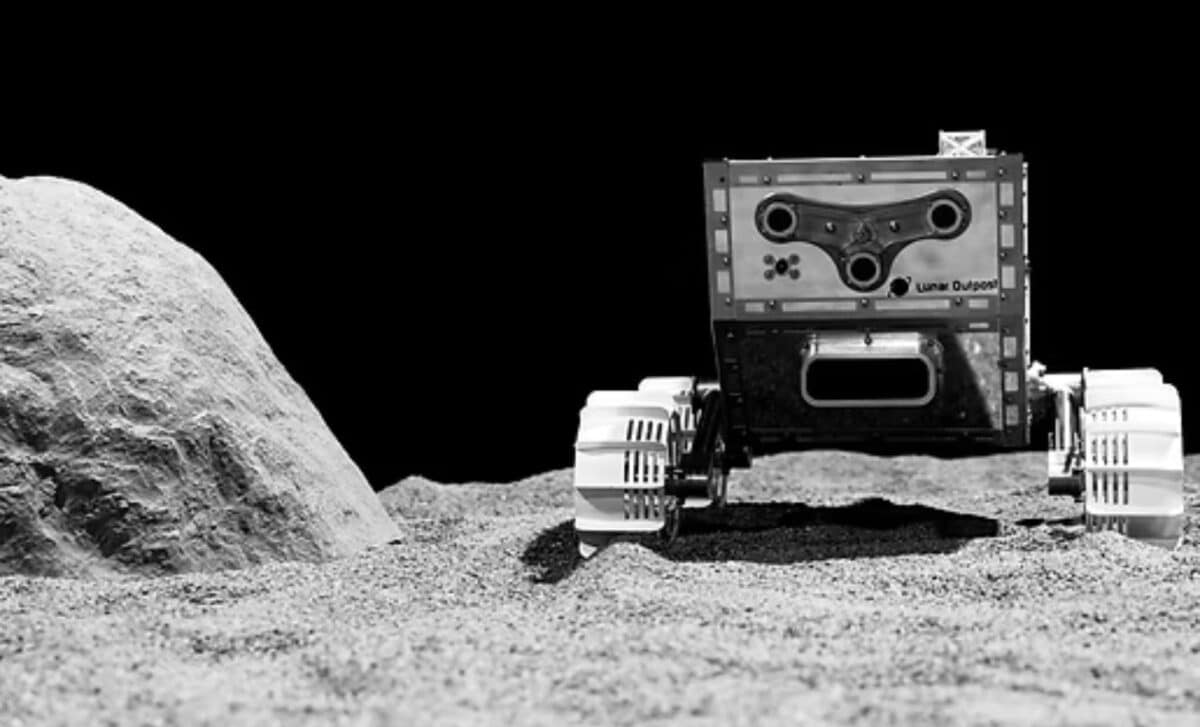
NASA’s Artemis IV mission, slated for launch in 2028, will feature a groundbreaking mini rover designed to study one of the Moon’s most mysterious challenges: lunar dust. The Mobile Autonomous Prospecting Platform (MAPP), developed by Lunar Outpost, will explore how dust behaves on the Moon. MAPP’s role is pivotal, offering NASA a deeper understanding of lunar space weather and dust dynamics as part of preparations for human landings under the Artemis program.
The Artemis program marks a new era of lunar exploration, with Artemis II expected to launch in 2024, sending astronauts on a mission around the Moon. Artemis III will land humans on the lunar surface in 2027, the first time since the Apollo missions. However, the Artemis IV mission, which will send astronauts back to the Moon in 2028, will bring new technological innovations, chief among them, the MAPP rover.
A Tiny Rover with a Big Mission
At just 18 by 15 by 16 inches (45 × 38 × 40 cm) and weighing only 22 pounds (10 kg), MAPP might seem modest in size, but its mission is anything but. The rover has already made history by being the first commercial rover to reach the Moon, and the first to explore its South Pole region, the focus of the Artemis program.
Developed by Lunar Outpost, MAPP’s compact design allows it to navigate the rugged lunar terrain with surprising efficiency. According to the company, MAPP can reach a top speed of 0.22 mph (0.36 kph) and carry a maximum payload of 33 pounds (15 kg), making it highly versatile for its mission.
“The Mobile Autonomous Prospecting Platform (MAPP) is the most advanced lunar roving platform ever built. Fully customizable, MAPP allows commercial and scientific customers unlimited access to the lunar surface,” as can be read on the Lunar Outpost website.
On its first mission, MAPP carried essential technologies such as a Nokia-developed 4G/LTE communication system and a 3D mapping camera from the Massachusetts Institute of Technology (MIT). The rover’s small size allows it to operate with agility, essential for the lunar surface’s harsh conditions.
Our MAPP exploration class rover, which operated on the Moon in 2025, is designed to chart the uncharted. From rugged craters to potential resource sites, it collects the critical data we need to understand, navigate, and one day inhabit the Moon.#TheNextLeap #LunarOutpost… pic.twitter.com/1yhk9Yn8LS
— Lunar Outpost (@LunarOutpostInc) August 14, 2025
Dust Study to Support Future Moon Missions
One of the central goals of MAPP on the Artemis IV mission will be to study lunar dust, a challenge that NASA has been keen to understand. The rover will carry two instruments designed by the University of Colorado Boulder’s Laboratory for Atmospheric and Space Physics (LASP): the Electrostatic Dust Analyzer (EDA) and the Relaxation SOunder and differentiaL VoltagE (RESOLVE). These tools will help gather data on how dust is ejected from the Moon’s surface when spacecraft land, lift off, or carry out other activities.
According to NASA, this study of dust dynamics is critical for future missions. As explained by Sharon Miller, principal investigator of the passive dust shedding material program at NASA Glenn:
“The dust is very fine, abrasive, and sharp, like tiny pieces of glass, making it more of a dangerous threat than just a simple nuisance.”
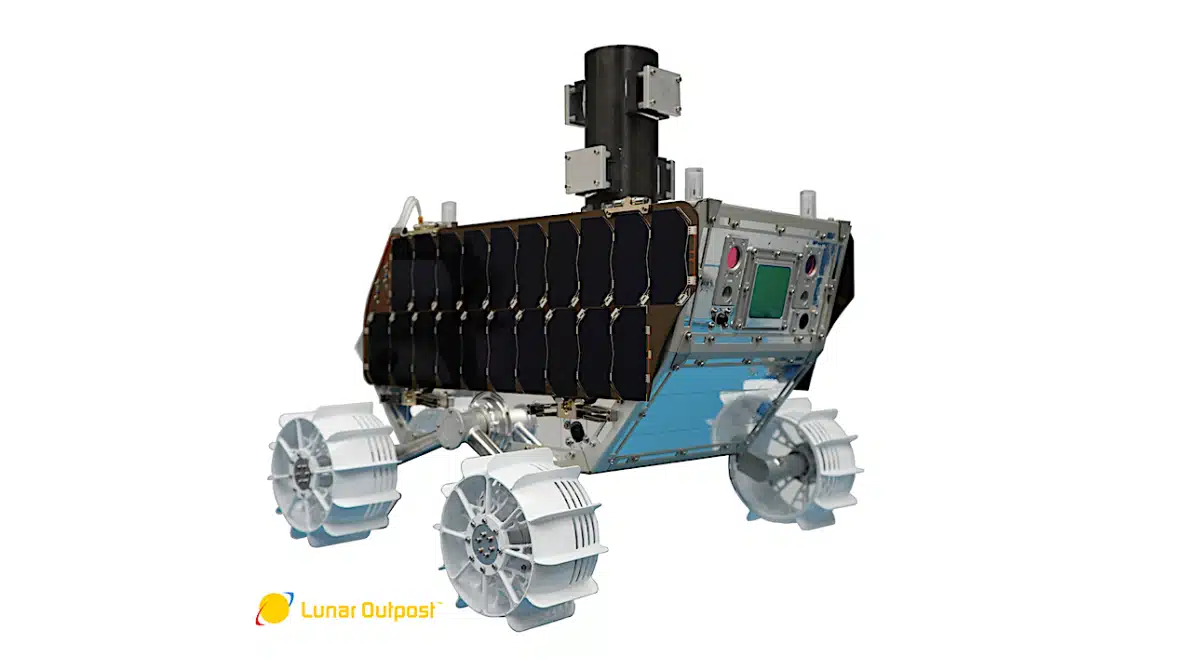 NASA’s mini rover, designed to explore the lunar surface, equipped with innovative wheels and solar panels. Credit: Lunar Outpost
Lunar Outpost’s Role in Artemis IV
The company, behind the MAPP rover, has made significant strides in commercial space exploration. In addition to MAPP, it has been involved in other lunar projects, paving the way for private-sector contributions to NASA’s goals. The company’s focus on advanced technology for space exploration aligns with NASA’s broader Artemis vision, which includes returning humans to the Moon and establishing sustainable lunar exploration by the 2030s.
Lunar Outpost’s success with MAPP is a testament to the growing partnership between NASA and commercial enterprises. In fact, MAPP’s role in Artemis IV marks the first time astronauts will deploy a rover during an Artemis mission. This collaboration represents a shift toward involving private companies in the critical research and technology development needed to support long-term lunar exploration.