
The on-field issues that plagued the All Blacks this season – from their wild inconsistencies to the third-quarter fades, struggling attack, high-ball vulnerabilities and defence – were widely evident, but more pressing concerns are now emerging that NZ Rugby must confront head on.
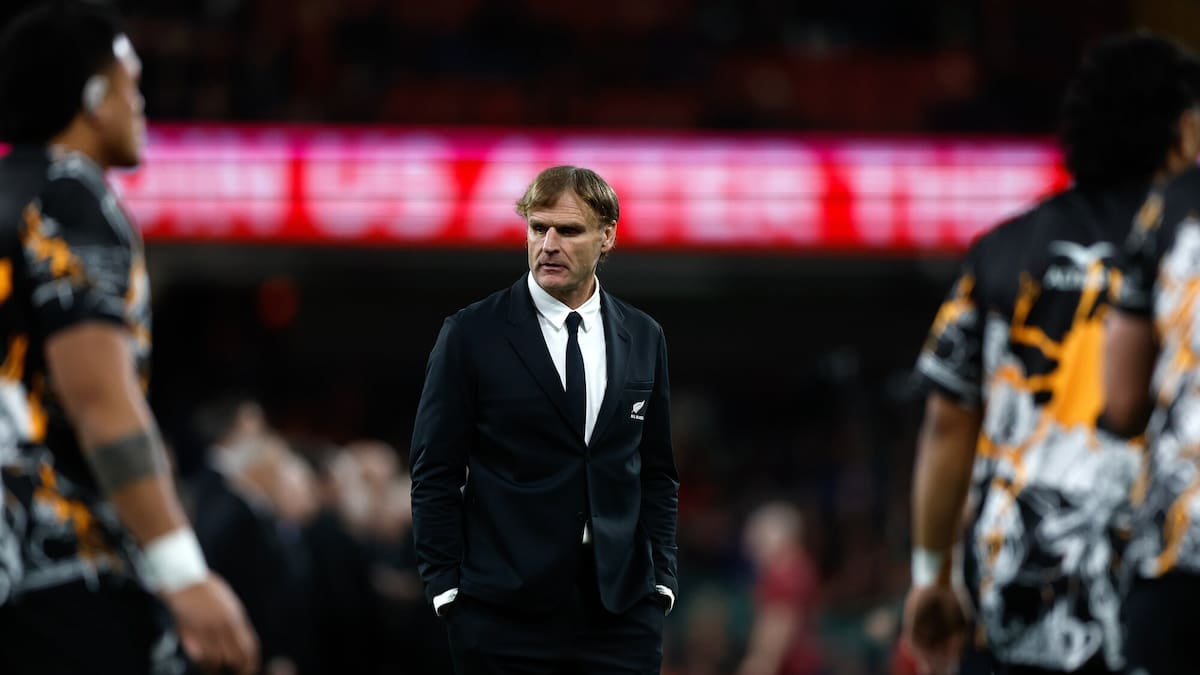
All Black coach Scott Robertson contemplates last month’s defeat to England at Twickenham. Photo / SmartFrame
The Herald understands feedback from players and staff presents a deeply concerning picture of the All Blacks environment, with multiple sources pointing to widespread internal frustrations.
Two assistant coaches, Leon MacDonald and Jason Holland, voluntarily departing in the last two years sparked red-flag concerns with how the All Blacks are being run. But the fresh, stinging feedback from within – with communication, trust, strategy and selection all believed to have been raised – cannot be ignored.
All teams have unhappy players with selection, but concerns with the All Blacks environment are believed to spread well beyond individuals alone.
Support from senior players proved powerful in Ian Foster retaining his position as All Blacks head coach in 2022 – as the players approached then NZ Rugby chief executive Mark Robinson in his Johannesburg hotel room to strongly voice their views.
This time around, the opposite could be true.
Such a situation leaves NZ Rugby facing a pressing dilemma. Do they act now or retain faith in Robertson and his remaining coaching team?
While it seems unfathomable that Robertson, halfway through his four-year contract, could be removed as head coach, insiders believe NZ Rugby is gripped by uncertainty.
With outgoing chief executive Robinson concluding his six-year tenure, general manager of community rugby Steve Lancaster assuming the reins in an interim capacity, and the next NZR boss unlikely to start before March, the timing of the leadership handover enhances concerns around the ability to drive decisive decision-making.
While the NZ Rugby board will have some say on the All Blacks, chairman David Kirk sits in the kingmaker seat with the biggest decision of his role thus far.
At this stage, NZ Rugby is likely to allow Robertson further time to deliver significant improvements but if the players aren’t satisfied with the initial post-season All Blacks review findings and solutions – which could range from changes in coaching personnel to roles and responsibilities – they may request a second review is conducted.
Former All Blacks first five-eighths Nick Evans has emerged as a potential All Blacks skills/kicking/high-ball coach to replace Holland in the coaching team – but that change is unlikely to go far enough.
The narrative of potential alternatives has largely centred on Highlanders head coach Jamie Joseph, who contested the All Blacks head coaching job alongside Robertson in 2023.
But with a plethora of quality New Zealand coaches littering the global rugby scene, that bubble view must be broadened.
The timing doesn’t align with immediate change, but one solution is to go all in on convincing Joe Schmidt to assume an all-encompassing director of rugby role next year.
From left: David Kirk, Joe Schmidt, Scott Robertson and Jamie Joseph. Photos / SmartFrame; Photosport
Schmidt is contracted to the Wallabies until he hands the reins to Les Kiss in July, but he is then expected to return to New Zealand.
Schmidt’s profound impact was widely evident when he was parachuted into the All Blacks in mid-2022. He then played a leading role in transforming the team on their rise to the 2023 World Cup final.
Feedback from the All Blacks on the vastly experienced Schmidt was overwhelmingly positive, with many players extolling his level of detail and expert analysis.
Schmidt was alienated by NZ Rugby during the process to appoint Robertson while Foster remained All Blacks coach, but a change in leadership at the national body that includes a new chair, incoming chief executive and revamped board, could pave the way for reconciliation.
A director of rugby role that sits over top of the All Blacks head coach could appeal to Schmidt and potentially help appease disgruntled players.
Ireland and Scotland have benefited from director of rugby positions in recent years with Australian David Nucifora fulfilling both roles.
In a New Zealand setting, Schmidt is also the ideal candidate to help address everything from coaching development to age-grade teams and player pathways.
Wayne Smith is another compelling candidate to fill a director of rugby brief but his limited involvement with Robertson’s All Blacks suggests he prefers a more part-time position.
Beyond Schmidt, there are many options other than Robertson and Joseph, too.
Dave Rennie, regarded as one of the best coaches at harnessing an inclusive culture, is off contract at the end of the Japanese season in June after three years leading Kobe.
Tony Brown, one of the world’s best attacking minds, is yet to be locked in as Springboks assistant coach beyond the 2027 World Cup. Securing his services should be among NZ Rugby’s top priorities.
Clayton McMillan has immediately impressed since departing the Chiefs to join Munster this season – but he, too, could be prised home by the carrot of the All Blacks.
To perform proper due diligence, assess the state of the All Blacks and determine where to from here, NZ Rugby must consider all options, including these highly credentialled alternatives, to map a short and long-term path forward.
Liam Napier is a Senior Sports Journalist and Rugby Correspondent for the New Zealand Herald. He is a co-host of the Rugby Direct podcast.