
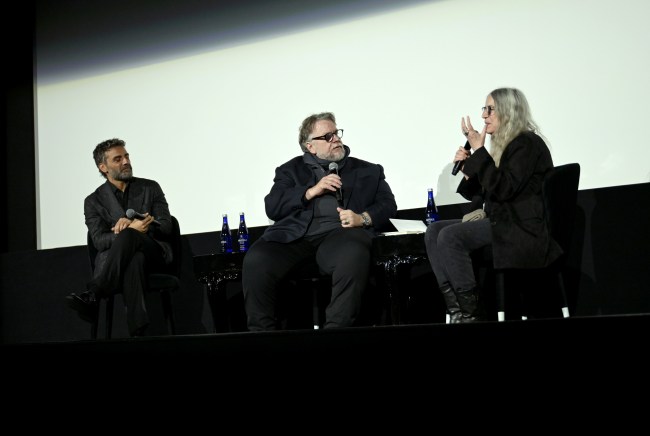
Guillermo del Toro has never met a Q&A he doesn’t like. More than most, he enjoys sharing his enthusiasm with moviegoers and smart interlocutors like poet-musician-author Patti Smith (her latest memoir, “Bread of Angels,” is in bookstores). Oscar Isaac joined them for a lively conversation about the awards contender “Frankenstein,” which is currently streaming on Netflix. Watch the video exclusively above.
Here’s the December 2 New York Q&A, edited for brevity and clarity.
Patti Smith: In the early 50s, when I was a child, I saw, as we all did, James Whale’s “Frankenstein” and “The Bride of Frankenstein” and was greatly beguiled and saddened. But when I read, as you did, “The Modern Prometheus” by Mary Shelley, I saw that there was a whole world of imagination and thought processes and the evolution of the creature. And [I] wish that James Whale was still alive and would do another one. But we didn’t need him, because you came along and you gave us really something so much more akin that merged your sensibilities with Mary Shelley’s. Give us a little bit of you as a child. What world of books? I know how it happened to me. I want to hear about you.
Guillermo del Toro: I was weird. I was extremely thin. I’m not joking. I used to button my shirt all the way up, and had a bowl haircut. I was like a Rutger Hauer son. almost albino, very pale. And in 1969, my father won the National Lottery, and he became a millionaire, and he bought a house, and somebody told him that he needed a library, because he was now a cultured gentleman. So he bought a huge library, which he never visited, and I read everything in there.
I read an encyclopedia of art that made me know as much about painting or sculpture as I would have a comic book artist: Jack Kirby or Monet or Manet or Renoir, they were all mixing in my imagination. I read an encyclopedia of health that made me the youngest hypochondriac in history. I stayed and read. And that was part of the disappointment. “This child is not well.” They sent me to a psychologist, and he gave me clay and said, “Could you do something with this?” And I did a skeleton. It didn’t go well.
Patti Smith: I’ve seen this movie now three times, on a little screen, on the airplane, on a bigger screen… One thing that always intrigues me is Victor Frankenstein’s body language. It’s almost like an artless choreography that becomes art. You’re always in motion. You make everything seem almost like a dance. It gives the film almost an operatic sensibility. I wanted to ask you about your body language, if that was a choice.
Oscar Isaac: It was very much in the conversation with Guillermo. The camera never stops moving. It’s always moving, and so often I’m moving in counterpoint to the camera. It always felt very musical. The whole thing, that first scene, when he’s in the medical conference, it feels very much like an aria. There were times when I was filming it where I was expecting people to start singing; the sets were so operatic as well. And a lot of the movement came from Kate Hawley’s incredible costumes.
Patti Smith: You can see the fabric, like in your shirts, and the threads.
 ‘Frankenstein’©Netflix/Courtesy Everett Collection
Oscar Isaac: There was a lot of pleasure in wearing those little black high-heeled boots and running up and down the stairs in those plaid pants and the things that she would put me in, that crazy robe. It also came a lot from Guillermo. He’s a fucking superhero of pain (laughs) and darkness and hilarity and absurdity. And so, we became completely linked and synchronized, for better or worse.
Guillermo del Toro: We’re still trying to shake it off.
Oscar Isaac: The movement was like a symbiosis that happens.
Patti Smith: The creature, like you and Jacob — that’s like ballet movement. Then, when you’re giving the exhibition to the courtroom, it’s a different sweeping, and then you take Elizabeth in your arms and a different kind of sweeping, the whole thing, your body language is fantastic.
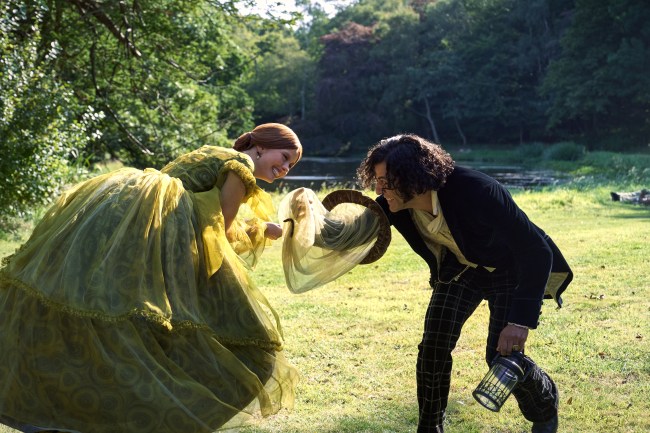
Guillermo del Toro: We actually designed the wardrobe to look like ’60s London, like he would be coming out with The Rolling Stones or Jimi Hendrix. We wanted him to feel like a rock star.
Oscar Isaac: Yeah, you talked about, especially that scene, that you wanted that swagger, to command that, the flowing shirts. But even using that cape is almost like a matador, yeah, it’s expressive, heightened.
Guillermo del Toro: And a lot of hips.
 ‘Frankenstein’Ken Woroner/Netflix
Patti Smith: You’re right about the sets. They’re so majestic. You should do [the opera] “Parsifal,” the holy fool. Just throw out Wagner’s “Parsifal,” do some of it!
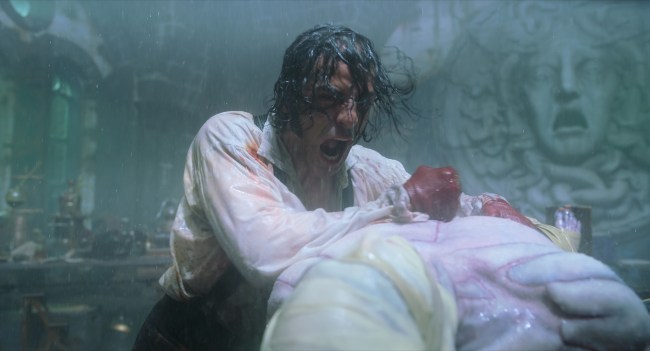
Guillermo del Toro: Like a Mexican “Parsifal.” Well, we tried to design as if it was an opera, the big Medusa, the minimal elements that are around everything. I always say there’s no eye candy in my movies. There’s high protein, because we’re telling the story. I can take you through the shapes and the colors, precisely why we designed them like that, but we wanted to make it as a novel, as epistolary. And one of the things that Gothic romance does is have a story within a story within a story. So I wanted to have self-contained color and camera language and shape language in each of the points of view, and if I made the fabric of the main characters, we wove. We didn’t buy it. We made it. We hand-embroidered it, we printed it, we dyed it, everything. We created rolls of fabric because all the language and the clothes is from nature, like Elizabeth has natural patterns from minerals, from butterfly wings. Her shawls are X-rays. Victor has the embroidered circulatory system. The vest had that. And we wanted to create this world of natural anatomical fields, and we repeat the patterns of the sets on the clothes, etc.
It’s impossibly rich, all those things. And even with the movement, again, to talk about it, starting in this vital place, alive with movement. And slowly calcifying as he gets more angry and more regret[ful]. And then he becomes more creature-like, even with those costumes and the prosthetic leg, as the creature becomes more human. So even those two are rising in opposite ways.
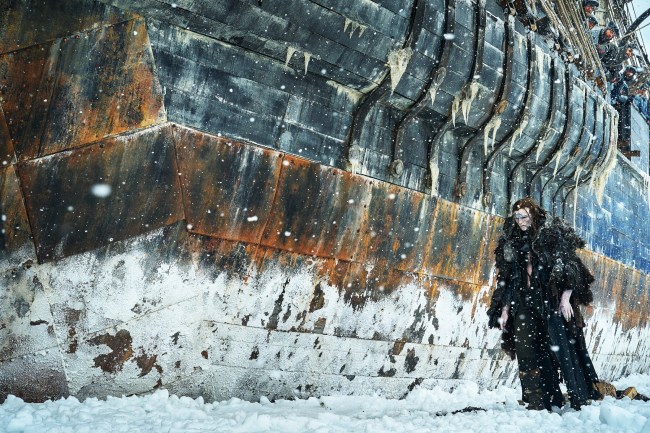
Patti Smith: I was so in love with that ship. I love all the Antarctic explorers and Shackleton.
Oscar Isaac: Imagine rolling up to the Netflix studio, and there’s a fully-sized ship, like the huge, actual-size ship, on gimbals in the parking lot. That was one of the first things that I saw when I arrived.
Patti Smith: It looks like these glass pictures, found in Antarctica. It almost made me feel nauseous, in a good way.
Guillermo del Toro: My producing partner felt nauseous when I said, “We’re building it for real,” but I was making a point that it should be a handcrafted movie by humans, for humans. There’s something that happens when 90 percent of what you’re seeing has a physical component. Yes, we built a ship. When he moves the ship, it’s on motors, and he’s moving the ship with all the sailors on top. When you see the ship, every shot you see is a real ship. We covered the parking lot with ice. We came up with a method to sandwich translucent solids on the icebergs. And we were inspired mainly by Caspar David Frederick, the glass plates from Shackleton, whatever has been found undocumented. We went to the places in Scotland, the UK. We shot in real locations. And we built full-size sets.
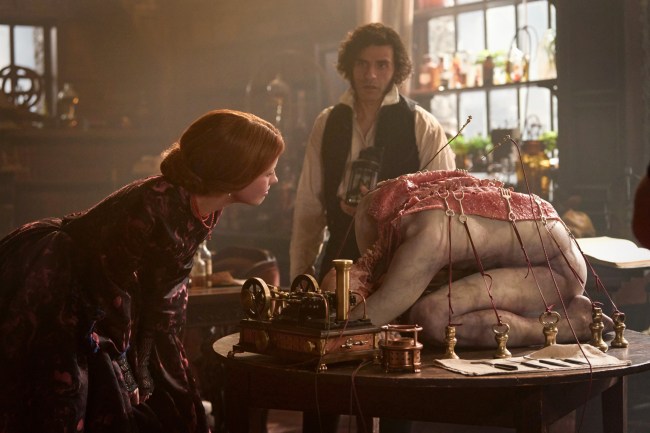
Patti Smith: How you worked is the same process as Victor, because when he’s making the sinews of [the creature’s] fingers and all the details of how he’s putting them together and stripping the other bodies, it’s all by hand. It’s a metaphor for your work.
Oscar Isaac: What’s beautiful is that, as opposed to it being this horror scene, it’s lit so beautifully. There’s this beautiful waltz playing, it’s him at his most calm and peaceful.
Guillermo del Toro: He’s happy.
Oscar Isaac: Yeah, that’s what he knows how to do, make his creature…It’s fast, it’s passion, it’s heightened. This isn’t naturalism. We watched movies, different films, to find the tone of it. Oliver Reed was somebody that we watched; what a complicated, huge, magnetic, and scary person. And Pedro Infante, we watched these 1930s Mexican films. We spoke a lot in the words of telenovelas. [Guillermo] would say, “I need you to give me the Maria Cristina. Come on.” We spoke in Spanish the entire time to each other. For me, it is the mother tongue. My mother spoke to me only in Spanish, even though I grew up here since I was a year old. But there was something about speaking that way, that unlocked a mode of unconscious expression, and giving over to that kind of unbridled expression.
Patti Smith: Of the female characters, like Ofelia [“Pan’s Labyrinth”], who I love so much, and Elisa [“The Shape of Water”], and now Elizabeth, and they all give themselves. They all feel empathy with something that everyone else would be frightened of or repelled by, they’re all drawn. And I wrote my notes, “Who are you in all these films?” I think you’re the little girls. You have that eternal young girl longing for a pure love, and they all find it even in death.
 ‘Frankenstein’©Netflix/Courtesy Everett Collection
Guillermo del Toro: The Catholic part is to suffer. But there is a pristine way of looking at life in all its ups and downs. And if you don’t look for perfection, if you look for imperfection, but necessarily, you can either accept or let go. That’s about it. And both are in the lexicon of existing. Elizabeth is the only modern character [in “Frankenstein”] and the only character that is not alone. It’s about loneliness so much, and then for a moment, a brief moment, [she and the creature] are together. The creature and Victor are always in the mirror together because they’re part of one single soul, which is what fatherhood and being a child is. You don’t realize it’s a soul that has been split in two, but Elizabeth and the creature are an emptiness split in two, and they attract each other because they feel that they both were broken in the same way. The tone visually has to be of a piece with the tone of the actors. When you think of Jimmy Cagney or Oliver Reed, they’re not naturalistic, but they’re real.
I like the heightened sensation that you’re in a movie, you’re not in the real world. But all that goes to hell if Elizabeth looks at the creature and she sees makeup. She has to see it like a real soul. So, every time they were together, I would shoot them at 36 frames. So I would be able to slow down when she enters with the dress, it floats, and when she’s looking at him, I speed it up to 18 frames so her face is vibrating. And when she’s looking at him, all these little things that you learn through 30 years of craft are invisible, but her performance being real is the key, the performance of Victor and the creature has to be real. Their arc starts in opposites. Victor finishes his life’s work the night the creature starts his life. And also, he’s so heartbreaking; they’re never going to see eye to eye. He basically becomes a mother in the first four weeks of postpartum. Those three characters form a single soul, Elizabeth, Victor, and the creature for me.
Patti Smith: He starts his sorrow the minute he achieves his goal, when he sits on those steps and thinks that there’s no more, forget what he says about the horizon, it’s done. He’s finished his course, and now the debris of all his work is going to haunt him. But as a girl, I was attracted to the creature. Frankenstein, the monster as James Whale gave us, I was never attracted to him. I felt empathy for him always, even when he accidentally killed the little child; you still have pain for him, but the way that I felt about your creature was completely different. He gave me hope, the idea that he would achieve another level of intelligence or answers to immortality. How did you decide how his countenance would look?
Guillermo del Toro: The two main inspirations were a statue of Saint Bartholomew in Rome, which is made of alabaster, and the lines are anatomically incorrect, but they’re beautiful. They’re almost Art Deco, and the head was designed after the patterns of phrenology that were created as a pseudoscience in the 1800s. There are so many echoes of Christ in the movie with the creature, and we can go through them and raising him, the crown of thorns, the red mantle on his shoulders, the wound on the side when he resurrects after three days, but it’s also Adam expelled, and finding a tree with red fruit, and getting to know pain through that. So all the biblical beauty, for me, tells you this is not a repair job, it’s a newly minted soul. Therefore, the ruining of it is more painful. They’re not ruining something they patched up. They’re ruining something that he minted.
And the pursuit has to be the red of the mother. The color red of the mother pursues Victor through the film and comes back with Elizabeth, the scarf, the gloves, the batteries, the angel, blah, blah, blah. He says he’s interested in life. He’s interested in vanquishing death. The way he treats life is completely cavalier. So the creature needs to be on the same color palette as Elizabeth, and they achieve this sort of translucent alabaster, nicotine oyster grace. And they come together at the end on their wedding night, which I wanted to make the one moment they have together. And the creature becomes, first, a baby, and the reactions are completely clean. And it’s very hard for an actor to do nothing, but he achieves it. Jacob, and then I give him three words: Victor, Elizabeth, friend, and the more he accumulates words, the more he knows pain. And with pain comes questions, and with questions comes the need for answers, and he finally achieves Grace at the end of the film.
He’s brutal with those that are brutal with him, he’s loving with those that are loving, and at the end, he is loving with those that were brutal with him, and accepts the grace of the son. So his performance tracking from Jacob was far from Victor’s part from Oscar, because they have such a beautiful arc together. For that, forgiveness seemed to work. I was betting on one gesture, and that’s the hand grabbing the hand. Oscar found it on the day. The first scene we shot together with the two guys was that scene.
Oscar helped me so beautifully. I wrote it for him, so I would send him pages before anyone, and we found the pentameter, so to speak, the rhythms of the language, so that 90 percent of the dialogue in the movie is completely new. It doesn’t come from the book, but he needed to have the same poetic breath of the book, and we found that.
 ‘Frankenstein’©Netflix/Courtesy Everett Collection
Patti Smith: When [Elizabeth] said, “Who hurt you?” I felt like that phrase hovered over the entire film. I felt like it was echoing over and over, even when the brother died, when the brother says, “You are the monster who hurt him.” He has this realization of how no one really hates the other, it’s just human nature or animal nature…The world consciousness, everything.
Guillermo del Toro: Pain is basically inevitable, and because we are mammalian hunter-gatherers, we’re going to necessarily get in the way, because your hope and my hope are never going to fully coincide all the time. And that’s why I wanted to paraphrase the book in giving the creature its own voice and [making] it a fairy tale. And he learns from the animals, the ravens give birth to him. The deer teach him violence. Then the mice adopt him, and then the wolves are the world. The wolves don’t care, but they’re going to hurt you, and that’s a fact. My father was kidnapped in 1998, kept for 72 days. And we had to go through it, and continue functioning, because you cannot stop functioning. You have to stay yourself. And the final image comes from that. When my father was kidnapped in the middle of the kidnapping, I resented the sun. I said, “Why does the sun rise, when I’m in pain?” And then the question became, “Why am I in pain when the sun rises?” You have to give yourself to that grace of a metronome that is much larger than your woes. And if you give in to that metronome, then you find release. So brutality is part of the language that structures reality. I don’t say I’m in favor of it existing. I was so familiar with loss when I was a kid. The familiarity that I have with Mary Shelley, my mother had many miscarriages. I had two siblings younger than me, and whenever she went to the hospital, I thought s”he’s gone, she’s not coming back.” “Who hurt you?” comes from a fairy tale, Oscar Wilde’s “The Selfish Giant.” When he raises the baby Jesus and he says, “Who hurt you?” I love that.
Horror, parable, and fairy tale are closely related. Horror articulates trauma in a way that no other genre does, except fairy tale and parable. And that’s why we are so moved by things that are intangible. Hans Christian Andersen and Oscar Wilde are the masters of pain and beauty. Those are two guys that are as much in touch with the brutality as they are in touch with the beauty. Every other tale can be sadistic or not, and in a more Jungian way. But those two, they are turning to aesthetics, pain, horror, and beauty.
Patti Smith: Well, thank you for being the eternal child. Thank you, Oscar. You’re both awesome.
“Frankenstein” is now streaming on Netflix.