
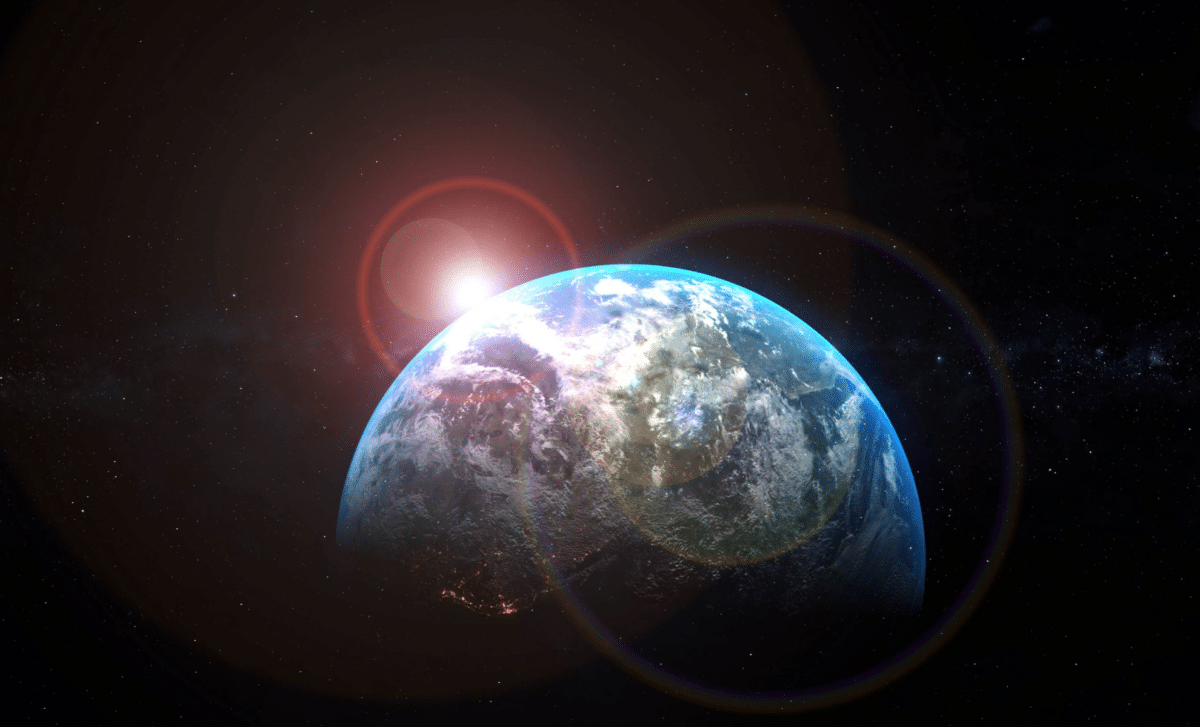
Perihelion, the point in a planet’s orbit where it is closest to the Sun, is a fascinating phenomenon that shapes much of our understanding of planetary motion. While Earth’s proximity to the Sun changes slightly each year, this variation has little impact on our seasons.
What is Perihelion?
In the vast expanse of space, celestial bodies follow elliptical orbits around stars, with one point being closer to the star—known as the perihelion. This is the term used to describe the point in an astronomical body’s orbit when it is closest to the Sun. Perihelion is derived from the Greek words peri (around) and helios (sun), meaning the closest approach to the Sun. For Earth, this occurs each year in early January, marking the time when we are approximately 91.4 million miles from the Sun.
Although the Earth’s orbit is elliptical, the difference in distance from the Sun between perihelion and aphelion (the farthest point in the orbit) is relatively small, approximately 3 million miles. This small variation does not significantly impact our planet’s climate. Rather, Earth’s seasons are determined by the tilt of its axis relative to its orbital plane.
The Discovery of Perihelion: A Historical Perspective
The concept of elliptical orbits and the presence of perihelion wasn’t immediately understood. It wasn’t until around 1604 that Johannes Kepler made a breakthrough in orbital mechanics. He proposed that planets move in elliptical orbits with the Sun at one focus, rather than in perfect circles. This was a pivotal moment in the history of astronomy, as Kepler’s findings laid the groundwork for future studies of planetary motion.
“In about 1604, Johannes Kepler fitted an ellipse model of Mars’ orbit to observations of Mars,” Bloomer told Space.com. “He came up with the first law of planetary motion that states that planets orbit the Sun on an ellipse with the Sun being the focus on this ellipse.”
This groundbreaking discovery revealed that the Sun was not centered in a planet’s orbit, challenging the long-standing belief in circular orbits.
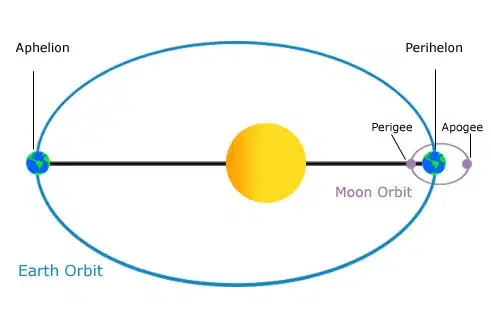 A diagram of Earth’s elliptical orbit around the sun. (Image credit: NOAA)
The Influence of Orbital Eccentricity on Planetary Motion
Planetary orbits are not perfect circles but ellipses, which vary in their degree of eccentricity. While some planets, like Venus and Neptune, have nearly circular orbits, others, such as Mercury, exhibit significant eccentricity. The difference in distance between a planet’s perihelion and aphelion can affect the speed at which it moves through space, with planets moving faster when they are closer to the Sun and slower when they are farther away.
The Earth’s orbit is only slightly elliptical, meaning the variation in speed is not as pronounced as it is for other celestial bodies. However, as we move through the year, the Earth’s distance from the Sun changes, albeit slightly.
“They were already talking about the difference between the solar day and the ideal day, the average value of that,” said Bloomer. “Things were running behind and ahead, which, as we later learned, is because of the changes of the speed at which Earth orbits the Sun due to the elliptical nature of its orbit.”
Perihelion and Earth’s Climate: No Impact on Seasons
Despite Earth’s closer proximity to the Sun during perihelion, this does not significantly influence our seasons. The real cause of Earth’s seasonal changes is the tilt of its axis. This tilt causes different parts of the planet to receive varying amounts of sunlight throughout the year, regardless of our distance from the Sun.
The misconception that perihelion directly influences the seasons can be traced back to the mistaken idea that the Earth’s distance from the Sun is the primary determinant of climate. In fact, the slight difference in distance between Earth’s perihelion and aphelion is negligible in terms of climate effects, and the variation has only a minor impact on the amount of solar radiation Earth receives.
Comets and High-Eccentricity Orbits
Unlike planets, many comets and asteroids follow highly eccentric orbits. These objects are more sensitive to gravitational influences from the Sun and other bodies in the solar system, causing their perihelion to vary greatly with each orbit. A comet’s perihelion is typically the point where it experiences the greatest amount of heat and solar radiation, often triggering the release of gas and dust, which forms the bright tail that is visible from Earth.
The paths of comets are far less predictable than those of planets, and their perihelions can vary greatly from one orbit to the next. For many comets, the perihelion marks the most exciting moment in their orbits, as they streak past the Sun, becoming visible to observers on Earth.
Will Perihelion Be Visible Soon?
While the perihelion itself is not something that can be directly observed, there are indirectly visible phenomena that coincide with it, especially when considering comets. The Sun’s closest approach to Earth in early January marks the point when we are closest to the center of the solar system, but there is no dramatic visual effect, like an eclipse or other celestial event.
However, the perihelion is significant for certain comets that follow high-eccentricity orbits, which can be visible as they approach the Sun at perihelion. Comets, with their often elongated and irregular orbits, experience intense solar radiation at this point, causing them to heat up and release gas and dust, forming their characteristic bright tails. These tails can sometimes be observed from Earth, offering an exciting opportunity for skywatchers.
So, while Earth’s perihelion itself is not visually striking, some cometary perihelions can offer spectacular views. As the Sun reaches its closest point to Earth on January 3, 2026, this could coincide with comets making their way through the inner solar system, providing a chance for stellar observations. Keep an eye on space observatories or news from astronomers for updates on comet sightings around that time.