
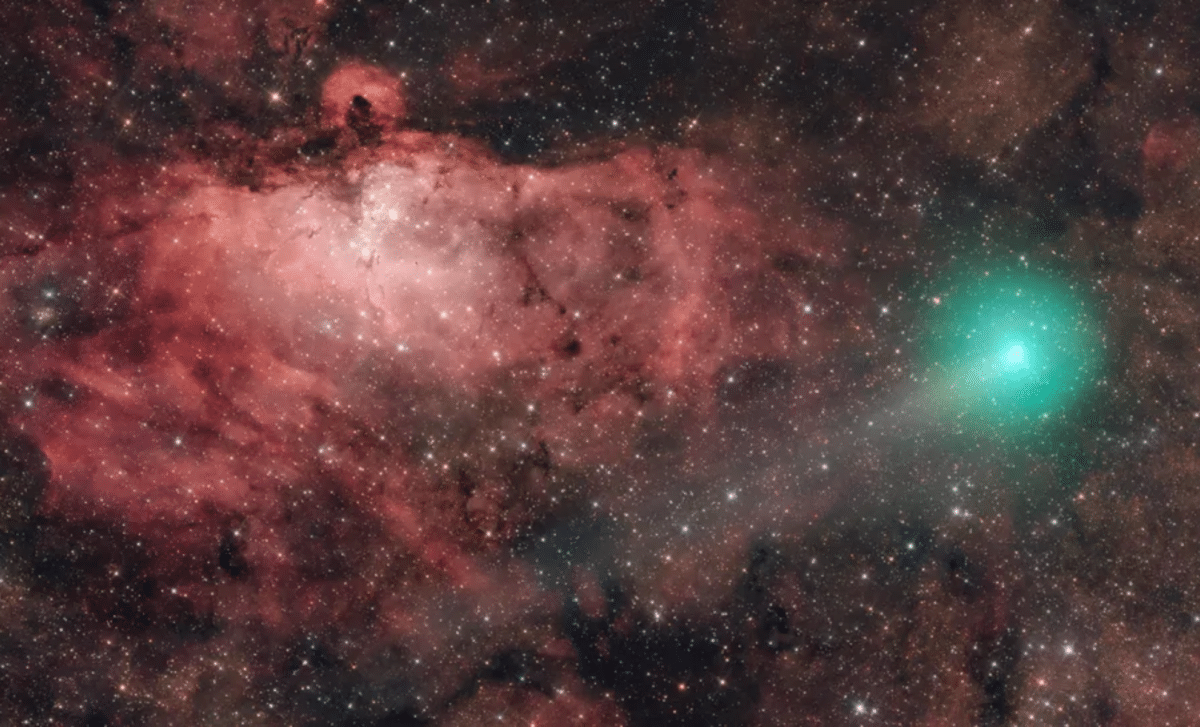
A mesmerizing deep-space photograph of Comet C/2025 R2 (SWAN), captured in front of the Eagle Nebula, has sent shockwaves through the astrophotography community. The image, snapped by professional astronomer Daniele Gasparri, highlights not only the comet’s ethereal green glow but also the iconic Pillars of Creation.
A Once-in-a-Lifetime View: Comet SWAN Meets the Pillars of Creation
On October 17, 2025, the night sky over the Atacama Desert in Chile witnessed a cosmic spectacle like no other. Professional astronomer Daniele Gasparri, located near the city of Copiapó, captured an awe-inspiring photograph of Comet C/2025 R2 (SWAN) as it passed in front of the Eagle Nebula. This particular event provided a rare opportunity to photograph the comet alongside one of the universe’s most renowned star-forming regions—the Pillars of Creation.
Comet SWAN, named after the SWAN camera aboard NASA’s Solar and Heliospheric Observer (SOHO), had a brief but breathtaking interaction with the Eagle Nebula, a vast and vibrant region of space that lies approximately 7,000 light-years from Earth. Known for its towering dust columns, which have been famously imaged by the Hubble and James Webb space telescopes, the Pillars of Creation stand as one of the most iconic images in the cosmos.
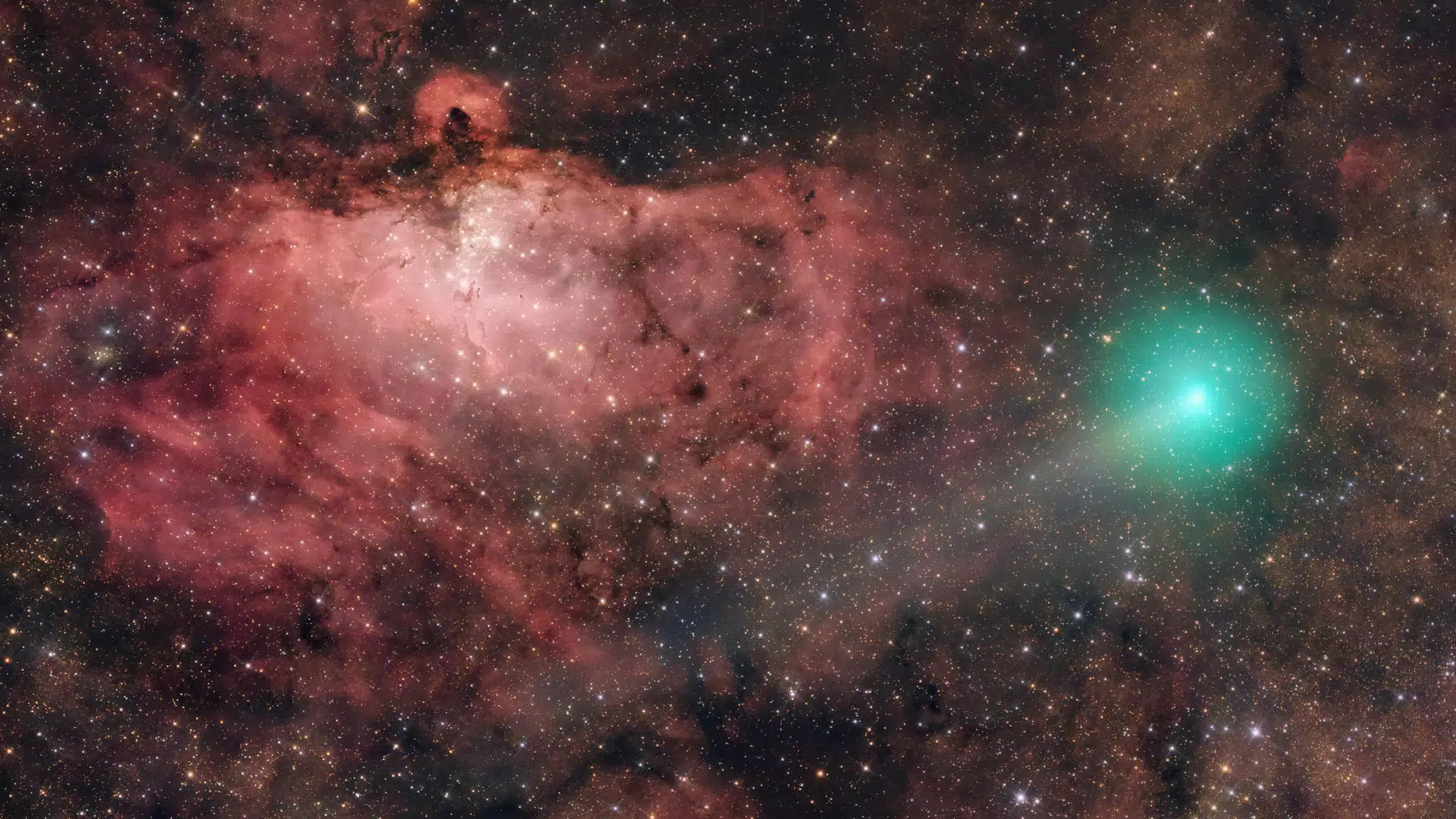 Comet C/2025 R2 (SWAN) glows alongside the Eagle Nebula. (Image credit: Daniele Gasparri)
The Tech Behind the Magic: How Gasparri Captured the Moment
The capture of such an awe-inspiring photograph is no simple feat. To photograph this rare event, Gasparri relied on a ZWO ASI533MC Pro camera, a tool renowned for its sharp resolution and stellar performance in astrophotography. The long exposure technique used in his images reveals a striking detail in both the comet’s tail and the glowing pillars. Gasparri spent hours in the high-altitude desert to capture 40 exposures, each lasting 120 seconds. The result is an image that showcases not only the comet’s glowing green coma but also the sprawling cosmic landscape of the Eagle Nebula, complete with the awe-inspiring Pillars of Creation in the distance.
“It was also an amazing sight through the eyepiece, with its characteristic green coma drifting across one of the most observed nebulae in the sky,” Gasparri shared with Space.com. This sentiment speaks to the overwhelming nature of the event for those lucky enough to witness it firsthand, emphasizing the humbling experience of observing such a distant and beautiful interaction.
The Comet’s Journey: A Glimpse into the Future of C/2025 R2 (SWAN)
Discovered by Ukrainian astronomer Vladimir Bezgly on September 10, 2025, Comet C/2025 R2 (SWAN) was identified through data collected by the SWAN camera on NASA’s SOHO spacecraft. Initially, astronomers had high hopes for the comet’s visibility as it approached the Sun, and its subsequent journey would make it one of the most talked-about celestial events of the year. The comet’s green coma, a feature characteristic of its icy composition, made it a fascinating subject for both professional astronomers and amateur astrophotographers alike.
Now, as the comet continues its journey away from the Sun, it has entered the far reaches of the solar system, never to return for an astonishing 1,400 years. The sight captured by Gasparri will likely remain the most prominent visual record of this elusive visitor for generations to come. Its brief appearance, though fleeting, has made a lasting impact in the world of deep-space photography.
The Cosmic Backdrop: The Pillars of Creation
The Pillars of Creation, immortalized by images from both the Hubble and James Webb space telescopes, are perhaps the most captivating feature in the Eagle Nebula. These towering columns of gas and dust, shaped by intense radiation from nearby young stars, represent an active star-forming region. As part of the Eagle Nebula, they are both a cradle of new stars and a testament to the dynamic, ever-changing nature of our universe.
The Pillars of Creation are not merely a static feature of the sky but a complex and evolving structure. Their creation and destruction occur in cycles of star formation, with new stars emerging from the very dust and gas that form these towering structures. Gasparri’s image beautifully captures the juxtaposition of the comet’s green coma with this cosmic wonder, offering viewers an extraordinary view of two of the universe’s most iconic objects sharing the same sky.