
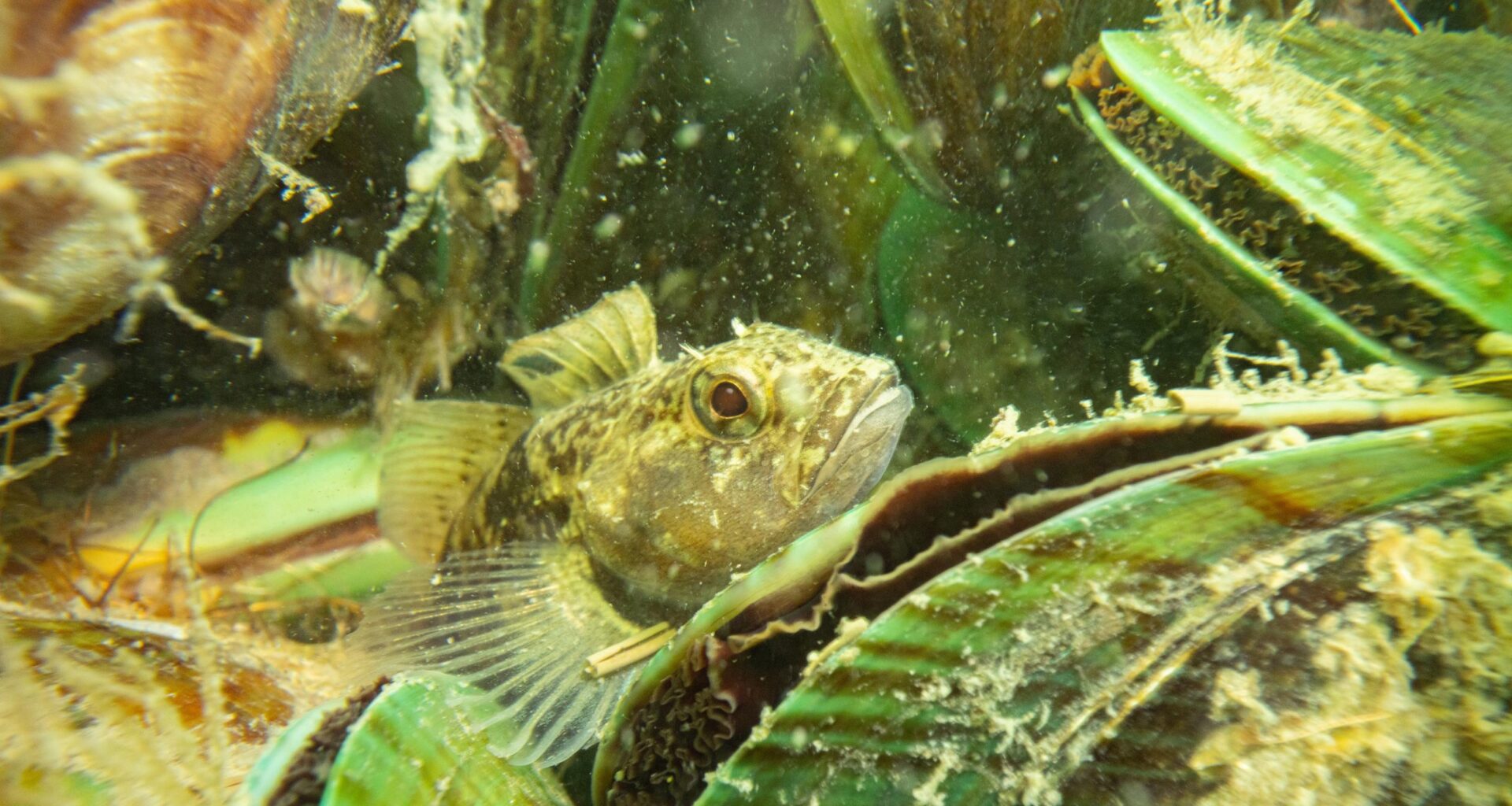
Picture vast expanses of sub-tidal mussel reefs, enough to cover 80,000 rugby fields, amid clear, unpolluted coastal water.
This was the world that, just a century ago, thrived in the Hauraki Gulf (Tikapa Moana/Te Moana-nui-a-Toi): a living mosaic of shellfish beds, seagrass meadows and teeming marine life stretching from Mahurangi Island to the Coromandel.
Much of it vanished within a matter of decades.
By the mid-1960s, the inner gulf’s sprawling green-lipped mussel (kūtai) reefs – more than 600 square kilometres of them – had been dredged to exhaustion for food and fertiliser.
The commercial fishery collapsed soon after, and the shellfish beds never recovered on their own.
In losing those kūtai reefs, the gulf lost one of its most powerful natural filters: each mussel can clear several litres of seawater an hour, cycling nutrients and binding the seafloor together.
The living, three-dimensional seafloor that existed before is now largely sand and mud, its clarity clouded by sediment resuspension and its biodiversity thinned.
Over the past decade, however, iwi, scientists and community groups have joined forces to try to reverse this devastating loss.
The University of Auckland has partnered with Ngāti Whātua Ōrākei, Ngāi Tai ki Tāmaki, the Ngāti Manuhiri Settlement Trust, The Nature Conservancy Aotearoa, and the Revive Our Gulf Trust to re-establish shellfish beds that once filtered the gulf’s waters and provided habitat for countless species.
They share three lessons they’ve learned along the way.
Don’t wait to begin restoring
Marine restoration has become one of the fastest-growing frontiers in conservation science worldwide, from reviving coral reefs and seagrass meadows to rebuilding shellfish beds.
Success, scientists say, much depends on first understanding what’s breaking these systems in the first place and recognising that system breakdown is both relational and cumulative.
In the Hauraki Gulf, researchers have observed how sediment, nutrients, over-harvesting and climate stress are increasingly colliding, often in ways that defy simple fixes.
Revive Our Gulf science lead Dr Jenny Hillman says sediment is a case in point: while smothering some seafloor habitats, it can also boost the growth of others.
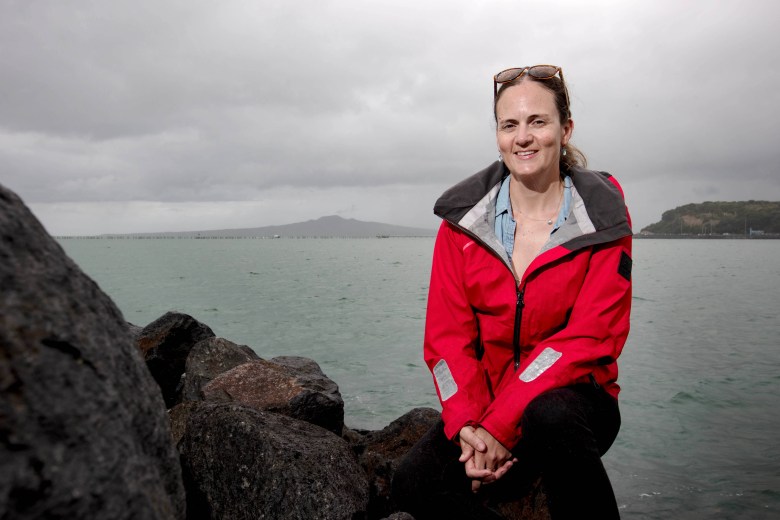 University of Auckland marine scientist Dr Jenny Hillman says marine restoration is still in its early days, but the gains already seen show why it’s vital to begin now. Photo: Chris Loufte
“It’s not as simple as just needing to remove sediment,” says Hillman, senior lecturer at the University of Auckland’s Institute of Marine Science.
If there’s a starting point to begin marine restoration, professor Simon Thrush says it’s in recognising land and sea as a single system, as has been long-held within te ao Māori.
“When we’re talking about restoration in harbours, there’s now a recognition about also restoring contributing catchments and managing sediment loads that are flowing into the sea,” he says.
“People are starting to think about the fact these systems are connected.”
Some may argue restoration can’t begin until problems on land are solved, but Hillman disagrees.
“Our understanding of large-scale marine restoration is still evolving; even after more than a decade, we are still learning. Marine restoration as we know it is in its infancy, reflecting the complexity of the moana, and if we don’t start now, then we’re not going to be ready.”
She considers progress, not perfection, the realistic goal.
That means working towards a place “where systems are working better”, even if harvesting kaimoana such as mussels can’t begin again anytime soon.
Mussels are ecosystem engineers
Since 2021, more than 25 million kūtai have been reintroduced through the Revive Our Gulf programme, making it one of the world’s largest shellfish restoration efforts.
Each barge-load of mussels begins its life hundreds of kilometres away: spat collected from Te Oneroa-a-Tōhe (Ninety Mile Beach) are grown to size on farms in the Coromandel before being ferried north and released into sites such as Kawau Bay.
The scale of work being led by the iwi partners is world-leading in restoring these types of shellfish, says Hillman.
“We are learning as we go and it’s a huge ongoing effort.”
Already, the kūtai have been demonstrating their ability as remarkable ecosystem engineers: creating habitat while filtering and recycling nutrients.
But their influence runs deeper than filtration, with reef acting as a living engine of renewal, binding the seabed and supporting the wider web of marine life.
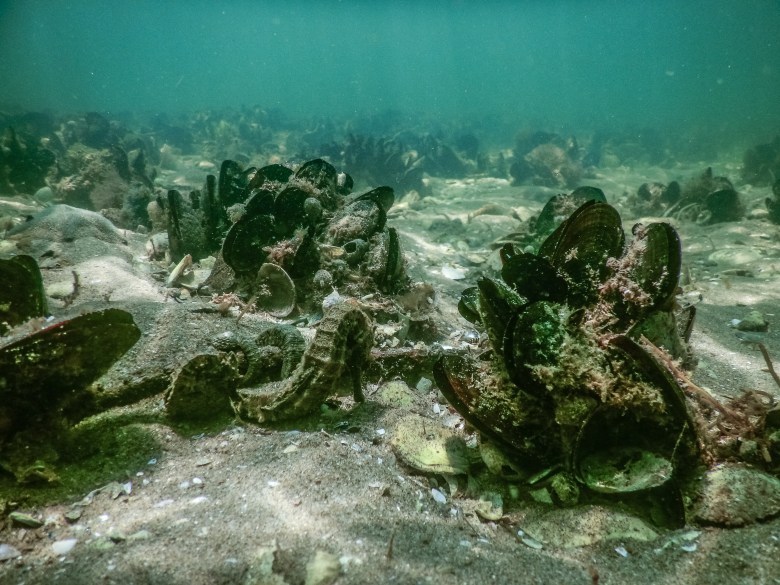 Bigbelly seahorses sheltering among restored kūtai beds in the Hauraki Gulf’s Okahu Bay: a vivid sign of the biodiversity returning to these rebuilt reefs. Photo: Shaun Lee
Hillman’s team has quantified their value in new ways.
“We were the first in the world to look at how restored mussel beds can support the removal of excess nitrogen from the ecosystem and found that they can be really beneficial at some sites,” Hillman says.
The research has since expanded into carbon cycling, though the processes are complex: “You’re essentially looking at all these multiple cycles happening at the same time and interacting.”
Although true success and scale will only come when natural regeneration processes are restored, these early experiments have generated significant learnings and shown immediate gains in marine biodiversity.
“We’ve found increased numbers of small snapper, for example, so it’s clear that the beds are having a benefit,” she says.
As well as drawing in snapper and blue cod, Hillman says kūtai also appear to help sustain an entire web of life beneath them, “right down to the microbes and tiny worms living in the sediment”.
It’s no wonder scientists regard mussels as powerful natural filters. Yet they’re also careful to point out that there’s only so much these shellfish can do to repair damaged ecosystems.
“It’s never as simple as ‘if you do this, this will happen’, because ecology – or the real world – is more complicated than that,” Hillman says.
Scaling up takes more than science
New ideas are already reshaping what scaling up marine restoration could look like.
Hillman was recently awarded a $1 million Smart Ideas research grant for a three-year project exploring how to rebuild coastal habitats using artificial horse mussel beds made from repurposed Greenshell mussel shells.
The work aims to stabilise seafloors, enhance biodiversity and test whether engineered shell structures can jump-start recovery in degraded systems, while turning thousands of tonnes of aquaculture waste into a useful resource.
By combining marine restoration with circular-economy thinking, the project could help communities restore more coastline, more quickly, and at lower cost.
Turning pilot beds into reef networks, however, remains a daunting task – and not just for the practical challenges involved.
Hillman says the process is costly and complicated. Because marine restoration is still in its infancy, New Zealand has no uniform restoration guidelines, meaning councils have different requirements, and different sites require different considerations.
Biosecurity concerns and data gaps add further hurdles, and what works in Mahurangi may not in Marlborough’s Pelorus Sound, where she’s also been involved in mussel restoration.
Restoring reef ecosystems at scale is the long-term goal, but Thrush notes that success doesn’t always have to be measured in hectares.
“It’s easy to think about an objective like restoring 50 square kilometres over a period of decades, but it’s perhaps more important to think about what success means in terms of a year.”
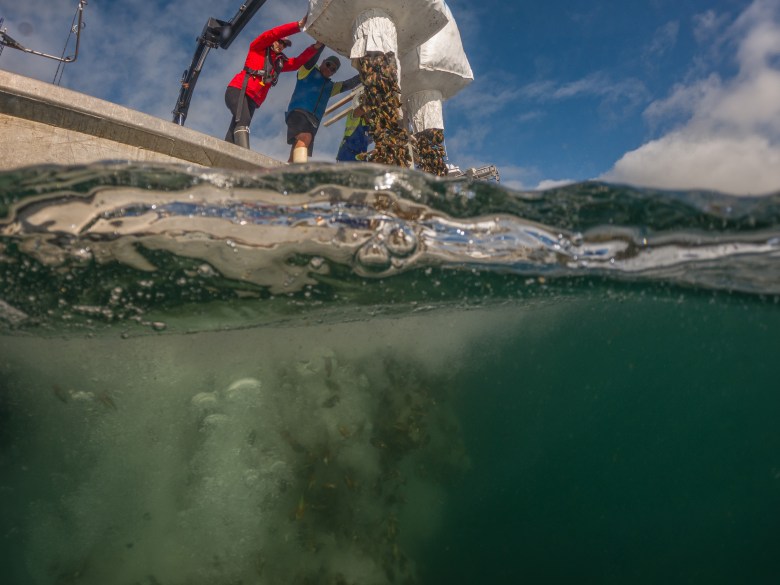 Deploying kūtai into the Hauraki Gulf: millions of mussels are released from barges like this to rebuild lost reef habitat. Photo: Shaun Lee
For both researchers, that success depends as much on people as on science. Hillman says she has seen iwi partners with differing perspectives come together around restoration work – “that kind of social success should not be underestimated”.
Hillman views her own role as simply providing the science that supports mana whenua and communities as they work to restore and protect the moana.
“If we’re putting this level of effort and time into it, then we want to work in a way that supports a shared responsibility for the moana.”
That collaborative philosophy underpins Revive Our Gulf, where iwi partnerships have guided where and how kūtai are laid, creating a sense of shared guardianship.
Thrush says future decision-making should better reflect a te ao Māori worldview – one that recognises the interconnection between living and spiritual realms.
Iwi leadership, he adds, seen in rāhui on depleted beds and proposals for Ahu Moana co-management, shows how restoration can evolve beyond “bureaucratic limbo”, often moving faster and more effectively.
Marine restoration is often seen as an effort to bring back what was lost – but Hillman and Thrush emphasise that it’s just as much about building resilience for what lies ahead.
“It’s about restoring into the future rather than restoring into the past,” says Thrush.
“People made the mess, and people will have to help fix it – and we can use nature to help us if we learn how to work with it.”
The world is facing unprecedented environmental challenges. Planetary Solutions, an initiative of the Sustainability Hub at Waipapa Taumata Rau, University of Auckland, and Newsroom, explores these issues – and the practical ways we can all be part of the solution.