
The landscape is strange but so familiar. It could be a dream, half-forgotten, or a memory from some self in the future that has drifted suddenly into view. Everywhere you look are grey pebbles, smooth and round. A clear stream ripples from an unknown source. It is peaceful here, too peaceful, and it’s hard at first to locate the source of this serenity or why it feels so disquieting.
Suddenly it dawns on me: there are no shadows, no birds, no reeds or grass or fish. There are no signs anywhere that we are walking through a living place. This is a shell, an exoskeleton, a remnant of what once was that has still somehow retained an eerie, austere beauty.
Riverbed is a 2014 installation originally conceived for Denmark’s Louisiana Museum of Modern Art by Olafur Eliasson, who has been working since the early ’90s. The artist was born in Copenhagen, the child of parents who migrated from Iceland. His art evokes meltwater, the crystalline brooks filtered by volcanic rock that crisscross the island in spring, formed as glaciers dissolve in Iceland’s highlands.
At Presence, Eliasson’s monumental new exhibition at the Queensland Gallery of Modern Art (GOMA) on the banks of Maiwar, the Turrbal name for the Brisbane River, Riverbed’s stark power takes on a different cadence. In March, the river burst its banks in the wake of Cyclone Alfred, the fourth time the city has flooded in a decade. When the installation was first shown at GOMA in 2019, parts of the state were grappling with drought. At last week’s opening of Presence, curated by Geraldine Kirrihi Barlow, viewers traipsed through the installation, crouching by the water in moments of solitude. They piled the pebbles – sourced locally – into tiny sculptures like offerings to the river that I only notice the next day.
Eliasson, who represented Denmark at the 50th Venice Biennale, once dyed waterways green in Stockholm, Tokyo and Los Angeles, part of an effort to alert us to the elements, to help us see the act of seeing that has been central to his trajectory. He is perhaps best known for The Weather Project (2003), which filled Tate London’s Turbine Hall with shrouds of mist and a giant sun. The installation attracted millions of visitors and helped to usher in the taste for immersive encounters, a tradition that the German romantics called Erlebniskunst or the art of experience. In an age of endless screens, when algorithms have made a world of neutered, flattened objects, this is diluted into art that treats the viewer as consumer, the hallmark of a moment that traffics in the logic of low standards, trapping us in our own feedback loops, incapable of imagining anything else.
I watch a cloud form out of air, accumulate shape and drift in a sequence of images across a hill, as serene as a Hokusai print.
It’s become fashionable to deride art as spectacle. We live in a world in which it is morally serious to “pay attention”, to “look slowly” – as if this stance might absolve us of a world that is frighteningly unequal. The week Presence opens, there are catastrophic floods in Sri Lanka, Indonesia and the Philippines, a pervading sense of emergency. It is hard not to feel immobilised. Moving through the exhibition, something shifts. Time starts to work in a mysterious way.
In the show’s first space I watch a cloud form out of air, accumulate shape and drift in a sequence of images across a hill, as serene as a Hokusai print. I can’t stop looking at it. Have I ever seen a cloud before? Next to it is a block of melting ice, its surface glittering against grey sky and flax-coloured grass. The sky changes. The ice shrinks and melts, and then it’s gone. Melting ice on Gunnar’s land (2008) is taken on an island owned by a family friend, the ice is just an ordinary block of frozen water – a substance that humans have long lived with, so inconsequential we barely notice it – rendered, via Eliasson’s gaze, with a frank curiosity.
In a talk, Eliasson tells the audience there are more than 200 glaciers in Iceland that will melt. As they fade, they reduce freshwater supply. There’s something about being faced with the fact of ice – its sheen, its glow, the way it refracts the light – that puts me in relationship with it, so it no longer feels like abstraction. In these works, mostly made in the noughties, there’s a great sense of subtlety, an insistence that you stay with the photographs and surrender to their duration. At times, I grow bored, almost restless.
Standing in front of The Hekla twilight series (2006), an ethereal scene that captures the snowy peak of Iceland’s Hekla volcano, its surface craggy and lunar, I wonder at first if I am looking at 20 versions of the same image. But then I notice the movement of pale gold hues, how night falls across the sequence, slowly and then all at once, the world suddenly leached of colour. The work, a study of dusk near the Arctic Circle where twilight hovers for hours, opens up to me. It attunes me to the rhythms of a landscape I’ve never visited and somehow, oddly enough, my own.
Across Presence, artworks move. Opposite Melting ice on Gunnar’s land is Parabolic planet (2010), in which a volcanic rock spins slowly like a miniature Earth, suspended in front of a concave mirror. We’re reminded by the exhibition guide that a parabola, which can refer to the orbit or trajectory of an object that has attained the speed to escape gravity, is also related to the parable, a narrative that imparts ethical lessons. There’s a story that we are living through now that sees the individual as the centre of the universe, a world view that, as the philosopher Bayo Akomolafe puts it, is heightened by our response to ecological catastrophe.
Nearby hangs Lost compass (2013), a piece of battered driftwood that floated for years in the ocean before washing up on Iceland’s north coast, an ancient tool that orients not to humans but to the Earth’s magnetic field. The large Iceland series (2012) shows ridges that have formed over millennia, stony and impassive.
Presence charts a continuum between our inner and outer landscapes. In the next room, I’m mesmerised by Pluriverse assembly (2021), in which arcs and orbs of colour, reds and greens and purples, float across a screen, their forms splitting and morphing. Light is split into its constituent elements like sun on water, an endless unfurling.
In the next gallery, two works commissioned for Presence explore polarisation, the process used to reduce glare that filters certain kinds of light waves and that also means extremes of opinion. In Your truths (2025), a series of fans and a transparent sheet spark a play of colour across a set of polarising filters, a makeshift set-up that is somehow beguiling.
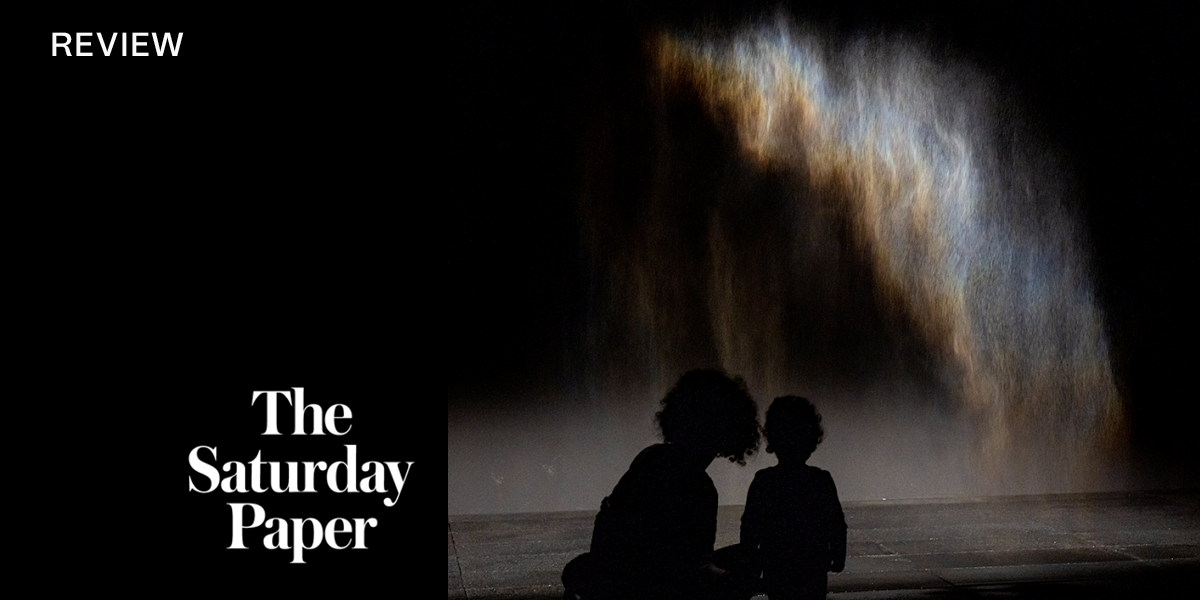
Through a dark passage nearby is one of the show’s best works, Beauty (1993). A glimmer of a rainbow darts across a curtain of water and changes shape against a backdrop of silvery mist, depending on your perspective. We might see the world differently but are bound by the rules of perception, the collective language of colour and light, a syntax that belongs as much to us as it does to the landscape around us. There’s something reassuring about this continuity. When I think of it I feel less atomised, as if my power lies not in my control over my surroundings but in how I am part of an infinite universe, a sea of shifting sensations in which I play a part.
I had assumed Riverbed was an elegy, ecological grief being the defining mode of our moment. And yet in the last room of the exhibition, I stand under Presence (2025), one-eighth of a golden sphere abutted by mirrors that my senses perceive as a single whole.
“Presence” refers to a state of mind, attention to what exists. But it also means simply to be with, to exist alongside something, to witness it in its entirety – and to commit, fully, to what is here.
Olafur Eliasson: Presence is showing at Queensland’s Gallery of Modern Art, Brisbane, until July 12, 2026.
Neha Kale travelled with the assistance of GOMA.
ARTS DIARY
EXHIBITION Ron Mueck: Encounter
Art Gallery of New South Wales, Gadigal Country/Sydney, until April 12
VISUAL ART Rachel Riggs: Between the Devil & the Deep C
Walyalup Fremantle Arts Centre, Whadjuk Noongar Country, until December 22
FASHION Diva
Australian Museum of Performing Arts, Naarm/Melbourne, until April 26
THEATRE A Christmas Carol
Playhouse, Meanjin/Brisbane, until December 24
CULTURE Hobart Current: Here
Tasmanian Museum and Art Gallery, nipaluna/Hobart, until April 26
Last Chance
THEATRE Carol
Heath Ledger Theatre, Whadjuk Noongar Country/Perth, until December 14
This article was first published in the print edition of The Saturday Paper on
December 13, 2025 as “Being there”.
For almost a decade, The Saturday Paper has published Australia’s leading writers and thinkers.
We have pursued stories that are ignored elsewhere, covering them with sensitivity and depth.
We have done this on refugee policy, on government integrity, on robo-debt, on aged care,
on climate change, on the pandemic.
All our journalism is fiercely independent. It relies on the support of readers.
By subscribing to The Saturday Paper, you are ensuring that we can continue to produce essential,
issue-defining coverage, to dig out stories that take time, to doggedly hold to account
politicians and the political class.
There are very few titles that have the freedom and the space to produce journalism like this.
In a country with a concentration of media ownership unlike anything else in the world,
it is vitally important. Your subscription helps make it possible.
Send this article to a friend for free.
Share this subscriber exclusive article with a friend or family member using share credits.

Used 1 of … credits
use share credits to share this article with friend or family.
You’ve shared all of your credits for this month. They will refresh on January 1. If you would like to share more, you can buy a gift subscription for a friend.
SHARE WITH A FRIEND
? CREDITS REMAIN
SHARE WITH A SUBSCRIBER
UNLIMITED
Loading…