
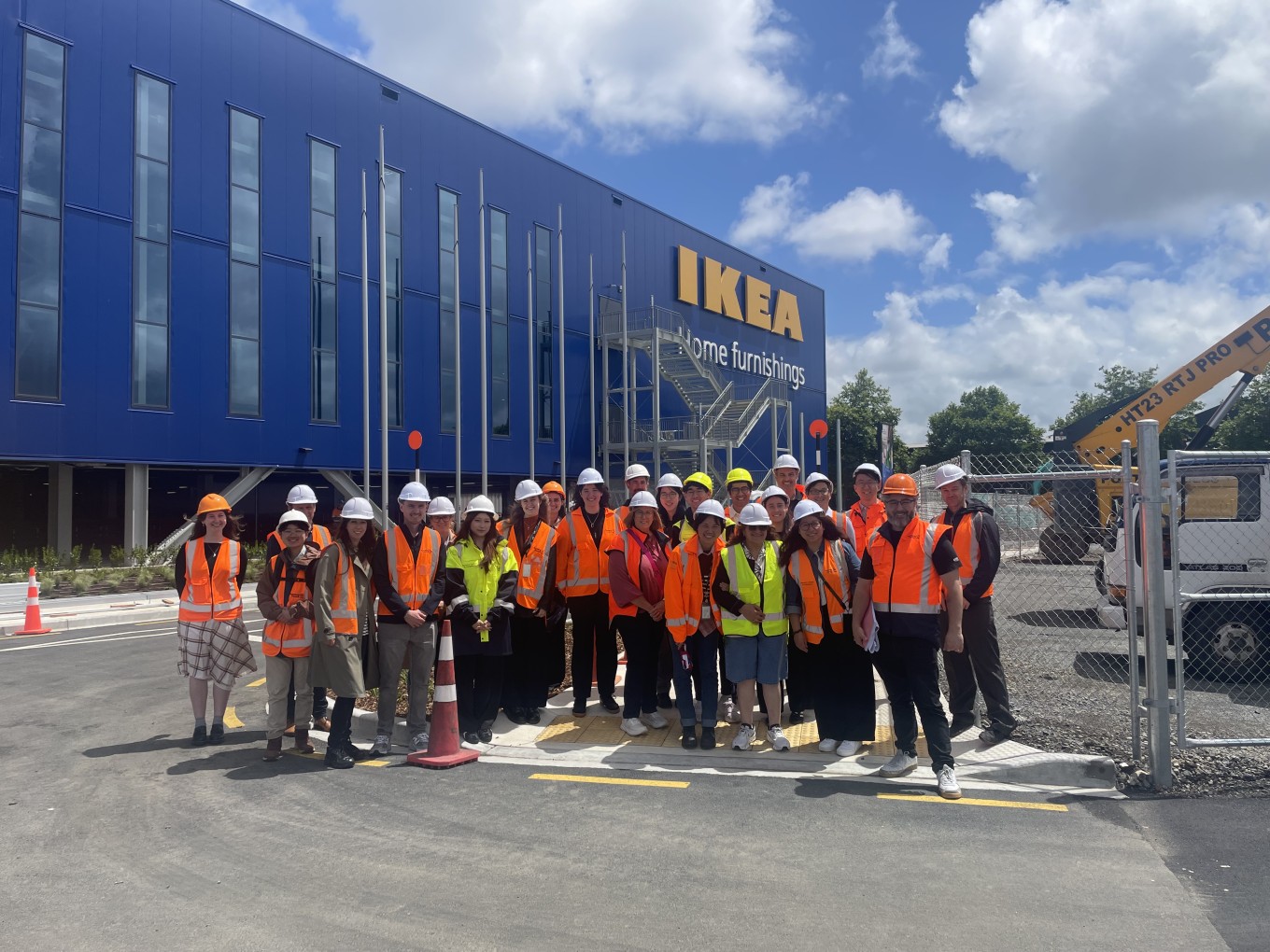
If you’ve driven past Sylvia Park lately, you’ll have noticed a giant blue-and-yellow newcomer has arrived!
Getting the green light for New Zealand’s first IKEA store at Sylvia Park wasn’t as simple as dropping in some flat-packs and grabbing an Allen key! The construction, now complete, was one of the most technically demanding resource consent processes planners say the city has seen and showcased the breadth of expertise within Auckland Council.
The application was lodged in October 2021 and, although limited notified to adjoining neighbours, IKEA secured written approvals from all parties. As no submissions were received, a hearing was not required, a rarity for a development of this scale.
Still, the technical work involved was substantial. Over 20 specialists contributed to assessments spanning urban design, ecology, transport, cultural effects, economics and stormwater.
The site’s location within the wider Sylvia Park retail precinct required several planning variations to ensure strong pedestrian connections and seamless integration with the existing metropolitan centre especially for people walking between shops, carparks and the train station.
Transport specialists played a significant role, shaping safer pedestrian links, vehicle-access arrangements, and a reconfigured parking layout. Auckland Council’s Transport Engineer Honwin Shen said:
“Our focus was making access intuitive for everyone, people walking from the train station, buses arriving more frequently, and motorists navigating a much busier precinct. The connections had to feel effortless.”
Mana whenua groups were strong partners in the process, providing guidance that influenced site layout, cultural artwork and the naturalisation of a stream corridor. They also delivered cultural inductions for contractors and put in place accidental-discovery protocols for any Māori artefacts encountered during excavation.
Council’s economic specialist Shyamal Maharaj considered how a retailer of IKEA’s international scale might influence nearby centres including Newmarket, Panmure and Botany.
“Our analysis showed that while IKEA draws significant footfall, its product range is sufficiently distinct that it complements rather than erodes the vitality of surrounding centres.”
Recently, Auckland Council’s resource consents team visited the construction site with Naylor Love and Kiwi Property to reflect on how several months of planning work has now materialised on the ground.
Processing planner Oscar Orellana says seeing their work turn into a real, physical project has been especially rewarding.
“Working across so many disciplines—transport, ecology, cultural heritage—really expanded my understanding of what it takes to deliver a major project. Seeing that work reflected in what’s being built on site has been genuinely motivating.”
For the team, IKEA is more than just a big blue box, it’s a reminder of the value of the resource consent system. Careful assessments across environmental, cultural and economic fronts are exactly what give major developments the confidence, and community backing, to go ahead.
IKEA Aotearoa: Key Facts
Location: Sylvia Park, Mount Wellington
Status: completed
Opened: December 2025
Consent lodged: October 2021
Notification: limited-notified to adjoining neighbours including KiwiRail
Submissions received: none (all neighbours provided written approval)
Hearing: Not required
Key considerations: transport, cultural effects, economic impacts, stream naturalisation, urban design, integration with Sylvia Park, contamination, construction impacts
Mana whenua role: site design input, artwork, naturalisation corridor, contractor inductions, accidental-discovery protocols