
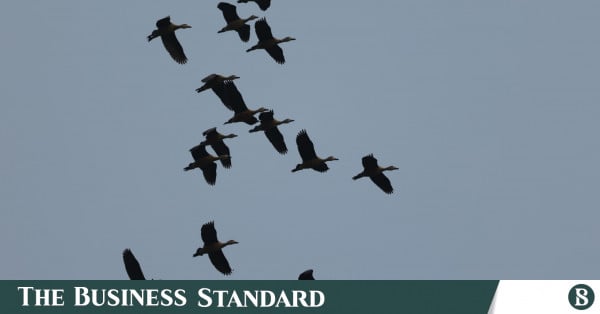
For nearly two decades, the Jahangirnagar University lakes became one of Bangladesh’s most famous and easily observable winter roosts. However, since 2020, flock sizes have sharply declined from several thousand to just a few hundred
15 December, 2025, 01:20 pm
Last modified: 15 December, 2025, 01:37 pm
Every year, as autumn leads to winter, the media report a familiar story: the arrival of migratory ducks at the lakes and marshlands of Jahangirnagar University (JU). Coverage often includes sweeping shots of flocks of ducks gliding across the campus sky, accompanied by their soft, rhythmic calls—the very sounds that earned the ‘whistling ducks’ their name.
What draws these birds to the university’s wetlands has long been a subject of speculation. Many believe that the relative safety of the campus — free from hunting, poisoning, and large-scale netting—creates a sanctuary for wintering ducks, waders, and other waterbirds.
Observers who spend time by the lakes quickly notice how the migrants rest on lily pads, water hyacinths, and floating vegetation, taking to the air only when startled by a passing raptor or sudden human disturbance. Jahangirnagar University seems, in every way, an ideal refuge.

Keep updated, follow The Business Standard’s Google news channel
Yet a basic ecological question emerges: what do these ducks eat, and where do they forage—especially at night? A simple tracking effort using GSM or radio transmitters could reveal where the birds go once they leave the campus to feed. The absence of such information has created a gap in understanding the decline in their numbers.
The shifting roosts
In the 1980s, Dhaka’s extensive wetlands and lakes provided vital feeding and roosting grounds for hundreds of thousands of migratory waterbirds. But later that decade, a remarkable behavioral shift occurred. Large flocks abandoned their long-favoured Bannerghata–Mirpur lakes and began roosting at Mirpur Ceramics Lake, which for years became a major daytime sanctuary.
After 2000, the entire wintering population gradually shifted again—this time to the lakes of JU and the wetlands surrounding the campus. The JU lakes offered what the ducks needed: gentle slopes, shallow vegetated wetlands for occasional feeding, and large trees providing shade and security.
For nearly two decades, the Jahangirnagar lakes became one of Bangladesh’s most famous and easily observable winter roosts, attracting thousands of visitors, researchers, birdwatchers, and students. After 2020, observers began reporting a troubling trend: flock sizes were shrinking. What was once a spectacle of several thousand ducks had dwindled to just a few hundred by this winter.
For lake modifications, the filling of shallow wetlands, and the removal of large trees to make way for new buildings, the university authorities could be blamed. However, my long-term field observations indicate that the main reason lies beyond the campus.
Urban growth may be convenient to humans, but it’s shrinking the dining and resting grounds of Dhaka’s wintering waterbirds. Photo: Dr Reza Khan
“>
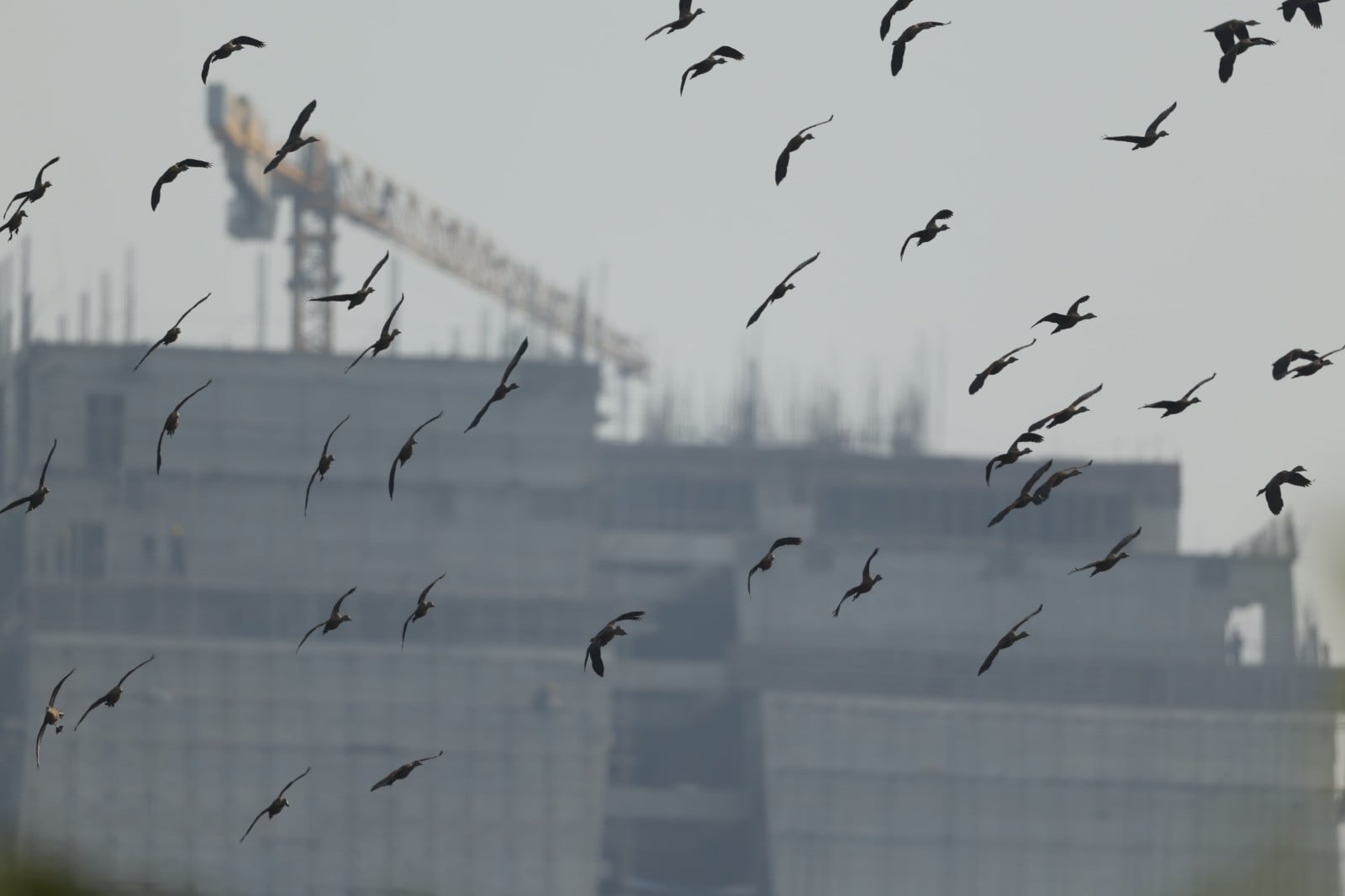
Urban growth may be convenient to humans, but it’s shrinking the dining and resting grounds of Dhaka’s wintering waterbirds. Photo: Dr Reza Khan
Dhaka’s vanishing feeding grounds
Migratory ducks do not select roosting sites randomly. Their primary requirement is access to feeding grounds within roughly a 10 km radius. If nutritious wintering wetlands disappear, birds will not return to roost in the daytime because their nightly foraging is impossible.
Over the past four decades, Dhaka’s surrounding wetlands have undergone extensive transformation. Many areas have been filled for housing and commercial development, while others have been blocked by embankments and elevated highways. Large tracts have been converted into farms, factories, and transport depots, and much of what remains has been heavily polluted by sewage, plastic waste, and industrial effluents.
As a result, the vast feeding wetlands of the 1980s—Keraniganj, Savar, Badda, Khilkhet, Gabtoli, Aminbazar, Beraid, Demra, and Kadamtali—have shrunk drastically. Fish populations have collapsed, aquatic vegetation has largely disappeared, and snails and other molluscs have declined due to pollution and pesticide use.
In short, if the feeding grounds disappear, the ducks disappear. No amount of lake beautification inside the campus can change this reality.
What the university authorities must do
Although the primary driver of decline lies outside JU, the campus administration still holds responsibility for maintaining ecological integrity within their boundary.
No authority should fell a mature tree without first ensuring that replacement trees were planted at least three years earlier and have reached a height of 3–5 metres.
These replacement trees must be native Bangladeshi species, particularly those that provide fruit, flowers, or shade, including figs such as Khoksha, Kak Dumur, Bot, and Pakur; Mandar (Erythrina sp.); Palash (Butea monosperma); Shimul (Bombax ceiba); Dewa or Lakuch (Artocarpus lacucha); black plum or Jamun (Syzygium); mango, guava, Jamrul, and Kadamba; Debdaru, Mahua, and Bokul; starfruit (Kamranga); palms such as Palmyra, coconut, date palm or Khejur, betelnut, and other indigenous varieties; as well as custard apple, bullock’s heart, sapota, neem, and Goraneem.
Dhaka needs to adopt the global “Blue-Green Infrastructure” approach, integrating wetlands, canals, lakes, and regenerative landscapes into urban planning. Cities like Singapore, Bangkok, Colombo, and Hyderabad have already made major investments in wetland restoration. Dhaka must not fall behind. To safeguard its wetlands, the government, developers, and private companies must invest in restoring and preserving them rather than destroying them.
These trees support insects, frugivorous birds, bats, and small mammals, all of which help maintain the campus food web.
Species such as the Lesser Whistling Duck, moorhen, coot, and swamphen depend on large expanses of shallow water ranging from 0.5 to 1.5 metres in depth, abundant aquatic vegetation including water lilies, duckweed, and marsh grasses, a healthy snail population, undisturbed foraging zones, low pollution and good water quality, and shaded roosting areas with tall trees.
Without these conditions, migratory birds will simply bypass Dhaka, opting instead for alternative wetlands in India, Nepal, Thailand, or Myanmar.
A call to action: Rebuild what has been lost
If we want to see the return of large flocks of ducks, rails and coots, herons and egrets, cormorants and darters, migrating terns and gulls, and even raptors like kites and eagles, we must restore the feeding grounds—the floodplains and shallow wetlands surrounding the city.
This requires protecting the remaining wetlands from encroachment, actively creating new artificial wetlands and retention ponds, ensuring campus authorities consult ecologists before altering lakes or cutting trees, educating students and community members about wetland ecology, enforcing strict waste management and water quality regulations, and reconnecting fragmented floodplains and canals.
Dhaka needs to adopt the global “Blue-Green Infrastructure” approach, integrating wetlands, canals, lakes, and regenerative landscapes into urban planning. Cities like Singapore, Bangkok, Colombo, and Hyderabad have already made major investments in wetland restoration. Dhaka must not fall behind. To safeguard its wetlands, the government, developers, and private companies must invest in restoring and preserving them rather than destroying them.
Only then can Dhaka once again host the magnificent winter gatherings of migratory birds that once defined the city’s ecological rhythm.
The declining number of Lesser Whistling Ducks at Jahangirnagar University is not a mystery—it is a symptom of a larger environmental crisis. The disappearance of Dhaka’s feeding wetlands has left migratory birds with nowhere to forage. Blaming the JU lakes alone misses the true cause. For the future of Dhaka’s biodiversity and the wellbeing of its citizens, wetland conservation is not optional—it is urgent and non-negotiable.
The return of the winter ducks is possible. But only if we rebuild the habitats they depend on.