
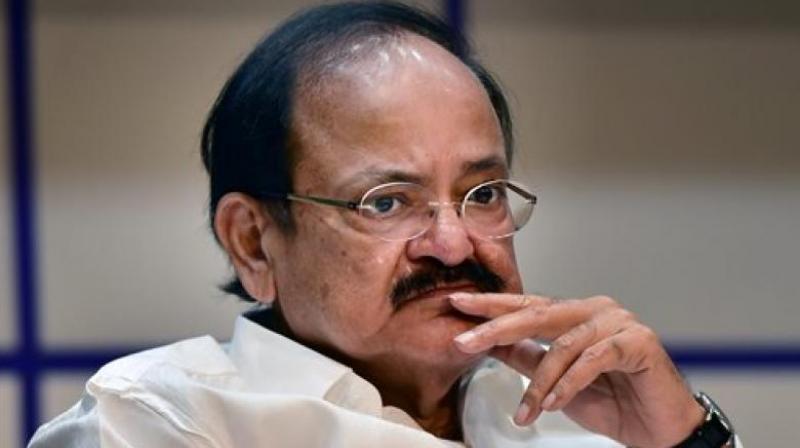
Hyderabad: Former vice-president M Venkaiah Naidu on Monday unveiled the statue of legendary singer S.P. Balasubrahmanyam at Ravindra Bharathi, amidst the presence of political leaders, cultural figures and musicians across parties.
Addressing the gathering, Venkaiah Naidu described Balasubrahmanyam as an artist who acted through his voice. “He did not merely sing. He performed with his voice.. When he sang for actors of other languages, including Kamal Haasan, it felt as if the actor himself was singing.”
Recalling his career, Naidu said Balasubrahmanyam recorded more than 40,000 songs in around 16 languages over a span of about 50 years. “Wherever he went, he carried Indian ethics and values,” he said.
IT minister D. Sridhar Babu said Balasubrahmanyam belonged to everyone. “Balu sir was for all,” he said. “Beyond records and awards, he was a man of values and that is why he continues to be a source of pride.”
Former Haryana governor Bandaru Dattatreya said Balasubrahmanyam’s songs accompanied people through every stage of life. “From a child’s innocence in ‘Oh Papa Lali’ to songs loved by the young and the old, his voice stayed with families,” he said.
BJP state president N. Ramchander Rao said the singer stood beyond political identities. “He connected people across ideologies and regions,” he said.
The departed singer’s son Charan said his father consciously stayed away from political alignment. “My father was always apolitical, and that is what people loved about him.. He spoke about things that mattered, but he maintained the same civility with everyone across parties and regions.”
Pointing to the range of leaders on stage, Charan said, “This itself shows how he belonged to everyone.” He also said his father disliked being reduced to regional labels and preferred to be known simply as S.P. Balasubrahmanyam.
While the speeches reflected the public stature Balasubrahmanyam attained, the choice of December 15 for the unveiling of the statue carried a quieter personal meaning. It was on this day in 1966 that Balasubrahmanyam recorded his first song for the film ‘Maryada Ramanna’, a turning point recalled in detail by his childhood friend G.V. Murli, who has known him since they were about 13 or 14 years old.
Speaking to Deccan Chronicle, Murli recalled how Balasubrahmanyam almost missed that opportunity. “A car was supposed to pick him up and take him to the studio at 1.30 pm. It never came, even an hour later. Balu almost gave up,” he said. “I told him we would give up only if the people at the studio themselves said no.”
Murli said he took Balasubrahmanyam on a bicycle to the recording studio. “The watchmen would not let us in. We argued with them and told them he had been given a chance to sing,” he said. “That is how he finally went in and recorded his first song.”
A percussionist and retired radio engineer, Murli accompanied Balasubrahmanyam in several competitions and shows before he attempted playback singing. He also recalled that singer Janaki, who judged one of the competitions Balasubrahmanyam won, encouraged him to sing for films, though he was initially shy.
Several speakers referred to Balasubrahmanyam’s journey from local performances to national recognition, describing it as rooted in discipline rather than ambition. Many also spoke about his role as a mentor on the television programme Padutha Theeyaga.
One of the organisers recalled, “He could have just finished the show and gone home. But he was not just a judge. He was a mentor who taught beyond singing, including culture, tradition and morals.”
P.S. Gopalakrishna, the author of ‘Jeevanagaanam: SP Balasubrahmanyam’, said he first saw himself as a long-time admirer of the singer. “He was a living, walking art form. Placing him beside Ghantasala feels right,” he said. Another fan, Karunamma J, said, “We may not miss his songs because they are recorded, but we will always miss the warmth of his words, which were his own.”
Sculptor Padayaru said it was the honour of his lifetime to have been allowed to create the statue. He said he tried to capture Balasubrahmanyam in a form that reflected Telugu cultural identity.
The unveiling took place amid tight security following announcements of protests by some Telangana activists opposing the installation of the statue at Ravindra Bharathi. Police said preventive detentions were made to avoid disruptions. The programme proceeded without interruption.