
December 16, 2025
— A red and white conical cap that circled the world one Christmas Eve — not atop a jolly old man riding a reindeer-guided sled, but rather on a NASA astronaut aboard a space shuttle — has gone on display in Kansas to celebrate the holiday season.
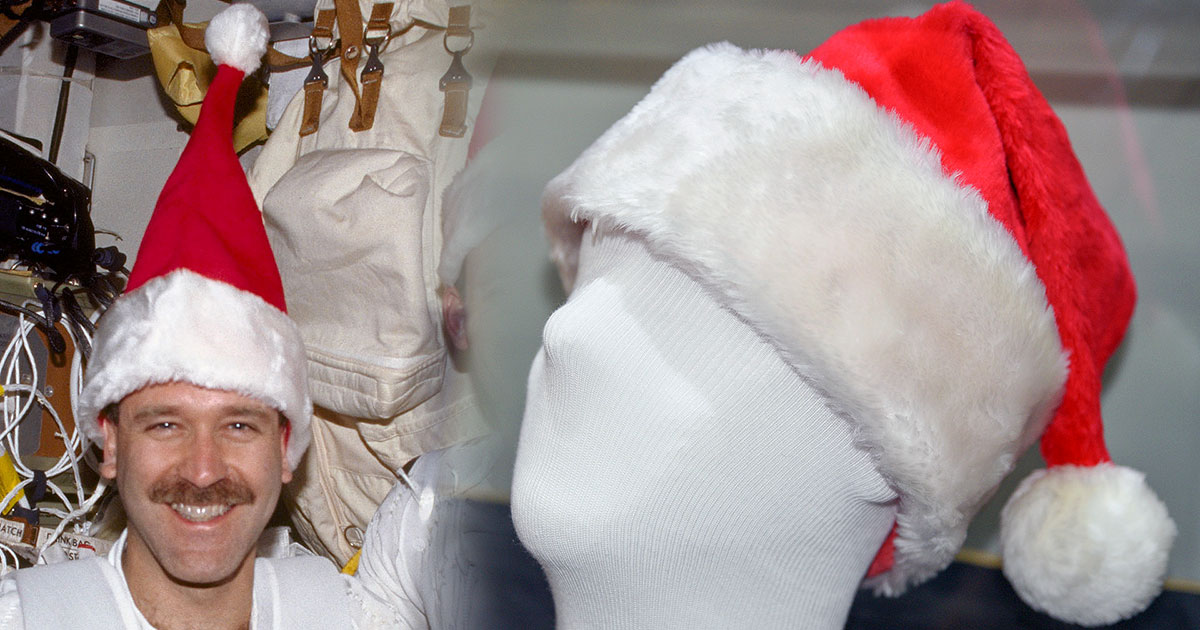
The Cosmosphere, a space museum and science education center in Hutchinson, has placed on temporary exhibit the Santa hat worn by STS-103 mission specialist John Grunsfeld on the third Hubble Space Telescope servicing mission in December 1999. During the nearly 8-day flight, which was the only space shuttle mission (out of the 135 in total) to be in Earth orbit on Christmas, the cap traveled 3,250,000 miles (5,230,000 km) while making 119 revolutions around the planet.
“Guests can view the space-flown Santa hat as part of the Cosmosphere’s 13 Days of Christmas Celebration, where it serves as a unique blend of space history and the holiday spirit,” read the museum’s announcement on Tuesday (Dec. 16).
The cap, with its fluffy white rim and pom-pom at its tip, is one of seven that were aboard the space shuttle Discovery — one for each member of the STS-103 crew, including commander Curt Brown, pilot Scott Kelly and Grunsfeld’s fellow mission specialists Michael Foale and Steven Smith with NASA and Jean-François Clervoy and Claude Nicollier with the European Space Agency (ESA). Grunsfeld loaned his flown cap to the Cosmosphere for the current display.
During a series of three spacewalks (sans Santa hats), Grunsfeld, Smith, Foale and Nicollier gifted the Hubble with new gyroscopes, a faster, more capable main computer and an improved transmitter for sending its astronomical data down to Earth, among other upgrades.
Photos taken between the extravehicular activities captured Grunsfeld and his spacewalk partner Smith sporting their Santa caps while still partially outfitted in their bulky spacesuits. The entire crew also wore their hats for a message they conveyed to everyone back on the ground.
“The familiar Christmas story reminds us that for millennia people of many faiths and cultures have looked to the skies and studied the stars and planets in their search for a deeper understanding of life and for greater wisdom,” said Brown. “We hope and trust that the lessons the Universe has to teach us will speak to the yearning that we know is in human hearts everywhere — the yearning for peace on Earth, goodwill among all the human family. As we stand at the threshold of a new millennium, we send you all our greetings.”
The STS-103 astronauts stood alone in celebrating Christmas on the shuttle, but included the fourth group of Americans to do so in space. The Skylab 3 (SL-4) crew of Jerry Carr, Ed Gibson and Bill Pogue were the first NASA astronauts to be off Earth for the holiday during their then-record setting 84-day mission in 1973. They did not have Santa caps, but devised a make-shift Christmas tree from spent food containers and cardboard.
The Skylab astronauts were followed a quarter of a century later by John Blaha and David Wolf, who were aboard Russia’s Mir space station on Dec. 25, 1996 and 1997, respectively. It isn’t clear if Blaha had one on board for his celebration, but there is a photo of Wolf and his cosmonaut crewmates Anatoli Solovyov and Pavel Vinogradov posing around a spacesuit wearing a Santa hat. (Wolf, who is Jewish, also had a menorah with him to celebrate Chanukah.)
Since then, and the start of 25 continuous years of a human presence on the International Space Station in 2000, Santa caps have become a more common sight in space. As far back as at least Expedition 10 in 2004 and continuing through Expedition 72 in 2024, crew members have donned the red and white hats while celebrating Christmas.
Back on Earth, the Cosmosphere’s display of Grunsfeld’s STS-103-flown Santa cap will extend through the holiday to Jan. 5, 2026.