
Global electricity demand is on track to more than double by 2050. Maintaining energy security and keeping energy affordable without throwing climate goals out the window will require a whole lot more renewable energy capacity, but – just as importantly – it will also require a huge leap in energy efficiency. But despite the critical importance of improving energy efficiency, it remains “a massively underutilised route to reducing emissions and improving returns.”
The fossil fuel industry – which still accounts for about 80% of global energy – is remarkably inefficient. Nearly two-thirds of all primary energy is wasted before it gets to its end user, lost in processes of production and transportation. “We waste almost 400 exajoule (EJ) of all energy going into our energy system, two-thirds of total, worth over $4.5 trillion, or almost 5% of global GDP — all before any value is created with energy,” reports the energy non-profit RMI.
Increasing energy efficiency is not just important for mitigating greenhouse gas emissions, it also just makes good financial sense. The World Economic Forum (WEF) reports that taking global action for increasing energy efficiency “could create a roughly 30% reduction in energy intensity and up to $2 trillion in annual savings.” And this wouldn’t even require technological innovation. “Existing technologies and solutions deployed and sectors like industrial manufacturing, transport and the built environment could have the most impact,” the WEF went on to say.
That being said, technological innovation could also have an enormous impact on energy efficiency pathways – both for better and for worse. Artificial Intelligence, for example, could yield incredible efficiency gains in the long run by streamlining all kinds of processes across economic sectors. In the short term, however, the indiscriminate integration of large language models into nearly every computing process is causing an enormous spike in energy usage that is leading to higher prices as well as higher emissions on a global scale.
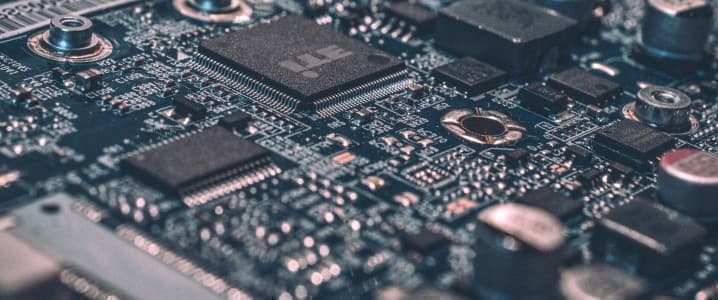
But a new technological innovation in computer chip technology could help increase the efficiency of computing processes. Researchers at the Massachusetts Institute of Technology (MIT) have developed a new fabrication method that incorporates new materials on the back end of a computer chip that allow for more functional components on a single circuit. The design behind the new methods and materials behind this breakthrough are described in detail in two scientific papers associated with the project.
“In traditional circuits, logic devices that perform computation, like transistors, and memory devices that store data are built as separate components, forcing data to travel back and forth between them, which wastes energy,” reads a recent MIT News report. “This new electronics integration platform allows scientists to fabricate transistors and memory devices in one compact stack on a semiconductor chip. This eliminates much of that wasted energy while boosting the speed of computation.”
This advanced fabrication method and material could offer a critical entry point for reducing the negative impacts of the AI boom. Walking back the spread of artificial intelligence is not realistic at this point, so increasing the energy efficiency of the complex computation behind large language models is the most viable option for mitigating trade-offs and enhancing the benefits of the nearly ubiquitous technology.
“We have to minimize the amount of energy we use for AI and other data-centric computation in the future because it is simply not sustainable,” says Yanjie Shao, MIT postdoc and lead author of both papers on this new transistor design. “We will need new technology like this integration platform to continue that progress,” Shao went on to say.
Increasing efficiency may not be the sexiest approach to “innovating” and “disrupting” the energy industry and Big Tech, but it is crucially important. According to Nick Eyre, Professor of Energy and Climate Policy at University of Oxford, “Historically, energy efficiency has delivered the largest share of greenhouse gas mitigation and reinventing it for the era of renewables will enable us to continue this trend and achieve net zero by 2050.”
By Haley Zaremba for Oilprice.com
More Top Reads From Oilprice.com