
O’Sullivan told the court: “He [Williams] told me that he regretted being involved. He described Mr Batchelor as a nutter, and he said Jim Grenon was paying for the whole thing.”
O’Sullivan said that Williams had told him that Grenon – a businessman who is a director and shareholder of NZ Herald publisher NZME – had contacted him, asking the former TVNZ presenter to be involved in the case as a witness.
Julian Batchelor at a Stop Co-Governance meeting in Kerikeri in 2023.
Defence lawyer Davey Salmon KC later indicated to the court that Williams’ comments – including his links to Grenon – would be covered in his closing address on Thursday.
In a statement to the NZ Herald on Wednesday night, Williams said: “It was, I thought, a private conversation between two old colleagues who first worked together 30 years ago.
“I never in a million miles thought it would go any further. Silly me. I’ve now officially retired as a court witness!”
Judge David Clark, referring to the revelation of the exchange between O’Sullivan and Williams, said: “These things happen, don’t they, in a trial.”
Other details emerged in court on Wednesday of how businessman Grenon came to financially support Batchelor’s defamation claim.
“Mr Grenon is picking up the bills for everything that is going on with this case,” Batchelor told the court.
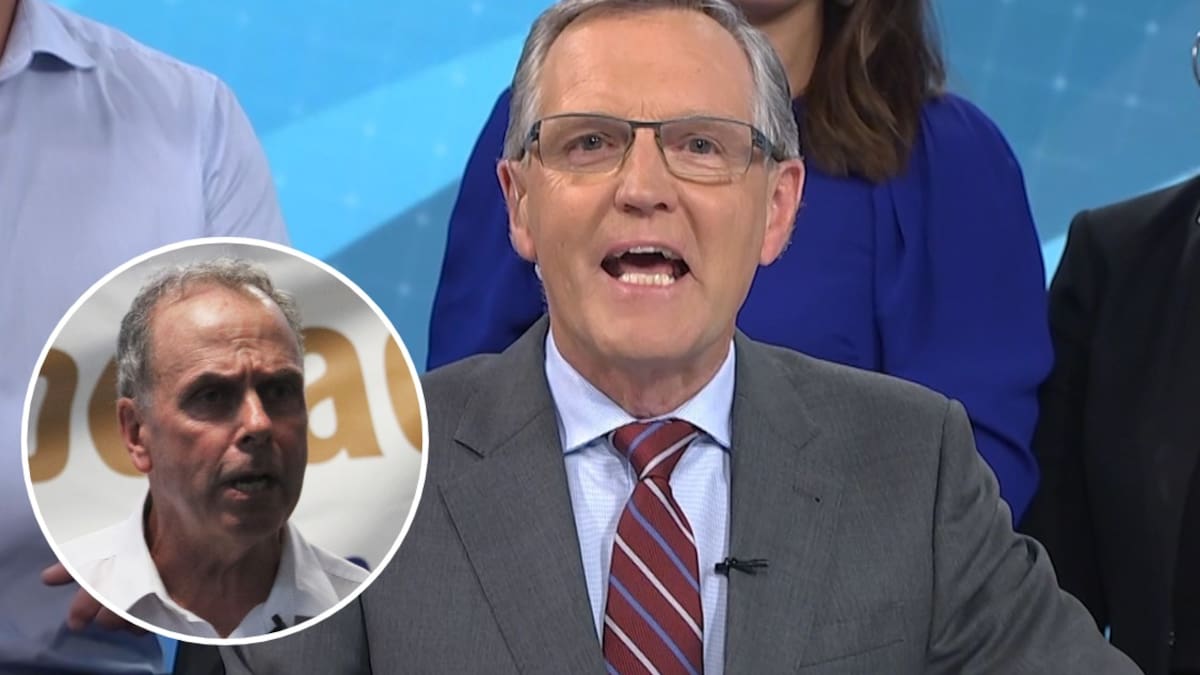
Former TVNZ broadcaster Peter Williams. Photo / Andrew Warner
TVNZ and former Disinformation Project research director Dr Sanjana Hattotuwa are being sued by Batchelor following a August 2023 story, which focused on an anti-co-governance pamphlet distributed by Batchelor before the general election that year.
The TVNZ story stated: “The pamphlets make a number of unfounded claims, including that a group of Māori elites are conspiring to take over the country and that co-governance is the ‘installation of apartheid’ in New Zealand.”
Hattotuwa, who at the time was a research director for The Disinformation Project, was quoted in the article, describing Batchelor’s platforms and pamphlet as “extremely worrying”.
“It is what you would call dangerous speech. It incites hate, and it instigates harm offline.
“This is racist rhetoric. This is colonialism’s long shadow.”
In court on Tuesday, Peter Williams, appearing as an expert witness on journalistic practice, answered questions in relation to his brief of evidence, including an assertion that the story was a “hit piece” without adequate balance.
Batchelor told the court yesterday that Grenon called him the day after the article appeared. He met Grenon at his home that day or in the days afterwards.
They talked about local and international politics, among a range of topics, “but mainly that TVNZ thing”.
Businessman and NZME shareholder Jim Grenon. Photo / Dean Purcell
He said Grenon had found lawyers for him and had been funding the case because he had viewed the article as a “terrible injustice”.
Of his own feelings, Batchelor said: “I was shocked by that news piece from TVNZ and very hurt by it.”
“Mr Grenon called me out of the blue, and I was very, very happy, obviously, that somebody wanted to help, because I thought, ‘What am I going to do about this? This is wrong’.”
Grenon, who holds just under 18.5% of NZME and led a charge to overhaul the media company’s board earlier this year, is overseas and earlier declined to comment.
A 9-minute call
On the witness stand on Wednesday, Batchelor claimed that the TVNZ reporter did not put to him any of the comments made by Hattotuwa when she called him just after midday on August 5.
Earlier, there was conflicting evidence heard in court about whether Batchelor could recall the call.
His lawyer later clarified that there was no dispute about the call happening, but Batchelor had no recollection of any of Hattotuwa’s claims being put to him.
Phone records show that TVNZ Māori Affairs Correspondent Te Aniwa Hurihanganui spoke to Batchelor for nine minutes just after midday on August 5.
Batchelor said that they spoke only about the Electoral Commission’s concerns about the pamphlet.
TVNZ is defending the case, with representatives, including Hurihanganui, taking the stand on Wednesday.
They say that Hattotuwa’s claims were put to Batchelor, and his position was accurately reflected in the article.
The online article states: “Batchelor denies he is racist, inciting hate or spreading misinformation.”
“I am saying she’s lying,” Batchelor told the court in regards to the reporter’s assertion that she had put Hattotuwa’s comments to him.
Neither a video of the reporter making the audio call nor the reporter’s notes were retained.
Defence lawyers Davey Salmon KC, left, and Daniel Nilsson, right, are representing Dr Sanjana Hattotuwa and TVNZ respectively. File photo / Dean Purcell
TVNZ lawyer Daniel Nilsson said the reporter’s evidence was credible and she should be believed. She had held the story to give Batchelor the chance to respond to Hattotuwa’s comments.
“There’s no dispute now that she had that conversation. It went on for nine minutes.
“Her recollection is that she put the substance of Dr Hattotuwa’s views to him for comment. She can’t quite recall whether she used the name Dr Hattotuwa or the Disinformation Project – but that doesn’t matter.”
Hurihanganui also took the witness stand to defend her work.
While she said she did not have a full record of the conversation, she remembered putting the claims of “racist rhetoric” to him.
His response was not succinct, but she had summarised his denials in the article.
Hurihanganui told the court she found Batchelor’s answers to her questions “long-winded and confusing”.
“I thought he was rambling a bit. I thought when I was interviewing him there’s no way I can distil this into a succinct grab or quote, so I am going to have to summarise it.”
She said the denial line that ended up in the article “was the most concise and clear way I could have communicated his response to our viewers and readers”.
Hurihanganui said she became aware of Batchelor through various news reports and his anti-co-governance position in early 2023.
In March that year, she started compiling a Google document on Batchelor, including some of his public statements.
She became aware of the Electoral Commission investigation into the pamphlet in late July. She planned to interview the commission, Batchelor and a law expert, she said.
The case continues on Thursday, with closing addresses.
Editor-at-Large Shayne Currie is one of New Zealand’s most experienced senior journalists and media leaders. He has held executive and senior editorial roles at NZME including Managing Editor, NZ Herald Editor and Herald on Sunday Editor and has a small shareholding in NZME.