 Image credits: Satya deep.
If you ask some people, they’ll tell you humans are wired to be monogamous — it’s in our very blood. But one look at the tabloids or your social media feed tells a different story: cheating and divorce are everywhere. So, are we biologically wired for fidelity, or is it just an artificial construct we struggle to uphold?
Mark Dyble, an evolutionary anthropologist at the University of Cambridge, decided to investigate. Not wanting to rely on self-reporting (because let’s face it, people lie about their relationships), he calculated a “fidelity score” based on hard genetic data across 103 human populations and 34 other mammal species.
He found that when it comes to monogamy, humans sit somewhere between meerkats and wild dogs.
The Mammalian Monogamy Soap Opera
Determining who really sleeps with whom in the wild is notoriously difficult. Animals sneak around, and humans lie. To get around this, Dyble utilized a simple but powerful metric: the ratio of full siblings to half-siblings.
In the land of sexual promiscuity, full siblings are rare because the mothers constantly switch partners between births. In a full monogamous system, full siblings are the norm. By aggregating data from modern hunter-gatherers, horticulturalists, and even ancient DNA from Neolithic graveyards, Dyble created a massive dataset to test just how “monogamous” the human species actually is.
Right from the get-go, the data was striking.
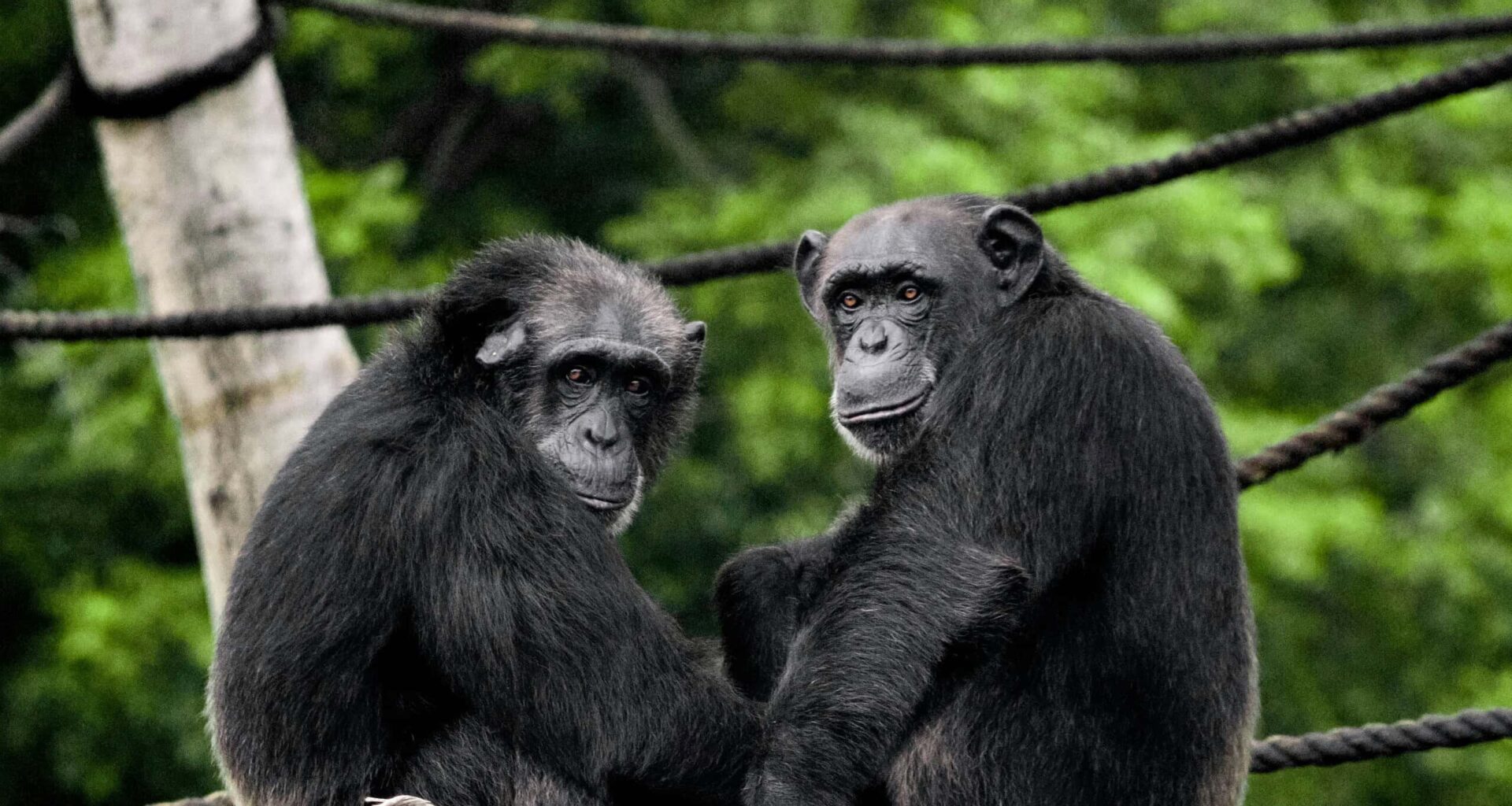
Our closest evolutionary cousins, chimpanzees, are the “non-monogamous” baseline. Chimpanzees live in multi-male, multi-female groups and mate promiscuously. The data reflects this chaos perfectly. According to Dyble’s analysis, the rate of full siblings among chimpanzees is a meager 4.1%. If you are a chimp, your brother is almost certainly just your half-brother.
Most African apes are also non-monogamous. But humans are different.
Humans Are Weirdly Monogamous
Across a global sample of 103 human populations, the average proportion of siblings who are full siblings is a striking 66%. This rate is comparable with socially monogamous non-human mammals, which average 70.6% full siblings.
And it consistently exceeds the range seen in non-monogamous mammals (which average 8.6% full siblings). We fit somewhere between meerkats (59% full siblings) and African wild dogs (85%). Even in human societies that allow multiple wives, most marriages are still monogamous.
But as far as monogamists go, we’re extremely weird.
Most monogamous mammals are antisocial. They tend to live in isolated pairs or small family units to avoid the temptation of other mates. They guard their partners jealously in deep burrows or vast territories. We live in massive, multi-male, multi-female groups. We surround ourselves with potential romantic rivals, yet we still manage to maintain pair bonds strong enough to produce high rates of full siblings.
In the natural world, this is extremely weird.
Why This Matters
When it comes to human society, the line between biology and culture gets blurry. Human monogamy is a hotly contested topic, with some research suggesting that it was an essential launchpad for human civilization. A high percentage of full siblings gives a higher incentive for collaboration, and also gives older brothers an incentive to help parents raise younger offspring because they’re basically investing in their own genetic future as well.
But this doesn’t settle the issue. Humans have serial monogamy (divorce and remarriage), which introduces half-siblings into the mix. We have extra-pair reproduction, though Dyble notes this is usually estimated at less than 5 percent in human populations. We don’t fall neatly into the “natural” structure of monogamy.
This seems to be an essential “glue” that enables our society to function, but it’s far from perfectly understood. Ancient human populations, analyzed using DNA from nine archaeological site, also show a great deal of variation. The sites ranged from Bronze Age nomads in the Ural to British Neolithic farmers. While on average, the proportion of full siblings in these groups fit very well with modern data observations, there were strong outliers. An Early Neolithic tomb in Britain revealed only 26% full-sibling rate, whereas in a Neolithic French cemetery, the rate was 100%.
We are a species that figured out how to live in a crowd without sleeping with everyone in it, for the most part. Whether this has been the case for all our species’ history, and whether it’s something that’s shaped by culture to some extent or only biology, remains to be seen.
The article can be read in its entirety here.