
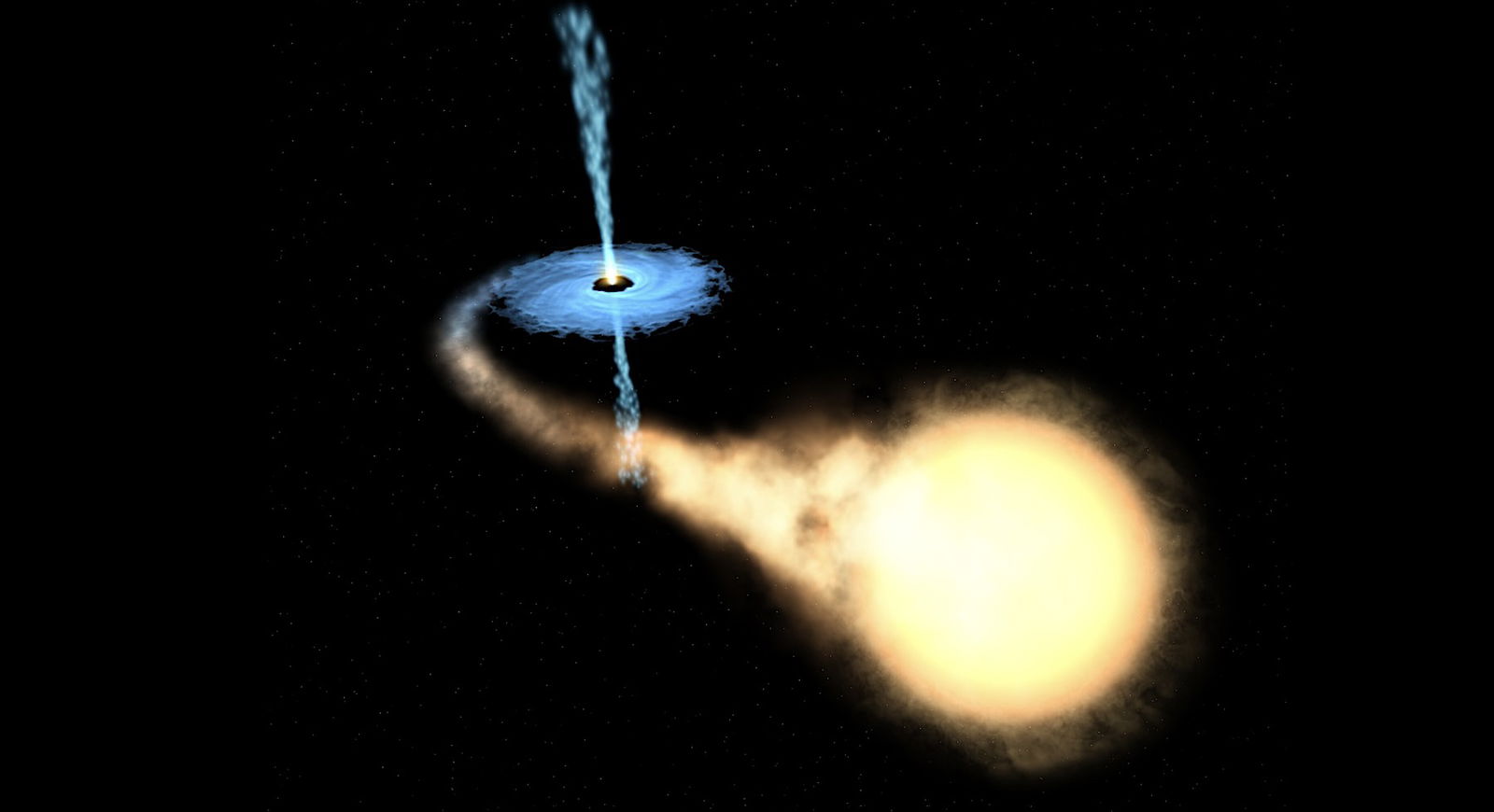
A star’s violent destruction by a black hole has offered physicists an extraordinary gift this holiday season: a cosmic wobble that betrays spacetime itself being dragged around by the black hole’s spin—an elusive effect first envisioned by Einstein and now seen with unprecedented clarity.
The strange cosmic phenomenon consisted of a particular wobble that a group of international scientists identified in the aftermath of a black hole tearing apart a star during a tidal disruption event designated AT2020afhd. That wobble was due to a phenomenon called Lense-Thirring precession—also known as frame dragging—in which a black hole twists the surrounding spacetime and pulls on nearby stars, as predicted by General Relativity.
Supporting General Relativity
Lense–Thirring precession was first hinted at by Einstein in 1913, and later mathematically formalized by Josef Lense and Hans Thirring in 1918. By confirming the effect during a tidal disruption event, the new findings open a window into accretion physics, black hole spin, and jet formation. The work—led by the National Astronomical Observatories at the Chinese Academy of Sciences with support from Cardiff University—is detailed in a recent paper published in Science Advances.
Researchers analyzed X-ray data from NASA’s Neil Gehrels Swift Observatory and radio data from the Karl G. Jansky Very Large Array. By modeling these signals together, the team determined that the observed wobbling of the disk and jet was consistent with frame dragging. Additional electromagnetic spectroscopy gave further insight into the disk’s structure and composition.
Catching Lense-Thirring Precession
Following the star’s demise at the hands of the black hole, a swirling disk of its remnants formed. This disk emitted powerful jets of matter into space at nearly the speed of light. X-ray and radio observations revealed rhythmic variability, suggesting that, on a 20-day cycle, the disk and its jet wobbled in sync.
“Our study shows the most compelling evidence yet of Lense-Thirring precession—a black hole dragging space time along with it in much the same way that a spinning top might drag the water around it in a whirlpool,” said co-author Dr Cosimo Inserra, a Reader in the School of Physics and Astronomy at Cardiff University.
“This is a real gift for physicists as we confirm predictions made more than a century ago,” Inserra added. “Not only that, but these observations also tell us more about the nature of TDEs – when a star is shredded by the immense gravitational forces exerted by a black hole.”
Inserra noted that, unlike previous tidal disruption events with steady radio signals, AT2020afhd showed short-term variability unconnected to typical energy-release mechanisms. “This further confirmed the dragging effect in our minds and offers scientists a new method for probing black holes.”
Understanding the Cosmos
“By showing that a black hole can drag space time and create this frame-dragging effect, we are also beginning to understand the mechanics of the process,” explained Dr Inserra. “So, in the same way a charged object creates a magnetic field when it rotates, we’re seeing how a massive spinning object – in this case a black hole – generates a gravitomagnetic field that influences the motion of stars and other cosmic objects nearby.
Inserra noted that the findings underscore the remarkable diversity of cosmic phenomena still waiting to be discovered.
“It’s a reminder to us,” he added, “especially during the festive season as we gaze up at the night sky in wonder, that we have within our grasp the opportunity to identify ever more extraordinary objects in all the variations and flavours that nature has produced.”
The team’s recent paper, “Detection of Disk-jet Co-precession in a Tidal Disruption Event,” appeared in Science Advances on December 10, 2025.
Ryan Whalen covers science and technology for The Debrief. He holds an MA in History and a Master of Library and Information Science with a certificate in Data Science. He can be contacted at ryan@thedebrief.org, and follow him on Twitter @mdntwvlf.