
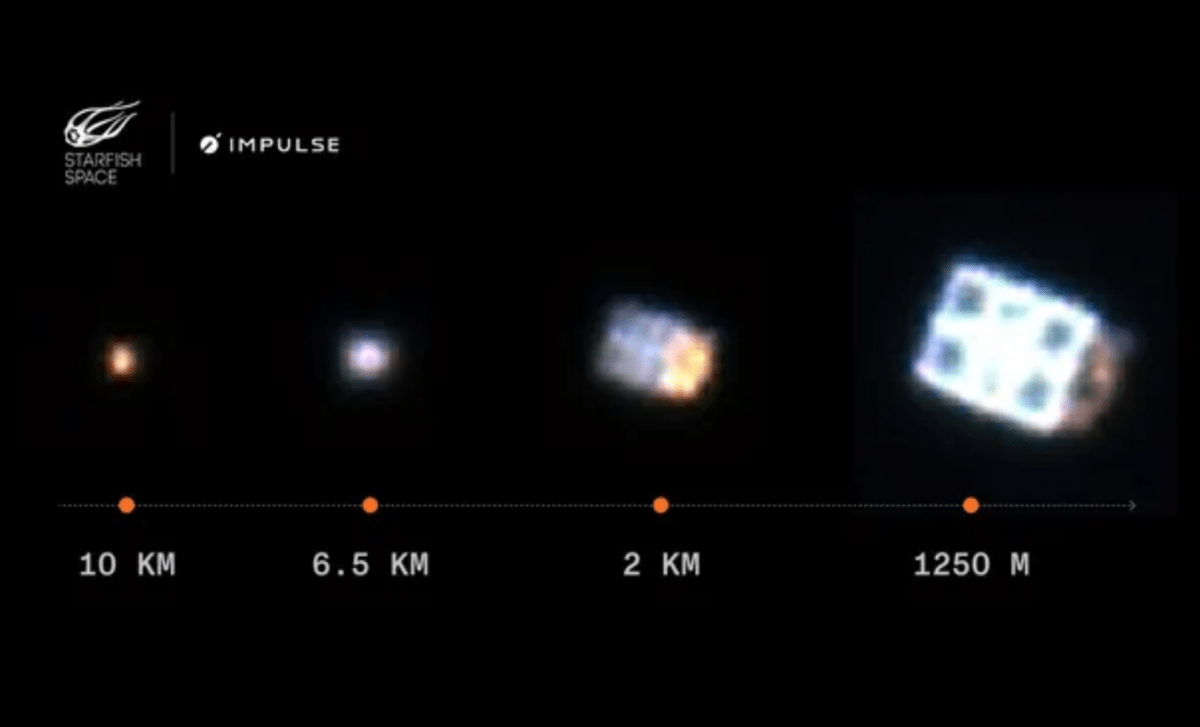
A new collaboration between Starfish Space and Impulse Space has made waves in the space exploration community with the successful Remora mission. Recently revealed, this mission involved two private spacecraft conducting a surprise rendezvous in Earth’s orbit, showcasing key advancements in autonomous technologies that could be pivotal for the future of satellite servicing. This operation, developed in record time, signals a significant step forward for commercial space companies and the potential for space-based infrastructure maintenance.
The Remora Mission: A Major Milestone in Autonomous Space Operations
The Remora mission was not just a rendezvous but a bold leap into the future of autonomous space operations. At the heart of this groundbreaking mission was Impulse Space’s Mira spacecraft, which used Starfish Space’s proprietary guidance and control software, Cetacean and Cephalopod, to autonomously approach another Mira in low Earth orbit (LEO). The two spacecraft rendezvoused with impressive precision, getting within 4,100 feet (1,250 meters) of one another.
As Impulse Space President and COO Eric Romo mentioned, the collaboration was a testament to their ability to rapidly bring complex projects to fruition: “Together with our partners at Starfish, we brought this mission from concept to execution in less than a year. Our team is ready and able to execute quickly and deliver versatile, complex operations where success is paramount. We’re looking forward to more RPO missions across more orbits in the future.”
The Vision Behind the Remora Mission: Fast and Precise Autonomous Rendezvous
As reported by Space.com, the Remora mission took place as part of Impulse Space’s larger initiative to test out and refine its orbital transfer vehicle, Mira. The modified Mira spacecraft launched on SpaceX’s Transporter 12 mission in January 2025 as part of the LEO Express 2 mission. Prior to the rendezvous, Mira had completed several key operations, including deploying cubesats and conducting engine burns to demonstrate its propulsion capabilities. However, it was the autonomous rendezvous that took center stage.
Using the Starfish GNC software suite, which was specifically designed for precise guidance and navigation, Mira was able to approach the target spacecraft, another Mira that had launched on SpaceX’s Transporter 9 mission in November 2023. This achievement marked an important milestone for both companies, showcasing their ability to execute highly complex orbital maneuvers with minimal human intervention.
Starfish Space Co-Founder Trevor Bennett emphasized the importance of this success: “With Remora, we set out to validate our unique approach to autonomous rendezvous and proximity operations in orbit. Proving this capability is a major milestone for Starfish, and gives us tremendous confidence as we move toward our first Otter launches next year.”
A Step Toward the Future: Satellite Servicing and the Otter Program
What makes the Remora mission even more exciting is its connection to Starfish’s Otter program. The Otter is a small, versatile spacecraft designed for a variety of satellite servicing functions. These include satellite inspection, refueling, repair, and even the de-orbiting of defunct satellites. While Remora was a significant achievement on its own, it also acts as a precursor to Starfish’s Otter vehicle, which will be launched in 2025.
The Otter program is seen as a key component in the broader vision for sustainable space operations. If successful, Otter will help alleviate growing concerns over space debris by offering solutions to maintain, repair, and safely de-orbit aging satellites. The Otter Pup missions, which have already demonstrated some early capabilities, are laying the groundwork for these ambitious goals.
The Speed and Innovation of Commercial Space Enterprises
What stands out about the Remora mission is the rapid pace at which it was developed. In less than a year, Impulse Space and Starfish Space moved from conceptualization to actual execution. This speed of innovation showcases the agility of commercial space ventures, which are becoming increasingly capable of tackling complex space operations that were once considered the domain of government space agencies.
The Remora mission underscores the importance of autonomous technologies in the future of space exploration. With the capability to execute complex rendezvous operations with minimal human oversight, space agencies and private companies alike could greatly reduce the cost and risks associated with satellite servicing missions. The implications for space infrastructure are enormous, as this could pave the way for more sustainable operations in low Earth orbit and beyond.