
Michael B. Jordan was lying on the floor of a Louisiana soundstage, covered in blood, and not remotely pleased about it.
“What I discovered about myself throughout this movie is I do not like fake blood. At all,” he says — not the most convenient epiphany when you’re making a vampire movie.
In Sinners, Jordan plays twins, Smoke and Stack, who return to their Mississippi Delta hometown after years working as mob fixers in Chicago. Their plan: open a juke joint built on soul-stirring music. Their problem: a vampire who blows into town and decides the joint’s clientele would make an excellent brood.
In one of the film’s messier scenes, Stack has been attacked and Smoke is left cradling his bleeding-out brother. Blood on bare skin wasn’t the issue, Jordan insists. It was when his wardrobe — multilayered 1930s suits — was covered in the red stuff: “Whatever you have on it is glued to you.”
Between setups, while fresh 70mm magazines were loaded and lights were reset, Jordan stayed put. Remaining horizontal was easier than peeling himself from floor and the costume. It was at this point that Ryan Coogler, his director and longtime collaborator, who is generally considered to be one of the most successful filmmakers of his generation, simply dropped down beside him.
“Coog was like, ‘Man, I got you, no problem,’ ” he says. He still keeps a photo of the moment on his phone: “I’m cracking up because we are both down on the floor in this fucking pool of blood.”
And it wasn’t their first time on the ground together. “The very first movie that we did, Fruitvale Station, I was laying on the ground on the set out in the middle of streets of Oakland and he laid down there with me.”

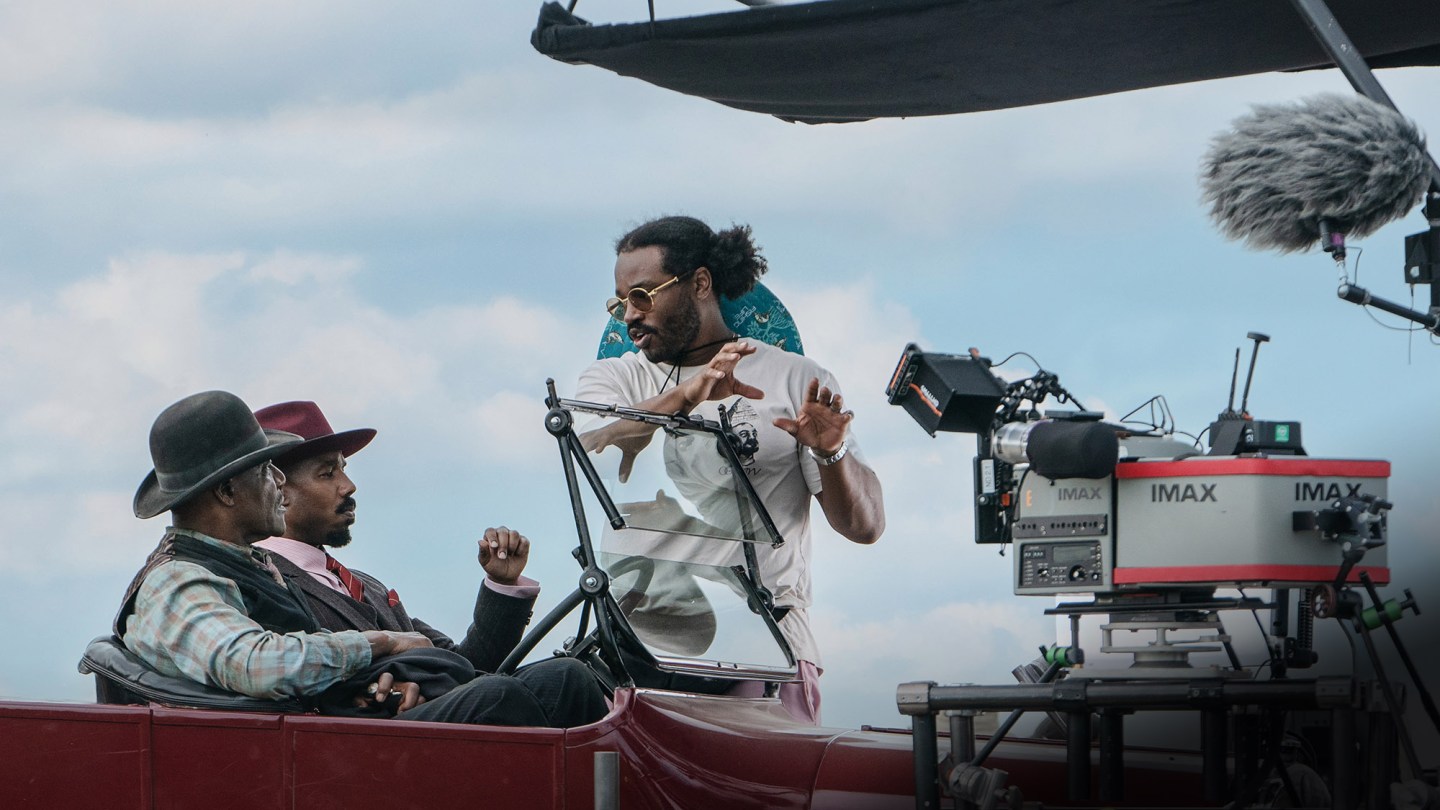
Coogler directs blues singer and guitarist Buddy Guy, who was cast in a cameo in Sinners, playing an older Sammie (Caton).
Courtesy Warner Bros. Pictures
Coogler’s logic is straightforward: He won’t ask anyone to do something he wouldn’t do himself. It’s a mindset that breeds camaraderie, which would come in handy on a production that was constantly throwing curveballs — from finding a studio partner to wrangling alligators to switching between two giant film formats in punishing Louisiana heat.
With Sinners, Coogler wanted to make something quick and entertaining before being called back to the time-consuming demands of a third Black Panther film. In December 2023, after finishing the script, he and producing partners Zinzi Coogler (also his wife) and Sev Ohanian (producer and Proximity Media co-founder) began reaching out to their regular collaborators, many of whom date back to film school, telling them to be on standby. With no studio yet attached, the early phases were handled indie-style.
“I believe in the moving-train approach and philosophy to getting movies made,” says Ohanian.
Jordan was on board from the start, leaving one major creative question: Who would play Sammie, the young blues singer whose voice, according to the film, could “pierce the veil between life and death” and who unknowingly attracts the film’s vampire?
Casting director Francine Maisler, who had worked with Coogler on the first Creed, scoured agencies, music schools and blues clubs across the South, New York and Chicago. Eventually, someone pointed her to Miles Caton, the opening act for R&B singer H.E.R.
“It’s like watching Michael Jordan dunk,” says Coogler of Jordan’s ease onscreen. “You’re not thinking about the fact that this man weighs almost 200 pounds.”
Eli Adé/Warner Bros. Pictures
“Toward the end of the tour, [H.E.R.] said somebody in the crowd saw me perform and said that I should audition for this top-secret big movie,” remembers Caton, whose only previous brush with acting was auditioning for a TV series about New Edition. “I’m working on music, but nothing else is really going on. So, sure, why not?”
He sent in a self-tape — about 30 takes’ worth, he admits — of himself singing Sam Cooke’s “Bring It on Home.”
“It looked like it was shot on a 2007 iPhone,” jokes Ohanian. “You can hardly see his face, but you hear his voice.” Adds Maisler: “Out came this voice. I’m not very religious, but that voice was coming from somewhere else.”
Caton got the role and began working with an acting and dialect coach, plus a guitar instructor, while studying blues icons like Howlin’ Wolf, Son House and Muddy Waters. He’s joined onscreen by Delroy Lindo, Hailee Steinfeld, Omar Benson Miller and Wunmi Mosaku.
Costume designer Ruth Carter dressed Mary in a contemporary 1930s long silhouette, while other characters were dressed in the older drop-waist dresses of the 1920s, which helped to show the economic disparity of the characters.
Courtesy Warner Bros. Pictures
“Finding Sammie was always the wild card because maybe there’s a world where we never found him,” says Ohanian. “When Miles came into the picture is when the movie became more real.”
Warner Bros. eventually won the bidding war for Sinners, and once the studio was on board, producers turned their attention to locations. The story is set in Clarksdale, Mississippi, but filming took place in more tax-friendly Louisiana. Production designer Hannah Beachler dug through reference photography from the Library of Congress, the Farm Security Administration author and photographer Eudora Welty.
“Cotton was everywhere. On the ground, on the road because it would fall out of carriages, on people’s porches,” Beachler says. She estimates they used about 500 pounds of cotton for set dressing.
Costume designer Ruth Carter, a two-time Oscar winner for her work on Coogler’s Black Panther films, relied on early Kodachrome slides from the FSA to rebuild 1930s clothing accurately. “You would think that you would buy a pair of denim overalls, and it would work in 1931 — not so much,” she says. Pockets and hardware were different, so she scavenged vintage fairs and built workwear from scratch.
Her dyeing and aging team focused on making the clothes look truly lived-in. Carter didn’t allow most characters or extras to have alterations. “It’s 1931, and most people have nothing, they care for their clothes,” she explains. “If something was big or was long, you cuffed it.”
Lindo (center) with Jordan (right) and Caton in Sinners. Roughly one third of the film was shot on location with the cast and crew contending with the Louisiana summer heat.
Courtesy Warner Bros. Pictures
The film’s main location is the juke joint Smoke and Stack renovate out of a decommissioned sawmill. Beachler’s team built two versions — one on a soundstage and one deep in the Louisiana bayou — an eight-week effort.
Beachler, who has lived in New Orleans for two decades, used salvaged wood from buildings being torn down around the city, mixing in new lumber her team weathered with borax and painted shadows.
The bayou build came with added complications. “We had walked there, originally, to find the location through water moccasins and cottonmouths and then we had to go in and bushhog the whole place, putting in roads just so people could be there,” she says. Adds Michael P. Shawver, Coogler’s longtime editor, “I’d never been on a shoot that had alligator and snake wranglers that were not for animals in the movie.”
One day, Ohanian heard an “alligator” was on set and assumed it was a nickname for new equipment. “It was literally a real dangerous alligator near video village,” he says.
Wunmi Mosaku as Annie, Smoke’s wife and Hoodoo practitioner. Production designer Hannah Beachler built Annie’s cottage at a slight slant, inspired by movies like Big Fish and a nod to Sinners’ supernatural plot.
Courtesy Warner Bros. Pictures
Explains cinematographer Autumn Durald Arkapaw: “It’s a harsh landscape, you feel it in your bones. There’s the humidity. The horizon is flat. The land feels heavy.” To capture that feeling, she looked to geographically expansive films like There Will Be Blood and The Hateful Eight and shot Sinners using Ultra Panavision 70 and Imax, switching between their aspect ratios.
To play both twins, Jordan shot every scene twice — once with a body double, then again as the other brother — with the VFX and editing teams stitching the performances together in post.
The twins’ first appearance onscreen shows them standing outside the sawmill, rolling a cigarette, passing the lighter and tobacco back and forth, and smoking it. The moves are simple, but the precision required — matching timing across multiple takes — made it one of the production’s most demanding shots. And it was filmed on the hottest day ever recorded in New Orleans. Crewmembers soaked towels in ice water and draped them over their necks, only for them to dry out within minutes.
Jordan (left) and Miles Caton in the Mississippi-set film.
Courtesy Warner Bros. Pictures
Jordan completed the scene after more than 20 takes. Onscreen, the movements glide together hypnotically. He also gave each twin distinct physicality. “You could see him from the back and know which brother he was,” says Ohanian.
Carter dressed Smoke in blue and Stack in red to help audiences track who’s who. Jordan added internal distinctions of his own. “They both hold their trauma differently,” he says of the characters, who allude to their World War I service and abusive childhoods. Smoke is a stoic caretaker; Stack is a fast-talker armoring himself with charm. When playing Smoke, Jordan wore shoes a size too big so he’d move more deliberately. As Stack, he squeezed into pairs a half size too small. “I wanted him to not feel as comfortable and always bouncing around.”
Coogler notes that Jordan’s ease onscreen can obscure how hard the work really is. “It’s like watching Michael Jordan dunk. You’re not thinking about the fact that this man weighs almost 200 pounds.”
Jordan says each of his twins, Smoke and Stack, “both hold their trauma differently.” Both are World War I veterans and endured an abusive childhood.
Courtesy Warner Bros. Pictures
Filming ran roughly three months, and starting in fall 2024 — less than a year after Coogler first sent out his screenplay — Sinners began screening to test audiences in locations like Las Vegas and to family and friends, including fellow filmmakers like Christopher Nolan.
“Ryan is not a precious filmmaker,” says Ohanian. “Every note is valid. We got to give it a shot.”
Some notes pushed them to introduce the vampire earlier.
Others suggested removing the epilogue, a cameo from blues legend Buddy Guy as an older Sammie.
And then there was the film’s “surrealist montage,” a three-minute one-er in which Sammie sings the breakout original song, “I Lied to You,” summoning musicians across past, present and future — from Zaouli dancers to an LL Cool J-inspired rapper. Some “very respected people,” Shawver says (declining to name them), suggested cutting it. To pull off the sequence, Caton sang live while composer Ludwig Göransson mixed audio in real time and a Steadicam operator carried an 80-pound Imax camera. Most of the cast and crew rehearsed on their days off, sometimes in pajamas.
Coogler, who had final cut on the film, reordered scenes and recut the film repeatedly, shaping versions that ranged from 90 minutes to two hours and 45 minutes.
Ultimately, the filmmakers kept the later vampire reveal, opting instead to add an animated prologue that hints at the film’s supernatural elements. And the surrealist montage stayed put, now widely considered the film’s signature moment. “We thought, ‘You have these amazing actors, you have these cool set pieces, these fun, funny moments. Let’s live here for a while,’ ” Shawver says.
Even with the heavy hitters in front of and behind the camera, a period vampire movie not based on IP, which is also part historical drama with heavy musical elements, was far from an obvious studio slam dunk. Yet Sinners has become one of the year’s biggest box office successes: an original film grossing $367 million worldwide on a reported $90 million budget.
“Had it not been for this group at this point in our careers and lives, I don’t think this movie gets made,” says Ohanian. “It really feels like we captured lightning in a bottle.”
Hailee Steinfeld’s Mary (seated) with a brood of vampires led by Jack O’Connell’s Remmick.
Eli Adé/Warner Bros. Pictures
Through postproduction and into release, Coogler’s leadership style — described as a mix of calm, clarity and football-team-captain energy (he played wide receiver at Sacramento State) — remained the film’s backbone.
Shawver recalls Coogler, a coffee aficionado, offering to brew something for whatever frazzled department head came into his office. Caton remembers, even after the longest filming days, returning home to texts from Coogler, reading, “Great job, young man. Keep working. Don’t be afraid to try different things.”
Maisler points out that when she first started working on Sinners, before a studio was attached, she took a fraction of her regular payment. When the film did get studio backing, Coogler and his producers said they would like to retroactively pay her her full fee, something that had never happened before in her decades-long career. She puts it simply: “Ryan has become kind of like a religion for those of us who’ve worked with him.”
For Coogler, the job’s straightforward. “All of my department heads are top-class, they are all very self-sufficient. Everybody can hold their fucking weight,” he says. “The job of the director, you have got to motivate everybody and give them clarity, but the management of the actor is really why I’m paid.”
Which, in his case, occasionally means dropping to the ground beside the person doing the bleeding.
“You’re thinking about the worst thing that ever happened to you in your life so that you can portray the worst thing that ever happened in the character’s life,” Coogler says, remembering that day on the soundstage floor soaked in fake blood, hoping to help his friend get a little more comfortable. “I know I can’t help his mental state because that’s part of the work. I can’t help him physically because that’s also part of the work. All I can do is just be there with Mike. So, let me lay down with him in this shit.”
The scene of the two collaborators together on a sticky floor is the perfect summation of how Coogler directs, how he leads, how he can build an onscreen world that rises above heat, blood, snakes, alligators and the pressure of intermittently shooting in 70mm.
And besides, he points out, fake blood always washes out.
Courtesy Warner Bros. Pictures
This story appeared in the Dec. 17 issue of The Hollywood Reporter magazine. Click here to subscribe.