
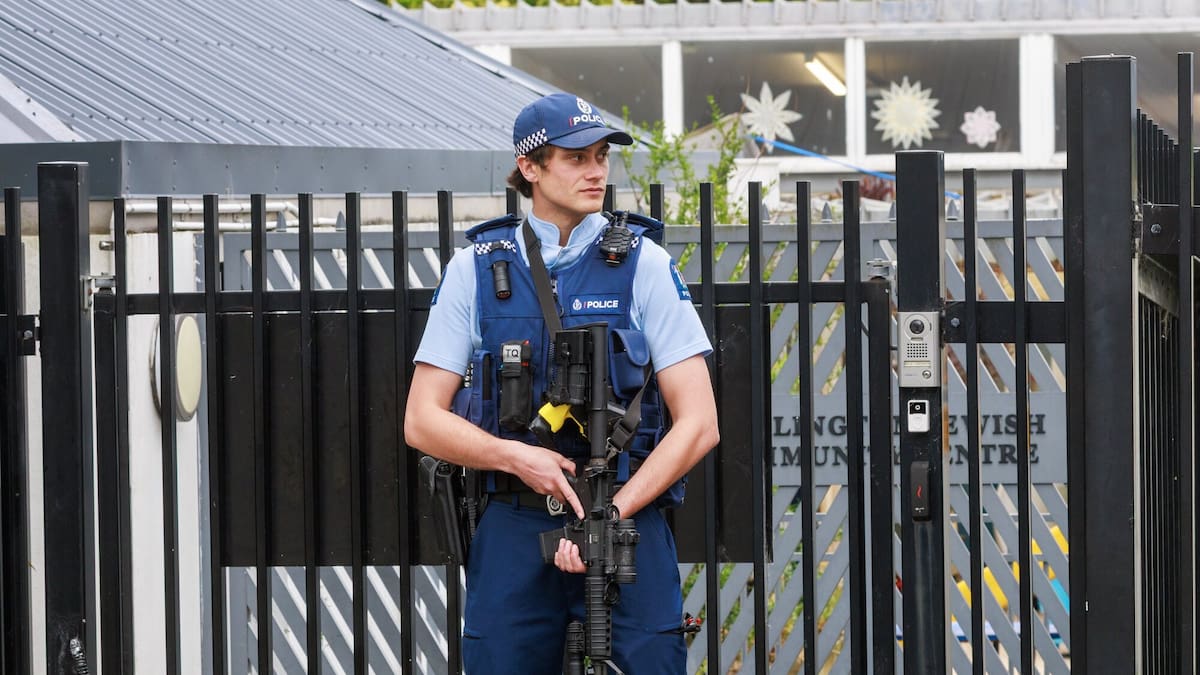
Keeping one’s head down though has become increasingly difficult. I’ve been forced to confront my ethnicity and personal history a lot more since I arrived. The Hamas attack on Israel on October 7th, 2023, was shocking.
Israel’s murderous response, overtly or tacitly supported by Western governments, is more shocking still.
Like many diaspora Jews, events have led to a lot of soul searching about our history, Israel’s actions and what it means to be Jewish. Then there was Sunday’s Bondi Beach attack. It has left me and my family quite shaken.
A growing display of flowers and tributes is seen at a memorial outside the Bondi Pavilion as Jewish communities reflect on rising fears following violent anti-Semitic attacks. Photo / Getty Images
We are unnerved because we feel unsafe and unsupported here. And it’s not just about the horrendous events elsewhere. Anti-Semitism is alive and well in Aotearoa New Zealand too.
Saying that makes me feel awkward because anything I have suffered pales into insignificance when set against the death and destruction currently taking place in Gaza (or historical massacres of races here and elsewhere). But please hear me out.
Since we arrived, we have encountered more instances of anti-Semitism in six years than in a lifetime before. From ignorant generalisations and casual, throwaway comments, to quite marked institutional racism. Appeals to senior managers are generally brushed away.
Under the casual category might be put people’s responses to the Covid vaccine mandate; people around us regularly claimed that vaccine mandates were akin to the Yellow Stars of David used in Nazi-era Germany.
My children are regularly distressed by the casual anti-Semitic comments (with lots of likes) that appear in their social media feeds on a daily basis.
But our experiences are also more institutional. One of my kids spent four years at a South Island university. On one of the student’s college committees, the treasurer was always given a kippah (a Jewish cap). Guess the inference.
Most upsetting of all, was the short extract of Shakespeare’s Merchant of Venice play performed one night. It was a scene with Shylock, that ended with the whole cast repeatedly yelling ‘the Jew, the Jew, the Jew’. They encouraged the audience to do the same.
Call to confront anti-Semitism and racism after Bondi shooting. Photo / Getty Images
My child wandered out bewildered and in tears. When they tried to take it up with the head of the college concerned, they were politely ignored. When I took it up with the vice-chancellor, there were some genuine concerns expressed but no recognition or apologies forthcoming from the responsible college heads.
My partner has been studying te reo Māori for a couple of years. The first class she attended was going well until it came to everyone presenting their whakapapa.
After speaking about her Jewish roots, the teacher began treating her particularly harshly without explanation. My partner, who is quite a good linguist, was the only one in her group to be failed.
My own experiences at my university have been fairly grim. At one point, a disturbed student began racially harassing me and others. It eventually turned into a completely fabricated complaint against me and two other Jewish members of staff.
The university’s response was not to challenge this ongoing pattern of racist harassment. Instead, it chose to investigate us. We were exonerated but no one from senior management has ever contacted us to acknowledge what we’ve been through.
Now here’s the thing. These actions in themselves are relatively “soft” in nature. But, in allowing such behaviours to go unchallenged, as they have multiple times in history, leads to a climate in which tacit racism is normalised.
Tacit racism supports the more extremist ideas of far-right groups, enables racist politicians to gain power, and results in persecutions, imprisonment and massacres.
But there is a broader race issue that goes beyond my personal experiences of anti-Semitism here. Aotearoa New Zealand has a problem related to the fact that engagement with race issues predominantly takes place within a bi-cultural framework. Māori-Pakeha relations is the only discussion that seems to be on the table.
Multiculturalism, as a policy or political practice, does not exist in my experience. I never see it discussed in my university or talked about by politicians or commentators (except when there is a massacre). But 28.8% of the population were born abroad. Asian citizens make up a similar percentage of citizens as Māori. Hindus, Muslims, Buddhists, Sikhs and Jews all have established communities here. Do none of us count?
Call to confront antisemitism and racism beyond bicultural debate. Photo / Getty Images
It’s not that I wish to dismiss the events of the past or the very real ongoing struggle of Māori and Pacific peoples, and the entrenched inequalities and racism that exist.
However, if that is all that matters, it ignores the experiences of the 28.8%. Racism against minorities is all too easily ignored.
The country and its institutions need to confront this elephant in the room. Doing so might just help prevent another Christchurch or Bondi Beach taking place.
Catch up on the debates that dominated the week by signing up to our Opinion newsletter – a weekly round-up of our best commentary.