
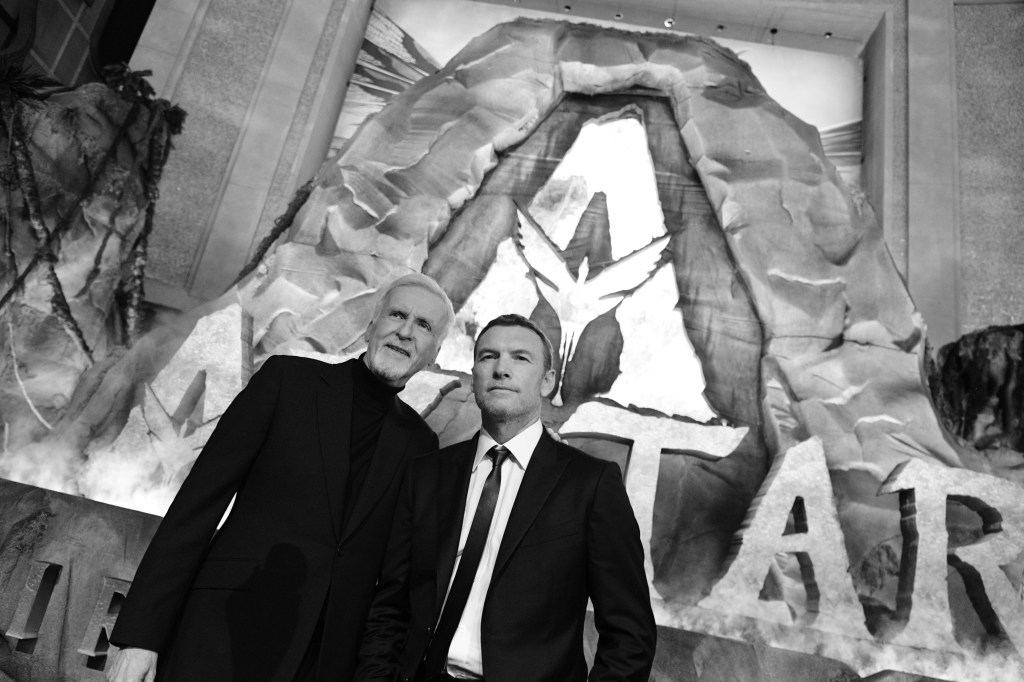
At an early LA screening of James Cameron’s Avatar: Fire and Ash, starring Sam Worthington as lead character Jake Sully, loud cheers erupted from the audience before the film had even started. The reason for the premature exuberance? During a pre-movie featurette, the director explained his opposition to the replacement of actors using AI. With this, the third in the Avatar series, Cameron made a decision to pull back the curtain on exactly how these films are made — in particular, the artistry of the motion capture process.
In the past, Cameron had aimed to retain some mystery, thinking that showing how it’s done would “dispel the magic a little bit.” But now, he says, “We realized that people were starting to conflate our process with AI.” Cameron wanted viewers to see that the human actor-director experience was very much intact behind the scenes – no AI required.
Although Disney (purveyor of the Avatar films), has made a recent deal with Open AI, Cameron himself underlines that he has used no AI and says he is determined that the technology be handled with ethical guardrails across the industry.
The other main driver of this choice to reveal exactly how Avatar magic happens, was Cameron’s clear respect for the work of Worthington, with whom he has worked on Avatar for some 12 years now. As Cameron says, “I realized that you guys weren’t getting the proper credit for the hard work and the great work that you were doing… And people are thinking it’s a voice part, which couldn’t be farther from the truth.”
Here, on the eve of Avatar: Fire and Ash’s premiere, in conversation with Deadline, Cameron and Worthington discuss their longtime collaboration and what lies ahead for Avatar. Plus, how they handle the pressure of following up the preceding two films in the series, Avatar and Avatar: The Way of Water — two of the box office’s highest-grossing movies of all time — in an era in which more and more people eschew the theater experience for their living room couch.

James Cameron, Sam Worthington on the set of ‘Avatar: The Way of Water’ in 2022.
Walt Disney
DEADLINE: So, this interview is for a feature called The Partnership , focused on two people with a long or especially intense working relationship…
JAMES CAMERON: Let’s just get this out of the way up front. We can’t stand each other. So this is all going to be a bit awkward and tense.
SAM WORTHINGTON: Oh, yeah.
DEADLINE: Evidently. So, what do each of you what you remember about your first meeting?
CAMERON: I had just broken my foot that day, is my memory of it.
WORTHINGTON: Yeah, you fell off a gym mat.
CAMERON: Yeah, I fell a good, I don’t know, inch and-a-half. I was on crutches, I was in a boot, but I’m trying to video Sam and Zoe together. You guys did a read, a cold read, right? And I’m hopping around, trying to keep the camera stable. I don’t know what you were thinking.
WORTHINGTON: I think I was hopping with you.
CAMERON: I think you didn’t even see me. You were just checking out Zoe.
WORTHINGTON: It was in Jim’s old office. And I always remember, you went down a corridor, and it had the posters of every single one of his movies. So you’re kind of intimidated by the time you get to the end. But Jim, as I said, was hopping over in a boot and it relaxed me straight away.
The liquid hit the head camera. The problem was then, the head camera kind of set on fire. And me being me, I ran around the room, forgetting that it was connected to my head.
Sam Worthington
DEADLINE: Sam, I was really interested about what it’s been like for you to spend this much time working directly with Jim. Is there a memory where you felt, “OK, this is a peak actor-director experience?”
WORTHINGTON: It’s a curly question. I’ve known Jim 20 years, and then if you add up all the time, we’re talking that we’ve worked together, I’m estimating it’s like seven or eight years, solid. So that’s a lot of time just to pick one moment.
CAMERON: I feel it was when you puked on the head rig camera.
WORTHINGTON: Yeah. Jim, the truth is in the details. So all you’re looking for in the way we shoot it is, how to get to the truth. And I think the scene involved me having to drink something that was described as disgusting. So I said to Jim, “Well, you got to just give me something disgusting.” I think he mixed a concoction of fish oil?
CAMERON: Yeah, no, we went and got some Vietnamese fish sauce. Like, “All right, this is going to set him back.”
WORTHINGTON: So when I drunk it, it did the exact thing you wanted. It was disgusting. But it was so disgusting it came flying out. Of course, we’ve got head cams on, so all the liquid hit the head camera. The problem was then, the head camera kind of set on fire. And me being me, I ran around the room, forgetting that it was connected to my head. When all I had to do was take the helmet off.
CAMERON: It was definitely a peak moment.
WORTHINGTON: I don’t know if it’s a classy moment.
CAMERON: It’s not a classy moment.
DEADLINE: That’s not really what I’d imagined, but that works.
James Cameron and Zoe Saldaña on he set of ‘Avatar: Fire and Ash’
Mark Fellman / © 20th Century Studios / courtesy Everett Collection
WORTHINGTON: That’s the process. The process is always problem-solving. And it’s often something so out of the box it leads down to these kind of moments. Where it’s like, “Wow, that’s so crazy, but it works.”
CAMERON: Sam brings a lot of physicality to the work. I mean, he’s obviously a consummate actor — the emotion, the vulnerability. I think that a lot of what Sam brings to the role of Jake is the fact that you see past his armor. He’s a tough guy, he’s very stoic, and all that. But you see the pain on the inside, and that nuance of that, I think, is what really makes Jake compelling. But he’s also very physically adept with the weapons work, and the flying, and all that.
I remember you created the stance for the riding the Leonopteryx, because we’d figured out how to ride an Ikran, which we also called a banshee, on the first film. And you ride, you kind of straddle it, and you’ve got a foot on a stirrup on each side. And you kind of fly it kind of like it’s a board sport and you’ve got to lean uphill. Well, Sam’s a surfer, and you came up with the stance for the Leonopteryx…
WORTHINGTON: Yeah, you couldn’t straddle it, so I said, “Why don’t we try popping up on it, like I would on my board?” And then that gave us something that was dynamic. I think that was what was cool about it. It’s difficult to do, but it suddenly made him different from the other riders as well. So it helped the story, as well as just made it possible.
Zoe Saldaña, Sam Worthington and James Cameron.
20th Century Studios
CAMERON: Yeah. We spent a lot of time on the physical stuff, so we had to figure out, “OK, how’s he holding on? Oh, twist your arm through the antenna. You’ve got the weapon in the other hand,” and then he’s doing all this kind of dynamic stuff. I remember, your glutes and your quads were dead the next day. He came in like an 80-year-old guy the next day.
WORTHINGTON: Yeah. And this is the thing, you can’t just fake it because Jim will say, “No, where your foot is is where the Ikran breathes,” or, “your hand placement, that it would get gnawed off, the Ikran might take it.” So you really have to be detailed, and it was in position, exactly right.
We realized that people were starting to conflate our process with AI, and that’s entirely my fault, because I didn’t want the public to see, before they saw the movie, people in marker suits and head rigs. I thought it would dispel the magic a little bit.
James Cameron
DEADLINE: I watched the making-of documentary, Fire and Water: Making the Avatar Films, and when I saw Fire and Ash on the lot, in LA, we saw a little featurette beforehand, which was like a condensed version of the documentary. I’m really interested in how you’ve pulled back the curtain on how this is done, and the decision to do that. Because obviously, Jim, I understand there’s the worry that people are going to assume that there’s AI involved, when there isn’t…
CAMERON: They did [assume that] I think on Avatar 2. On The Way of Water, I think that assumption was kind of rampant at the time. And so I thought, ‘All right, this is doing a huge disservice to how hard the cast are working.’ Because the original assumption was, ‘Oh, it’s a voice part.’ And I still see in print media, all the time, “Sigourney voices Kiri,” because they can’t imagine that she’s actually physically performing a 15-year-old at the age of 71, or 72 when she was doing it. And it’s like, no, she didn’t do a voice part. She was on the movie for 18 months, performing every scene, including all the underwater work, all the work at the surface, riding the creatures, all that stuff. It’s a complete physical performance. It’s not just a voice performance, right?
But then it got worse, because then we realized that people were starting to conflate our process with AI, and that’s entirely my fault, because I didn’t want the public to see, before they saw the movie, people in marker suits and head rigs. I thought it would dispel the magic a little bit. And then I realized that you guys weren’t getting the proper credit for the hard work and the great work that you were doing. I mean, we’ve got Academy Award-nominated, Academy Award-winning actors. We’ve got Sam at the peak of his career so far, [they’re] doing some of the best work in their lives, and not getting credit for it. And people thinking it’s a voice part, which couldn’t be farther from the truth. So we decided to show how it’s done, and celebrate that process.
It doesn’t even feel like you’re doing a movie on this scale. I’ve always said to people, ‘It’s like a big indie, an independent film.’ That’s how it feels.
Sam Worthington
DEADLINE: What has that meant to you, Sam? To have Jim show audiences why you deserve this credit and have them understand what you’ve been doing all this time?
WORTHINGTON: It’s interesting. I still think it’s going to take a lot more for that needle to move, for actors and directors and producers to understand the mechanics of it. I think the audience, they still just get swept up in the magic, and that’s the important thing for me. But in the industry, it’s just about education and learning. And I think Jim’s so far ahead of everybody else that the race hasn’t even begun for some people, and maybe this allows them to kind of catch up and utilize the tool that we love to use. Or at least, when it comes to our work, it’s not necessarily, I find for myself, about recognition. But it’s kind of interesting to see their eyes light up when they see the behind the scenes, and you see the potential of what we’re doing and how we do it.
Jake Sully (Sam Worthington) and Neteyam (Jamie Flatters) in Avatar: The Way of Water’
Walt Disney Studios Motion Pictures / Courtesy Everett Collection
CAMERON: I think there’s a hook for people to really get this: to think of it as makeup. It’s digital makeup. So nobody questions an actor’s performance, even though you don’t really see their face when they’re completely painted, or covered with latex, or whatever. And even when they have scleral covers over their eyes. It’s like you literally will see nothing maybe but an actor’s teeth, maybe even then, they’ve got fake teeth. And nobody questions that. But then the pushback on this is, “Oh, we’re not really seeing the actor’s face.” Except, you are. We do a laser scan of the actor, and then we push and pull the features a little bit, we make their eyes a little bit bigger, but it’s basically their face. Probably much more so.
We’re not talking about artificial super intelligence, right? That’s a whole separate problem. We’ll probably all be dead in a hundred years. But anyway, let’s enjoy the movies in the meantime. But generative AI is a very powerful tool. We just need to tame it, and we need to use it ethically.
James Cameron
DEADLINE: Jim, you’ve spoken quite a bit about wanting to protect that director-actor experience, and not have AI cross that line. But there is a way that VFX and AI can work together to make films like this more affordable. What do you think about that?
CAMERON: Yeah, my instinct is that you’re absolutely correct, that generative AI— because that’s what we’re talking about, we’re not talking about artificial super intelligence, right? That’s a whole separate problem. We’ll probably all be dead in a hundred years. But anyway, let’s enjoy the movies in the meantime. But generative AI is a very powerful tool. We just need to tame it, and we need to use it ethically. So, I’m not an expert in AI. Like I said, I haven’t worked with it so far. We haven’t used it on the Avatar films, and that’s pretty much all I’ve been doing for the last few years. But I’m very curious about it, and I want to see, it seems to me there are certain specific tasks within the VFX pipeline that are so mind-numbingly boring and repetitious, that those could be done by a gen model of some kind. And even if I have to help develop some of that stuff, because the big developers, the Googles and Metas and everybody, they’re focused on public and business use, right? So, a lot of text-prompt models for text, and text-to-video models, and they’re not focusing on the kind of tools that we need in the entertainment industry. We’re just too small for them, ultimately, is what it boils down to. They think of having a constituency of eight billion people, you know what I mean? We’re just too small a market.
So I think we’re going to have to generate these tools ourselves, I’m very keen to figure out if we can bring the costs down using generative AI tools. Once again, within very specific guardrails that don’t intrude on the artist, we don’t intrude on the writer, we don’t intrude on the actor, most importantly. And I’ll be very vocal, in both camps, in a funny way. It sounds a bit dualistic, or almost confusing, but I want to make sure that we’re not replacing actors, and that we’re not bringing up a next generation of directors that think they can cut out the acting part of the process.
I would tell any young director coming in, because they get very excited about the tools. Because I mean, I’ll use an extreme case. I’m a young wannabe filmmaker, living in my mom’s basement, and I can make a science fiction film. And I just make up the people, right? And all of a sudden I’m on the way to being a big-shot Hollywood film director, except you skipped the most important part, which is learning how to bring the characters to life through the acting process. I would tell any young filmmaker, first thing you should do, after you’ve figured out how Maya and Houdini and all the other stuff works, take an acting class. Put your ass on the line. Even if you’re terrible, it doesn’t matter, you’ll know what it feels like to breathe life into a character.
I’ll be very vocal… I want to make sure that we’re not replacing actors, and that we’re not bringing up a next generation of directors that think they can cut out the acting part of the process.
James Cameron
DEADLINE: Obviously you’ve smashed it at the box office multiple times, and just got a Golden Globe nomination for Box Office and Cinematic Excellence, even before Fire and Ash has premiered.
CAMERON: We haven’t made a dime yet. It’s hysterical. They’re just assuming that that’s what-
DEADLINE: I mean, no pressure.
WORTHINGTON: And we broke another record, the film with the lowest box office, getting nominated for the best box office. We broke another one.
DEADLINE: Obviously, there is that high expectation there. But box office is changing, and we know the way that people are consuming cinema is changing. So on the one hand, I want to say to you, Sam, how does it feel? These kinds of films, these big budget films that need to make a lot of money at the box office, in the model that we have right now, I’m sure it’s going to change. You’re at the zenith of what can be done, before that shift comes, in terms of being a part of this huge budget, high-tech project that doesn’t use AI. So is there some sort of poignancy in making this latest film?
I think that’s what box office is, that connective tissue between a film and an audience. And I’ve had an experience on two movies that have done that on a global scale. I can’t let it affect what my job is.
Sam Worthington
WORTHINGTON: Look, I can try to come up with a clever answer. I don’t look at it that way. I’m a jobbing actor. That’s how I’ve always looked at it. I service the story to the director. If the movie connects, that’s completely out of my hands. I think that’s what box office is, that connective tissue between a film and an audience. And I’ve had an experience on two movies that have done that on a global scale. I can’t let it affect what my job is.
CAMERON: It’s not actable, right?
WORTHINGTON: Yeah. It doesn’t even compute with me, sometimes. Jim, I think, is right. He’s going to try and maybe figure out a way that this utilizes as a tool, and can create a faster process for these films. But that’s not going to affect what I do.
CAMERON: No. And you can’t even keep that in mind. I mean, when I was working on Titanic, which didn’t even use a lot of these CG tools, and I’m looking out across 2000 extras, I’m feeling the pressure of a big-budget movie. When we’re doing our work on an Avatar film, we’re in a small, empty sound stage. We cull the volume, we do very rudimentary sets. It doesn’t look glitzy, it doesn’t look glamorous, there’s not thousands of actors. It feels very intimate and contained.
Quaritch (Stephen Lang) in ‘Avatar: Fire and Ash’
20th Century Studios
WORTHINGTON: It doesn’t even feel like you’re doing a movie on this scale. I’ve always said to people, it’s like a big indie, an independent film. That’s how it feels. It’s a bunch of people that we’ve known even pre-Avatar 1. You’ve worked with a lot of the people on your other films. And I think it’s surprising when actors get into that space, or even directors getting in that space, of how quiet and calm and intimate the whole process is. This idea, yes, we have two massive movies in this saga, but the process itself is small. It’s about detail. It’s intimate. Yeah, it’s weird.
CAMERON: The critical part of the creative process, the kind of crucible where that which affects the audience, which is the emotion. Where that’s created is actually quite small scale. It doesn’t feel like a big production number at all. Now, where the money goes is into the VFX pipeline, for the next two or three years after that. That’s where we’re spending the money, and it’s all about creating photo reality. So if you’re doing a film like Moana, or name any Pixar movie, you don’t need photo- reality. It’s stylized, right? But our curve of difficulty goes up on a long curve. As we approach photo-reality, that’s where the cost is in the render pipeline, and in the creation of all the models that… We call them the assets, everything that you see in the film, every leaf on every tree. And so, we don’t think of it while we’re doing it. And maybe that’s, we put ourselves in a little cotton cocoon of creativity, but it works. It feels very natural and organic.
I’ve done a movie where we talked about the sequel as we were doing the movie. And it was like, ‘You’re putting the cart before the horse.’
Sam Worthington
we always knew that Fire and Ash was the end of one story cycle, one story arc. And I think it’s important to tell an audience, “Okay, you’re not going to go off a cliff. Frodo’s not going to get in the boat and row away halfway to fricking Mordor.”
DEADLINE: Jim, you’ve said that Fire and Ash is the conclusion of a particular arc. I know you’re holding off on the next two Avatar films to see how this one does, but if you do decide to do films four and five, what might be in store for Jake?
CAMERON: Oh, it’s all written out. I mean, you got to think of it as almost adapting novels that already exist. In my mind, that was the process. They were screenplays, but I wrote it in a very novelistic form. And we always knew that Fire and Ash was the end of one story cycle, one story arc. And I think it’s important to tell an audience, “Okay, you’re not going to go off a cliff. Frodo’s not going to get in the boat and row away halfway to fricking Mordor.” You know what I mean? It’s like, “No, this story lands. It ends,” right?
Now, if we do elect to start the next saga arc, that plays out across four and five, we know what that is. It’s hard for me to think about that right now. I always use the metaphor that if a woman is in labor, at the moment she’s crowning, you don’t ask her about her next children.
WORTHINGON: You’ve got to understand, Jim, when he spoke to me about it, it was told to me like a storyteller. Like a whole novel storyteller. He didn’t say, “This is movie one, movie two, movie three, movie four.” He just told me this story like an old campfire [tale]. He’s writing this thing. It’s interesting for me when people say, “When’s the next sequels?” Jim doesn’t work that way. It’s a bigger picture that’s going on here. It’s not like the Lord of the Rings films. It’s like Tolkien. He’s writing it, like that. And that’s interesting, from my point of view.
20th Century Studios
CAMERON: I think sequel triggers certain reflexes in an audience where, because most sequels that are ever made, they have an unexpected hit. Then they scramble around, and they try to write some story based on-
WORTHINGTON: I’ve done a movie where we talked about the sequel as we were doing the movie. And it was like, you’re putting the cart before the horse. It’s like, “Get this one right, and then you might get the opportunity to pursue more stories.”
The ground is shifting under our feet right now in the entertainment business with respect to cinema, what it means. The younger demos are shifting their habit patterns. We rely on them, of course, because they’ve got the energy to get up out of their house.
James Cameron
CAMERON: That’s kind of where we are. Look, you said it yourself, Antonia, that the market is shifting, the ground is shifting under our feet right now in the entertainment business with respect to cinema, what it means. The younger demos are shifting their habit patterns. We rely on them, of course, because they’ve got the energy to get up out of their house, and go and get some friends, and pay for the parking and actually show up. You know what I mean? But they also grew up with streaming, coming of age in the age of streaming. Habit patterns are shifting. We’re running about 30 to 35% below where we were pre-COVID right now, and it seems to have plateaued. It’s not descending, but it’s not rebounding, right? That’s my analysis. Seems to be true almost everywhere.
And I say 35%, because people are saying 25%, but they’re forgetting that ticket prices went up. So when you look at absolute admissions, it’s actually more like we’re down about a third right now. And that could be the entire margin of a film like Avatar. So let’s let the dust clear on this one, maybe we make some money, maybe we don’t. But we’ll look at the business model, and we’ll see how we can tinker with that business model, maybe by bringing costs down with some new technology. That would be my focus. Everybody says, “What’s the new technology that you used in this film?” It’s like, no, we’re at 100%, guys. Anything that we can imagine, we can do. It’s just a question of how much it costs and how long it takes.” And it’s really the length, because 90% of the cost of VFX is labor, so that which takes twice as long costs twice as much. It’s pretty simple.
James Cameron with Stephen Lang on the set of ‘Avatar: Fire and Ash’
WORTHINGTON: It’s also going to be, “How can we do it?” Because sometimes you write things and you tell me, “I don’t know how to do this.”
CAMERON: Yeah, that’s good. That’s healthy. I always try to challenge myself to do stuff. If I’m not scared, then we’re not doing it right.