
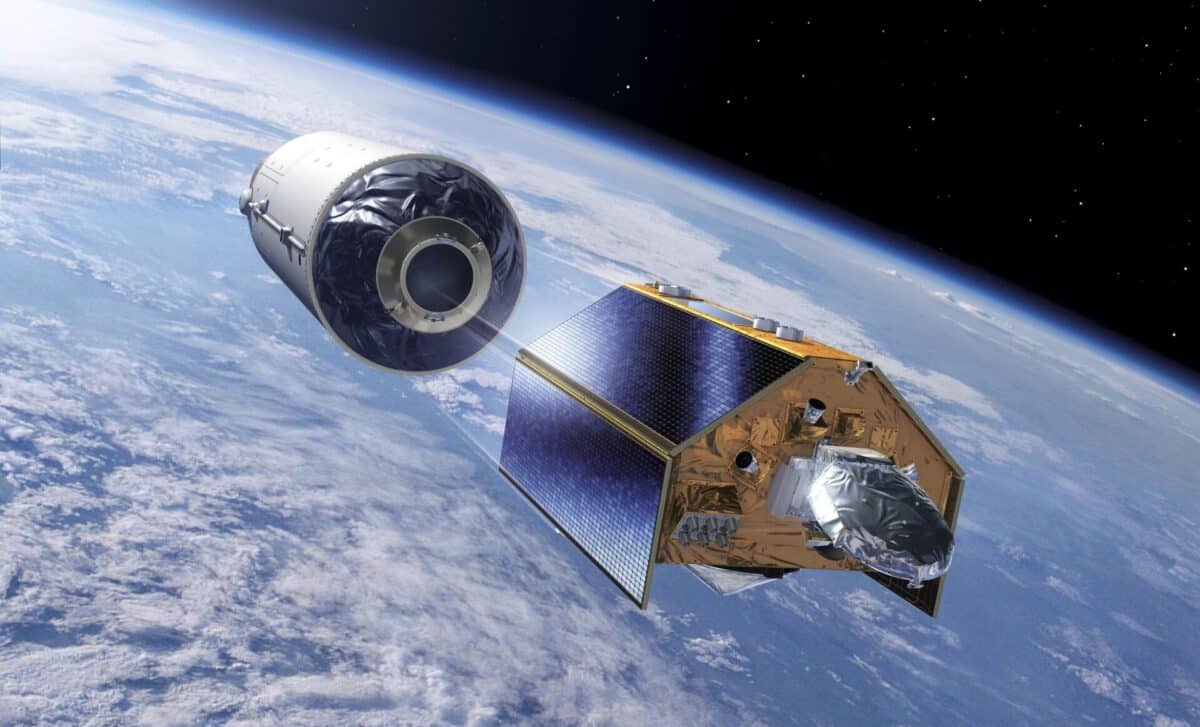
The Copernicus Sentinel-6B satellite has just delivered its first set of data. Launched in November 2025, the satellite’s initial images highlight sea level variations in the North Atlantic Ocean, continuing a mission that has become a crucial part of tracking climate change. This new data strengthens the long-term record of sea-surface heights, an essential indicator of the planet’s changing climate.
After reaching orbit just over a week following its November 17 launch, Sentinel-6B captured its first measurements on November 26. The mission, a follow-up to Sentinel-6 Michael Freilich (launched in 2020), is designed to provide the most accurate and up-to-date sea-level data ever.
Sea-Level Monitoring: A Key Tool for Climate Change Research
Sentinel-6B is a game changer in understanding one of the most pressing consequences of climate change: rising sea levels. As glaciers and polar ice sheets melt and oceans expand from warming temperatures, sea levels continue to rise, posing a serious threat to coastal cities, ecosystems, and infrastructure.
“This is the second launch for the Sentinel-6 mission, and I am very pleased to see that industry and agency teams have managed again to guarantee the essential continuity of the mean sea-level record, adding five years to the 35 years already accumulated,” said Pierrik Vuilleumier, ESA’s Project Manager for the mission.
According to ESA, the satellite’s primary mission is to keep track of these changes, providing data that builds on over 35 years of previous sea-level records. The importance of this ongoing data collection cannot be overstated. Rising sea levels are directly tied to climate change, affecting everything from global weather patterns to local coastal flooding risks.
By tracking sea-surface height with high precision, the mission supports decision-making for coastal protection, disaster response, and even maritime safety.
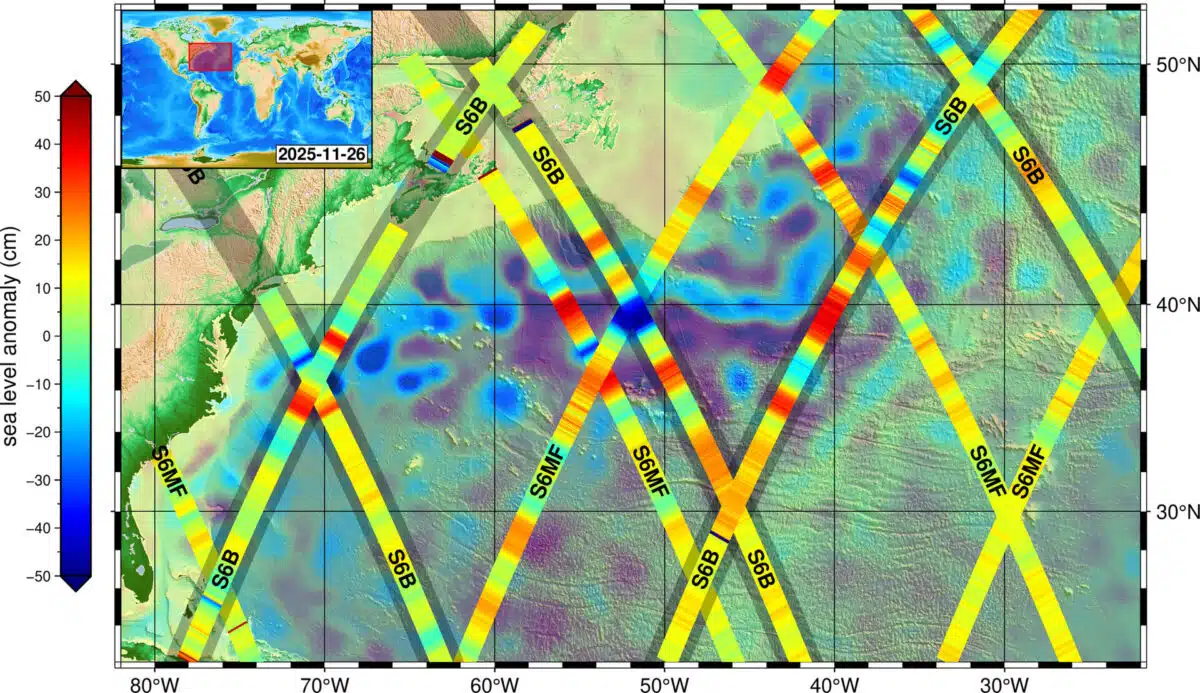 Sea-level measurements in the Gulf Stream, captured by Sentinel-6B. Credit: ESA
The Gulf Stream and Its Role in Climate and Marine Life
In its first data release, Sentinel-6B highlighted the Gulf Stream, a powerful ocean current that flows from the Gulf of Mexico toward the North Atlantic.
“The Gulf Stream is a hugely important area of the North Atlantic Ocean, not only for the role it plays in global weather patterns and climate, but also because it’s a busy shipping route as well as a key ecosystem for marine species and therefore an important fishing zone”.
What’s striking about this first image is how much clearer and more precise the data is, allowing scientists to track subtle changes in the Gulf Stream with much more accuracy than ever before.
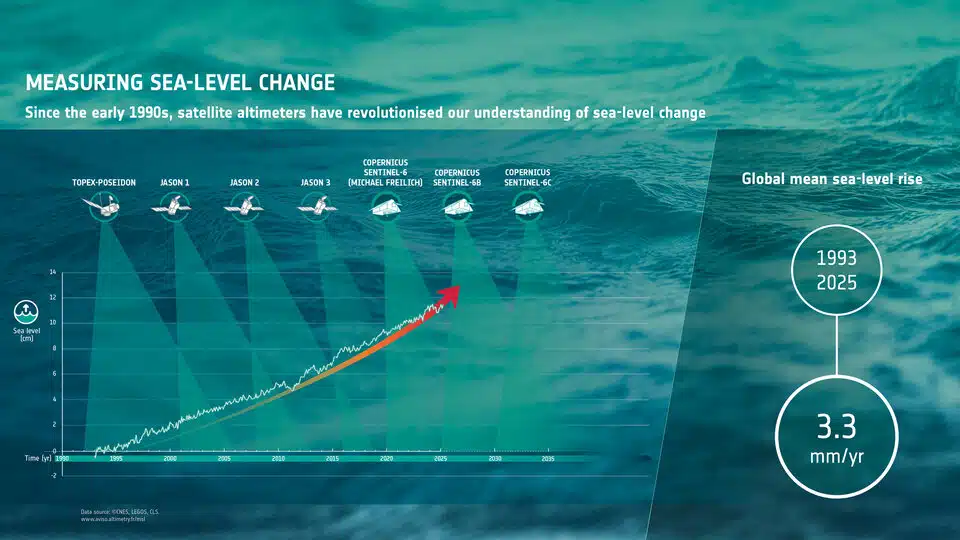 Sentinel-6B and other satellites show a consistent global rise of 3.3 mm per year. Credit: ESA
Cutting-Edge Technology Behind Sentinel-6B’s Success
The success of Sentinel-6B so far is due in no small part to its cutting-edge technology. At the heart of the satellite is the Poseidon-4 altimeter, a high-precision instrument that uses radar to measure the time it takes for pulses to travel from the satellite to Earth and bounce back. This process allows it to capture incredibly accurate sea-surface height measurements.
As ESA’s Mission Scientist for Sentinel-6, Alejandro Egido, points out that the early data has already shown great promise.
“It is very encouraging to see Sentinel-6B performing so well soon after launch. While the instruments will undergo a careful calibration phase over the coming months, the quality of the initial dataset is very promising. Once this phase is completed, the mission will be fully prepared to extend the sea-surface height measurement record through at least 2030.”
Researchers studying sea-level rise, the technological advancements aboard Sentinel-6B are a big step forward in obtaining the most precise data possible.