
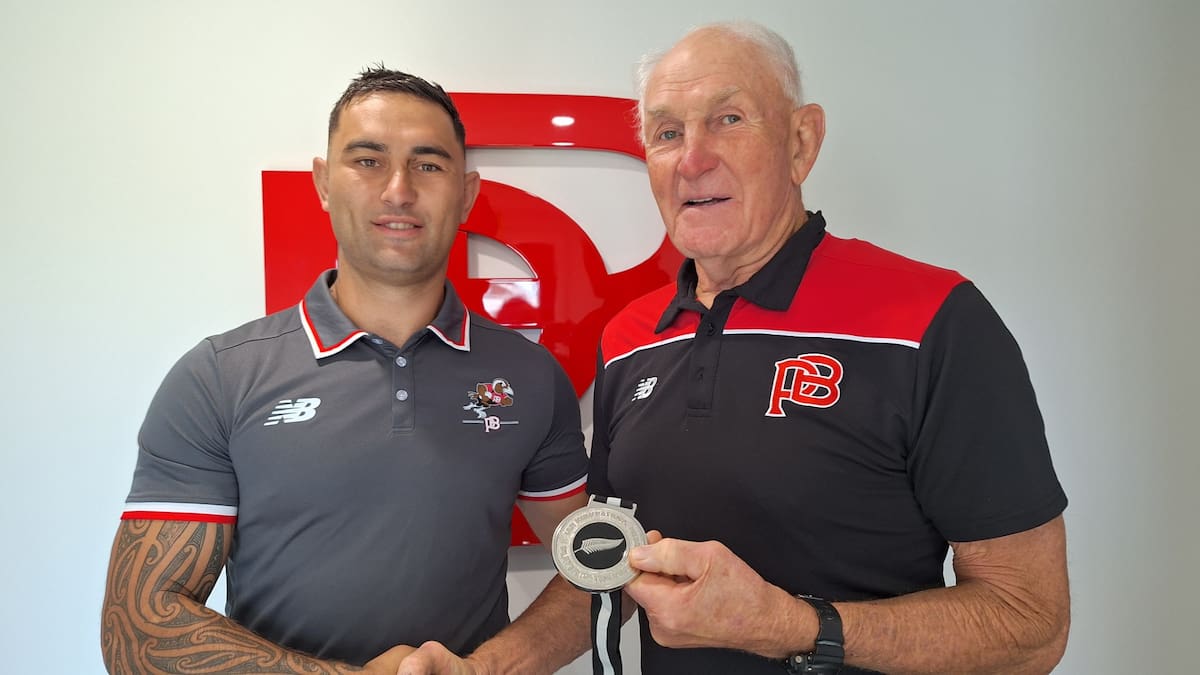
“You deserve it, mate,” Kirkpatrick replied.
The Ian Kirkpatrick Medal, presented since 2022 to the Heartland Player of the Year, goes to Poverty Bay’s Keanu Taumata this season. He is the second local player to win the award after East Coast halfback Sam Parkes won the inaugural award in 2022.
Taumata said he thought he had a chance of winning the Ian Kirkpatrick Award, which is decided by opposition teams granting points to the best three players in games during the Heartland season.
The Taupae club flanker said he thought he might have gained points in the Heartland matches against South Canterbury, Mid Canterbury and Horowhenua.
Taumata’s Heartland season ended prematurely with a back injury suffered in the final round-robin match against Wairarapa Bush.
He said he was getting back to full fitness, was no longer in pain and expected to be able to play when the 2026 Poverty Bay club season started.
Taumata won the Tūranganui-a-Kiwa Māori Player of the Year at the Poverty Bay Rugby Football Union awards, while Auckland University loan player and No 8 Uini Fetalaiga collected the treble of the Paul Sceats Memorial Trophy for Poverty Bay Heartland Player of the Year, the Erle Tucker for Most Valuable Player and Best Forward.
“Uini would have won everything if he was a Māori,” Taumata said.
Loan players are not eligible for the Ian Kirkpatrick Medal.
Taumata and Kirkpatrick both favour the loan player system, although there are critics who want representative teams to consist totally of local players.
Kirkpatrick said the loan players were “bloody good”.
Poverty Bay improved in 2025, from not winning a game in 2024 to finishing seventh among the 12 Heartland teams and qualifying for the Lochore Cup (fifth to eighth) playoffs.
“From last season, it was good to put a bit of respect back in the jersey,” said Taumata.
Kirkpatrick said Poverty Bay had formerly relied on a team of locals with some out-of-town former Bay players or former Gisborne Boys’ High School players, “but it had not really worked”.
However, he said, some other teams were flouting the rules.
Kirkpatrick referred to teams such as West Coast, who were deducted Heartland Championship points and fined for breaching player eligibility rules this year.
It was their third such breach in 15 years.
Both men said the system was difficult to police.
Kirkpatrick, asked to comment on the All Blacks, said the best players were being selected.
“It’s all about size now. At the moment, we are not good enough, we haven’t got the size overall. It’s a pity the game has gone away from being aerobic like rugby league is at the moment.
“The Boks’ ‘bomb squad’ comes on and it’s a completely different forward pack.”
Asked to provide some advice to next year’s All Blacks who will tour South Africa, based on his experiences from New Zealand’s 1970 and 1976 tours, Kirkpatrick said: “We were playing against the bloody refs as well.”
Four or five South African referees umpired the early tour matches, leaving the All Blacks to choose the ref to control the upcoming test.
“We picked one and he became a totally different ref [in the test].”
Kirkpatrick painfully recalled the fourth test of 1976, which the All Blacks needed to win to draw the series.
“We were clearly 15 points better than them.”
Kirkpatrick said the All Blacks could have been awarded two penalty tries – one was definite.
Of referee Gert Bezuidenhout, Kirkpatrick said: “I could have wrung his bloody neck.”
Kirkpatrick said Bedzuidenhout farewelled the team at Johannesburg airport before the team flew home after the fourth test. The referee apologised to All Blacks captain Andy Leslie and said: “I have to live here.”
Kirkpatrick said if he had known that, he would have “wrung his neck” at the airport.
The then-New Zealand Rugby Football Union declined an offer from South Africa to use neutral referees in 1976.
“That was the stupidest thing ever,” Kirkpatrick said.