

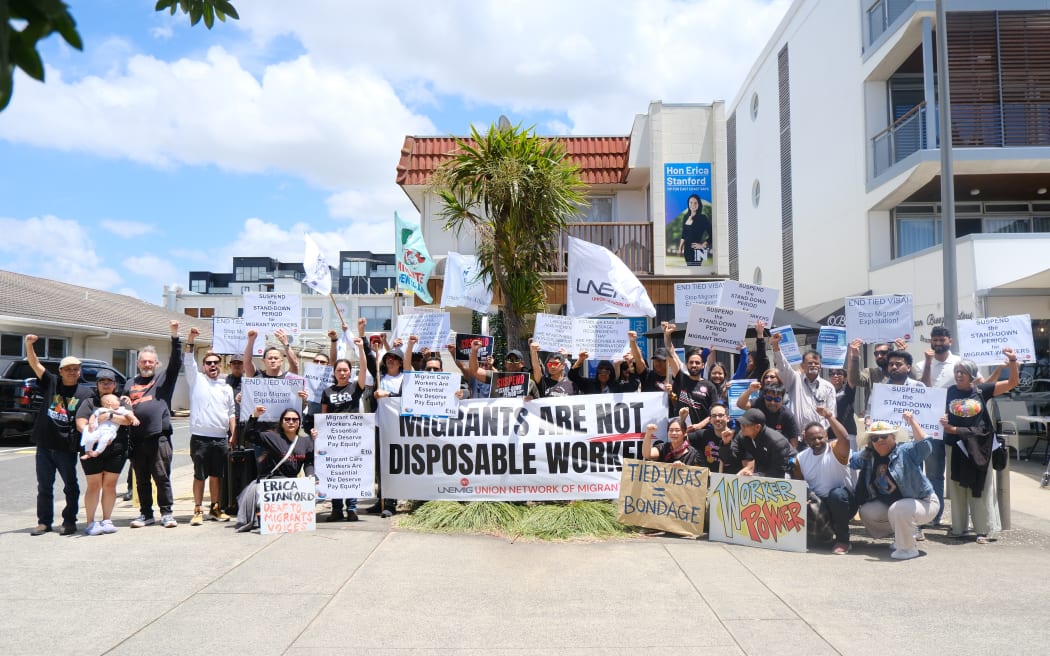
Dozens of protesters gathered outside Immigration Minister Erica Stanford’s Browns Bay office.
Photo: Supplied
Dozens of protesters gathered outside Immigration Minister Erica Stanford’s Auckland electorate office, calling out what they described as the “minister’s inaction on migrant exploitation”.
The demonstration on Thursday was organised by the Union Network of Migrants (UNEMIG) alongside groups including Migrant Workers Association NZ, Migrante Aotearoa, United Filipino Bus Drivers, Migrant Rights Network and International Migrant Alliance.
The protesters highlighted problems associated with New Zealand’s tied visa system which locks migrants to a single employer.
The gathering also highlighted the mandatory 12-month stand-down period for lower-paid Accredited Employer Work Visa (AEWV) holders, which they said forces some workers to leave New Zealand when their visa expires.
In 2024, the government made changes to the Accredited Employer Work Visa, but union advocates told RNZ the changes [ https://www.rnz.co.nz/news/chinese/542901/aewv-changes-may-prise-open-labour-market-but-exploitation-risks-remain] still left room for exploitation.
“We’ve organised a protest outside the immigration minister’s office not only to recognise the immense contributions of migrants, but also to highlight some of the harsh realities many migrants face due to our flawed immigration system,” president of the Union Network of Migrants Mandeep Bela said.
Bela said the current immigration system created a “profound power imbalance”, trapping workers in silence and fear.
“It is important that we don’t treat migrants as disposable labourers, as commodities or a cheap source of labour,” he said.
“It’s also important to treat them as humans, just like everybody else, and they should have the same rights with their employer.”
Former Labour MP Ibrahim Omer agreed.
“It is a no-brainer,” he said.
“As a migrant and former refugee I can say that visas tied to employers could lead to exploitation, and visas like AEWV shouldn’t be allowed as a tool for exploitation.”
Omer acknowledged most employers did not misuse the visa, but said a small number did, and that should not be allowed in New Zealand.
The protest came amid recent investigations highlighting migrant exploitation.
In October, a 59-year-old man was sentenced [ https://www.rnz.co.nz/news/indonz/576763/umesh-patel-gets-nine-months-home-detention-sentence-for-immigration-fraud] to nine months home detention, with six months of post-detention conditions, following a long-running immigration fraud investigation.
On Wednesday, a Hamilton woman received 11 months’ home detention [ https://www.rnz.co.nz/news/national/582118/hamilton-woman-who-exploited-migrant-workers-sentenced-to-home-detention] for exploiting three migrant workers and failing to pay them thousands in wages.
“Erica Stanford promised a lot to the migrant community while she was in opposition and now, she doesn’t even want to talk to migrants,” Omer said.
He added that New Zealand, as a country of migrants, had a responsibility to protect caregivers, bus drivers, hospitality workers and the wider migrant community from exploitation.
Bela also criticised the stand-down period for lower-paid AEWV holders, saying it uprooted migrant families and did not benefit workers or employers.
“It’s not good for the economy, it’s not good for businesses and it’s not good for the migrants either,” he said.
Protesters delivered a letter to the minister’s office in her absence.

Immigration Minister Erica Stanford.
Photo: RNZ / Mark Papalii
To be sure though, Minister Stanford had introduced the Immigration (Fiscal Sustainability and System Integrity) Amendment Bill, [ https://www.rnz.co.nz/news/indonz/568014/submissions-for-bill-criminalising-migrant-exploitation-set-to-close] early this year, which received royal assent in November.
“New Zealanders deserve an immigration system that is fit for purpose and responsive to risk,” Stanford said in November.
“This Bill delivers that by strengthening the integrity and flexibility of our settings and puts independent review recommendations into action like introducing safeguards for vulnerable people,” she added.
Stanford said the bill would also improve risk and protection settings and allow costs to be shared more equitably across the system.
The bill deterred exploitation by creating a new offence for knowingly seeking or receiving premiums for employment, whether in New Zealand or offshore, with penalties of up to seven years imprisonment or a $100,000 fine, the minister noted.
The government also tightened rules [ https://www.rnz.co.nz/news/indonz/531095/government-removes-ability-to-extend-migration-exploitation-protection-work-visa] for the Migrant Exploitation Protection Work Visa in October.
RNZ has approached Immigration Minister Erica Stanford for comment.
Sign up for Ngā Pitopito Kōrero, a daily newsletter curated by our editors and delivered straight to your inbox every weekday.