
 BBC
BBC

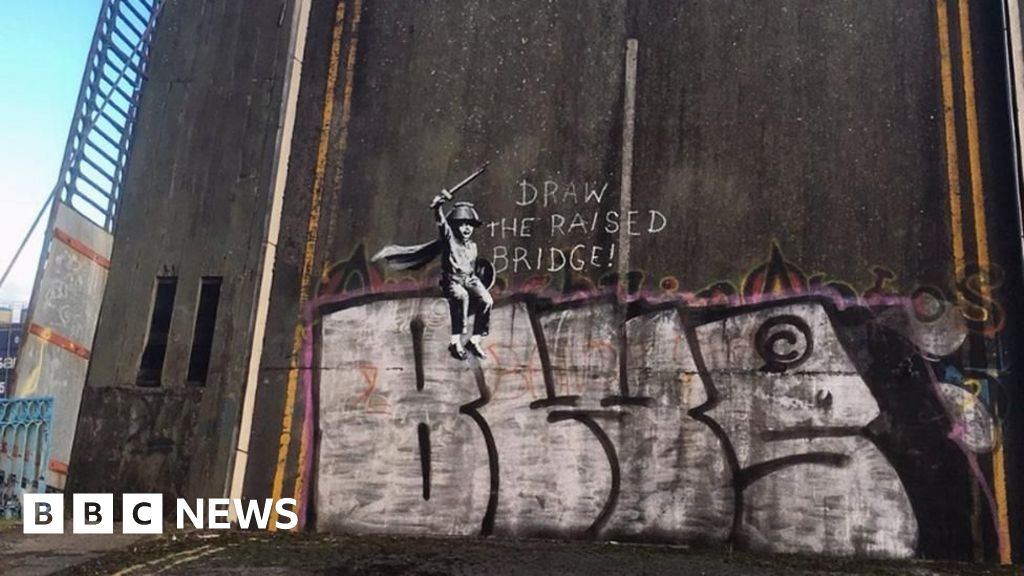
The artwork appeared on the disused Scott Street Bridge in January 2018
Nestled among factory buildings and warehouses, an inconspicuous metal fence stands between a cobbled street and the murky waters of the River Hull. There is nothing to suggest that this place was once the talk of the art world.
In 2018, the elusive artist Banksy paid a visit here to unleash their latest work on the disused Scott Street bridge, which was then where the fence now stands.
Within days of its appearance, the artwork was defaced and a protective screen was put over it by Hull City Council.
A year later, council officials cut away the painting, put it into storage and began to demolish the bridge.
Hull’s Banksy has not been seen in public since.
The stencilled design, which appeared in the dead of night, depicted a child wielding a wooden sword with a pencil attached to the end. Next to it was a caption that read: “Draw the raised bridge!”
“It was promised to go on public display and that was the whole point of it being cut down,” said Jason Fanthorpe who helped to clean the artwork after the vandals struck.
“They [the council] talked about it in 2023 but we’ve heard nothing since.
“It would be good to know where it’s stored and eventually where it’s going to be displayed.
“I hope it’s not been lost in some Indiana Jones-like warehouse full of priceless artifacts.”
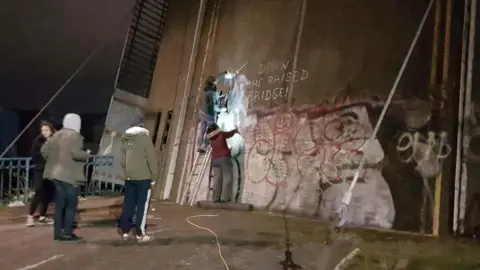 Jason Fanthorpe
Jason Fanthorpe was among volunteers who helped save the Banksy after it was defaced
Walking along Wincolmlee, it is hard to imagine one of the world’s most famous artists at work. The smell of spray paint from a nearby car repairers lingers in the air and industrial fans can be heard whirring in the distance.
There is graffiti, but it belongs to a legal open-air art gallery, which was set up in the wake of Banksy.
Nothing remains of the famous artwork here – just a gaping hole where the bridge once stood.
A small group of workers, taking a cigarette break nearby, offer little more than a shrug of their shoulders and a “don’t know mate” when asked if they know where the Banksy is.
In 2023, the council said it hoped to put the artwork on display in Trinity Market, which is home to independent eateries and stallholders and a regular venue for live music.
A year later, officials reiterated those plans and said surveys and reports were being carried out, but no further public statements have been made.
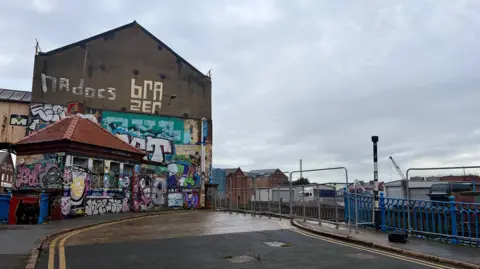 Richard Madden/BBC
A fence marks the spot where the bridge – and Banksy – once stood
The trail for Hull’s Banksy has gone cold. The only hint it still exists was provided by a council press officer who said it was being kept “in a secret location outside the city”.
In Hull’s trendy Humber Street, which has an art gallery and theatre among its restaurants and indie shops, people said the Banksy should be returned to public view “as soon as possible”.
Stepping out of a coffee shop, Davide, 47, remembered how the artwork “created such a buzz” when it was unveiled seven years ago.
“Hull needs good publicity. If we could have it back then it might attract more people and give another reason to visit,” he said.
Emily, 21, agreed and said art should be “seen and experienced”, adding that it was “nice to have something that not everyone has”.
“Give Hull its Banksy back,” she said.
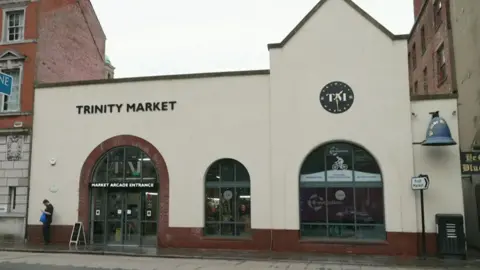
Trinity Market has been earmarked as an eventual home for the Banksy
In other areas of the UK, councils have preserved Banksy artworks to allow them to be enjoyed. In Bristol, the alleged birthplace of the artist, a stencil painting on the side of a boat was removed and is now in a museum.
So why would Hull’s council keep such an important piece of artwork in storage for such a long time?
Prof Paul Gough, who has written two books about Banksy, said the removal of the artwork had been a “shame” but was a “characteristic” of the artist’s popularity.
“In Hull, the city laid claim to the Banksy and had huge affection for it. It’s unfortunate [that it remains in storage].”
“It’s hard to value work in a public space, but it would be worth tens or hundreds of thousands.
“The location on the bridge was brilliantly positioned, funny and comical – for it to be taken away will have an emotional loss to the city.”
For now, Hull’s Banksy remains hidden from view with no sign of when it will be seen again.
So while the question most people ask about the mysterious artist is “who is Banksy?”, in Hull it seems “where is Banksy?” is more appropriate.