
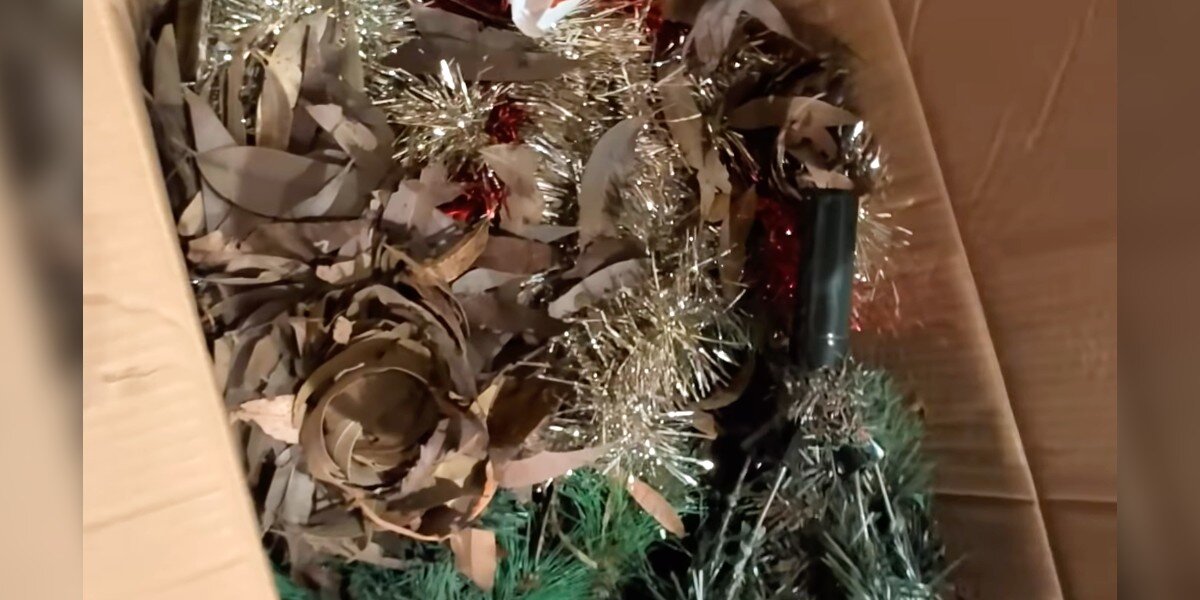
The other day, a family in Sydney, Australia, was carrying their artificial Christmas tree in from the garage when they noticed rustling sounds coming from the box. They weren’t sure who they were going to find inside, so they decided to call Hills Wildlife Sanctuary for help.
 Hills Wildlife Sanctuary
Ben Dessen, CEO of Hills Wildlife Sanctuary, figured a family of rodents had made themselves a nest inside the box. But when he arrived, he quickly figured out something more unusual was going on.
“[A]s soon as I sort of started opening the box, I could smell … that it wasn’t rats or mice,” Dessen told The Dodo.
 Hills Wildlife Sanctuary
Below a nest of gum tree leaves, small rodent-like babies were scurrying around. But Dessen knew the babies weren’t rodents — they were brown Antechinus, a rare kind of carnivorous marsupial.
 Hills Wildlife Sanctuary
“It’s a species that a lot of Australians have never heard of, let alone people around the world,” Dessen said. “If they do see them, they would just mistake them for a rat or a mouse.”
Unlike rodents, Antechinus have pointed snouts; small, round ears; short tails and sharp teeth they use to eat insects. They’re part of the dasyurid family of marsupials, along with Tasmanian devils.
As marsupials, when Antechinus babies are born, they live inside their mom’s pouch. These Antechinus babies, however, were about 2 to 3 months old and had recently outgrown their mother’s marsupium.
Dessen was surprised and delighted to come across the rare babies.
“I’ve worked with Antechinus over the years, but it’s not a species that you come across very often,” Dessen said. “They’re very secretive.”
Dessen knew the babies’ mother was close by, she’d just gotten spooked and ran away when the box was being moved. Dessen knew it was important for the family to be reunited and relocated as quickly as possible, so he came up with a plan.
 Hills Wildlife Sanctuary
With the homeowners’ permission, he gently transferred the Antechinus babies into a plastic bin with a ramp attached so the mother could get in. That way, the whole family could be safely moved outside together.
But the next day, Dessen found the entire family gone. He figured out that during the night, the Antechinus mama had brought her babies into the backyard and made a new nest there. Dessen was relieved — as a wildlife rescuer, his goal is always to help animals with as little contact as possible.
 Hills Wildlife Sanctuary
“Really, she relocated herself in the end,” Dessen said. “So it was a happy outcome.”
If you’d like to support Hills Wildlife Sanctuary, you can make a donation here. Couple Hears A Clatter On Roof And Finds Unique Animal ‘Enjoying The View’They needed expert help.