
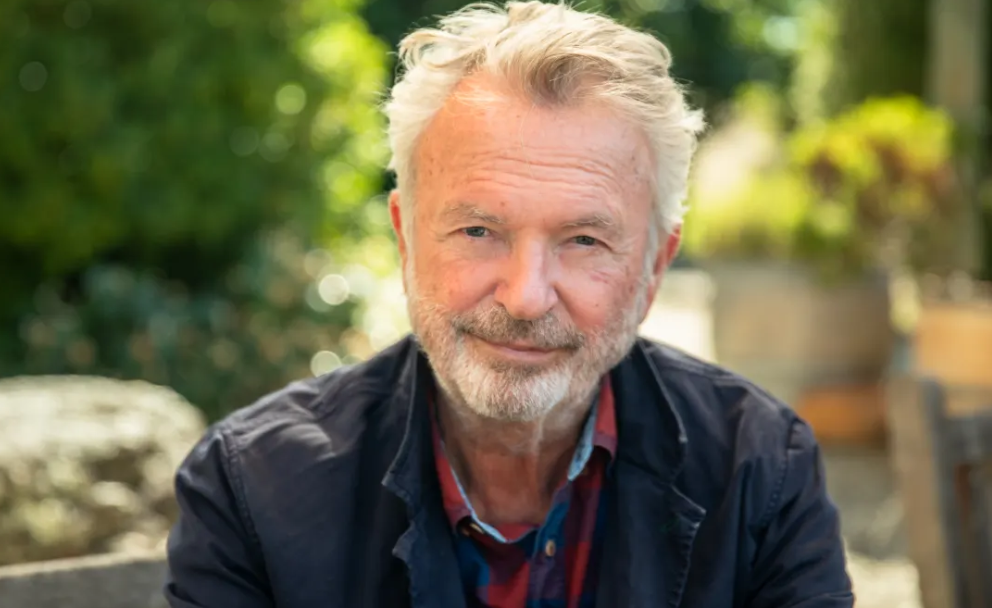
“The last thing I would ever, ever do is retire,” Sir Sam Neill says.
Recently named Screen Legend at this year’s New Zealand Screen Awards, the 78-year-old Central Otago actor says his 54-year (and counting) career still excites him.
“I love being able to go away, go home again too, but I love to go and work with some new people on new material.
“And I’ve always felt I’ve never actually gone to work. I go to play. It’s a very different thing. And to be able to do that for 50-something years is an immense privilege,” he told RNZ’s Nine to Noon programme today.
The Jurassic Park and Hunt for the Wilderpeople star remains baffled by his success and the industry accolades that have come with it.
“It does give you a chance to think back on the great good fortune I think my career has been, all the people I’ve worked with, and all the places it’s taken me, and also it’s given me the opportunity to live in the country that I love best, Aotearoa.
“I’ve had the best of all possible worlds really, I don’t know why I was so particularly lucky.”
It was Reilly, Ace of Spies, a 1983 British television hit that brought Neill, already established in New Zealand, to a world-wide audience, he says.
“That was good fun too… that made my career in Britain, so to speak, and got me attention in America.”
Since then, he’s played every type of role from The Omen -“I was very young to be playing the Antichrist” – to Cardinal Wolsey in The Tudor – “the great thing was that he was a rather rotund man, so I didn’t have to watch my diet in any way”.
His most recent role TV in courtroom drama The Twelve won the frustrated lawyer a Logie.
“I should have been a lawyer in another life. I wasn’t good enough for the exams and I was doing things like plays at university.”
But his character, Brett Colby is based on real life: “A couple of old barrister friends of mine from Christchurch, who love the sound of their own voice. And they’re sort of rogues too”.
There’s a natural overlap between an actor and a silk, he says.
“If you’re a good barrister, there’s an aspect of what you do that’s performative. There’s no question about that.
“And it helps if you can keep the jury awake. A little bit of performance, a little bit of entertainment, goes a long way, I think, in the court.”
Love of Central Otago
Central Otago, where Neill lives and makes award-winning wine, has a long family connection, he says.
“My great-grandfather landed there in 1861, about the time when the gold was discovered.
“And we’ve been there ever since. I was actually born in Northern Ireland because my father was 20 years in the British Army. But we went back to Otago, and I was effectively brought up in Dunedin.”
Family trips cemented his love for the region.
‘We used to go to Central Otago on our holidays, which I grew to dearly love, and I learned to fish up there. And one day, I always thought, this is where I’d love to live.”
He bought property there in the mid-1980s and embarked on a parallel career as a winemaker.
“I never meant to be an actor; I sort of stumbled into it by degrees. And the same thing happened with wine.
“I met a friend who said, ‘We’re planting some land down in the Gibbston Valley. We’re splitting it up into five vineyards. Would you care to come in on this?’ And I said, I would.”
He planted 2ha of pinot noir and Two Paddocks was born.
“We got our first vintage, and to my complete surprise the wine was very, very good. And that sort of brought on ambition.
“I thought, I want to be better and better. And it ended up being four vineyards gathered around the area, a bit like Burgundy, that’s what they do, people have little plots here and there, and I’ve got little plots here and there. They all produce very different sort of pinots.”
Bitterly against gold mine plan
Neill is bitterly opposed to plans for a gold mine in the area he loves.
“There’s a fellow called Shane Jones who’s in the government, I believe. He says we need to fast-track a mine because we need real working-class jobs for real working class New Zealanders.
“Well, we have so many jobs down there. It’s hard to find labour.
“And I wonder if they introduce this absurd mine, how many of those jobs will be affected?”
The approval process for the mine, which being fast-tracked, will have “serious ramifications for our area for hundreds of years,” he says.
He won’t be around for the “long-term consequences” of the mine, he says.
“But our children and their children will be stuck with this horrible, toxic thing forever.”
Meanwhile, healthy after treatment for cancer five years ago, there are some big projects (for which he’s “sworn to secrecy”) in the pipeline.
“I’m fully in remission and enjoying life. And to enjoy life, there’s nothing better than that… the alternative is a bit grim, really, isn’t it?”