

When director Aditya Dhar’s Dhurandhar was released in theatres on December 5, reports began to trickle in of block bookings over its first weekend.
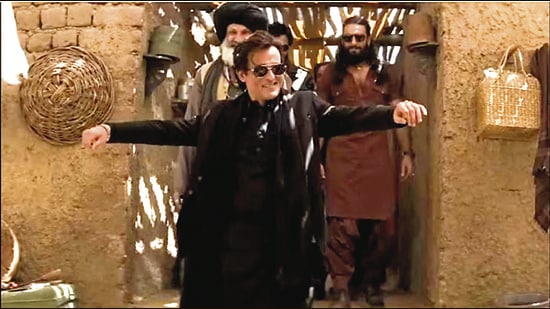 PREMIUM Akshaye Khanna as the gangster Rehman Dakait, being carefree and dancing to the song Fa9la.
“The story of the film is something like the hero infiltrating the terrorists but here it’s become about infiltrating the multiplexes and buying tickets,” the trade magazine Box Office India noted, while reporting that the film didn’t need such tactics. It was already garnering good word-of-mouth publicity, and seemed poised to make up for its lacklustre opening.
Dhurandhar really did gather steam. It is now set to be one of the biggest hits of 2025.
The film follows an Indian spy named Hamza (Ranveer Singh) who infiltrates a criminal gang in Karachi by posing as a lowly thug, and gets a ringside view of the blood-spattered turf wars in the notoriously violent neighbourhood of Lyari. He also sees first-hand the nexus between politicians, gang lords, military establishment and terror networks. All of which is a set-up for Part 2 of Dhurandhar, which is due out in March.
I imagine Hamza will go on a rampage in that instalment, but in this film, his victories are few. In its first part, Dhurandhar (Hindi for Stalwart) is about a hero forced to accept failure. His every move and every success is coloured by the fact that, in order to be India’s saviour, he must first be convincing as a Pakistani.
Set in the years following the IC 814 hijacking in 1999 and the 2001 attack on India’s Parliament, both by Pakistani terrorists, the film features a scene set amid the hijacking. A fictional character calls out “Bharat Mata ki…”, expecting the other Indians on board to finish the chant. Much to his shame, there is silence. The hijacked passengers would rather not anger the gun-toting terrorists holding them captive.
One of the ironies of Dhurandhar is that Hamza is forced to practise a similar brand of pragmatism, over and over. When he sees a suspected Indian asset being tortured, he must school himself not to react. When he finds himself in a room full of jubilant Pakistanis celebrating the November 2008 attacks on Mumbai, a devastated Hamza has no choice but to mouth their slogans in order to maintain his cover.
Wittingly or not, Dhurandhar occasionally makes space for complexity.
The politics of the film is akin to the discourse on certain WhatsApp groups, but skilfully adapted for the big screen, and backed by better research. Dhar is alert to the subtleties of such politics. For instance, he is careful to ensure that only Baloch characters get to be charismatic, among the Pakistanis (Balochistan has been home to separatist movements since the 1940s).
With the Pakistanis embodying hypermasculine villains and Dhurandhar being a set-up for its upcoming sequel, Dhar faces the task of creating a protagonist who will project strength and moral fibre despite being only a bystander. The plot demands that the hero blend in, but the grammar of popular cinema needs him to create a spectacle. Dhar compromises by making Hamza stand out, visually, in every scene. With his kameez-busting physique, Singh radiates masculinity and strength, despite his passivity. He uses weakness as a disguise and bides his time. Unfortunately, though, this does make him borderline forgettable.
In the end, the most memorable part of the film has nothing to do with the action, terror or testosterone. It is Akshaye Khanna as the gangster Rehman Dakait, being carefree and dancing to the song Fa9la (apparently spoken as Fashla, a Bahraini-Arabic word for “fun” or “party”). May we all have that energy, going into 2026.
(You can reach Deepanjana Pal @dpanjana on Instagram. The views expressed are personal)