
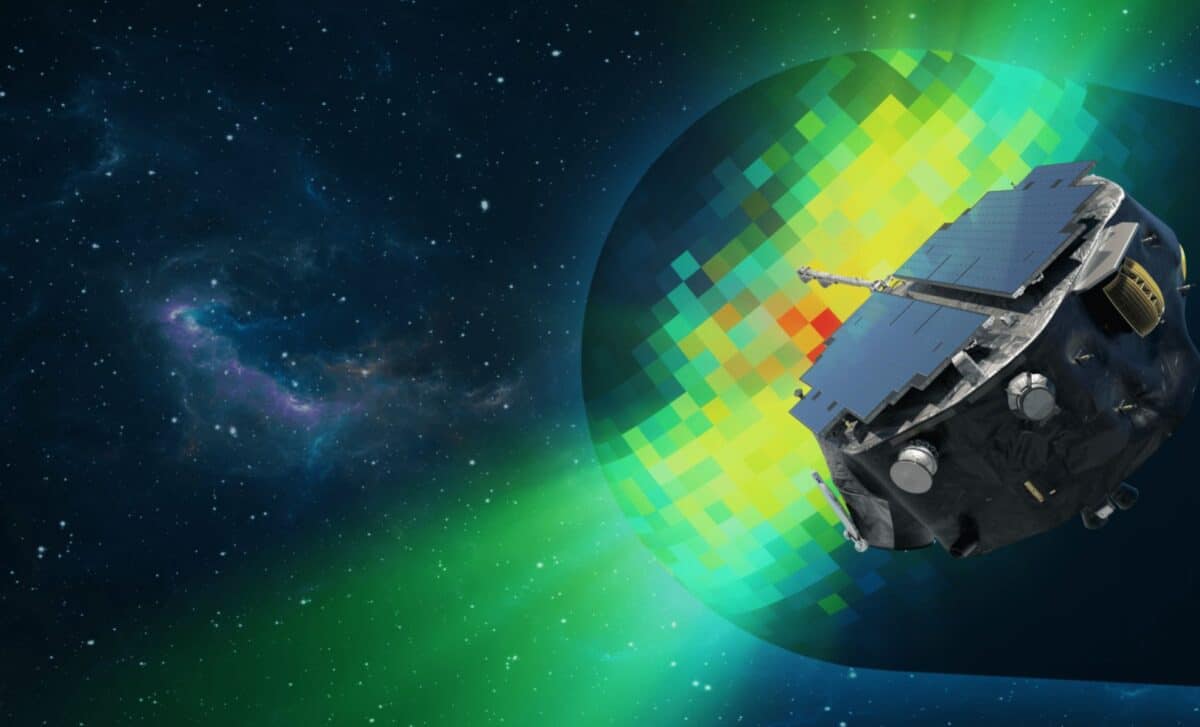
NASA’s Interstellar Mapping and Acceleration Probe (IMAP) mission has successfully captured its first light observations, marking a significant step toward unveiling the mysteries of space weather and the boundaries of our solar system. The spacecraft, equipped with 10 cutting-edge instruments, has already begun transmitting valuable data, setting the stage for its primary mission to study the heliosphere.
Currently, on its way to Lagrange point 1 (L1), approximately one million miles from Earth, IMAP is poised to provide crucial insights into the solar wind and the interaction between our solar system and the broader galaxy.
A Bold New Mission to Map the Heliosphere
Launched as part of NASA’s ongoing heliophysics program, IMAP is designed to chart the outer regions of the heliosphere, the vast bubble of charged particles created by the Sun’s wind. This mission is critical for understanding the dynamics of space weather, which can impact everything from satellites to astronauts in deep space.
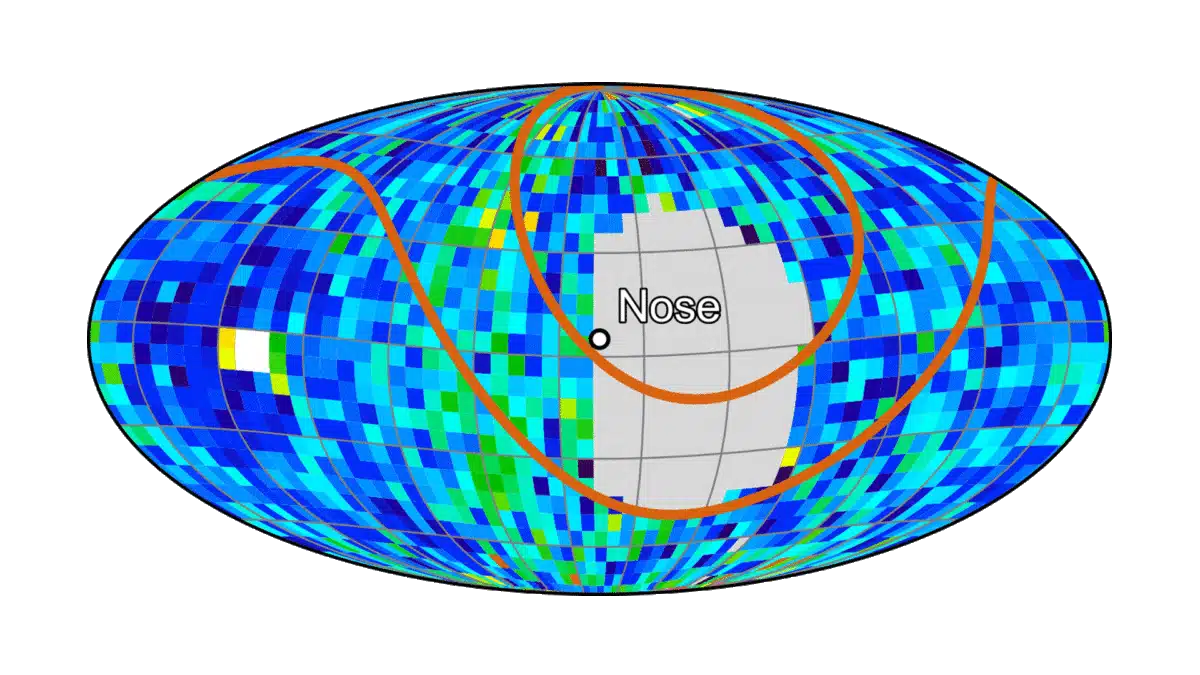 The first-light data from the IMAP-Hi, IMAP-Lo, and IMAP-Ultra instruments were used to compile these initial maps of the heliosphere’s boundaries. Credit: NASA
According to Brad Williams, IMAP program executive at NASA Headquarters, the mission has exceeded expectations in its early stages, with all instruments powered on and ready to begin their scientific work.
“ All instruments have successfully powered on, and our commissioning remains on track. We have already collected useful data including exercising our near-real-time space weather data stream.”
IMAP’s Mission to Map the Heliosphere
At the heart of IMAP’s mission is the task of mapping the boundaries of the heliosphere, which stretches far beyond the orbit of Pluto. As stated in the NASA’s statement, IMAP is equipped with three specialized instruments: IMAP-Lo, IMAP-Hi, and IMAP-Ultra, that are capable of detecting energetic neutral atoms (ENAs).
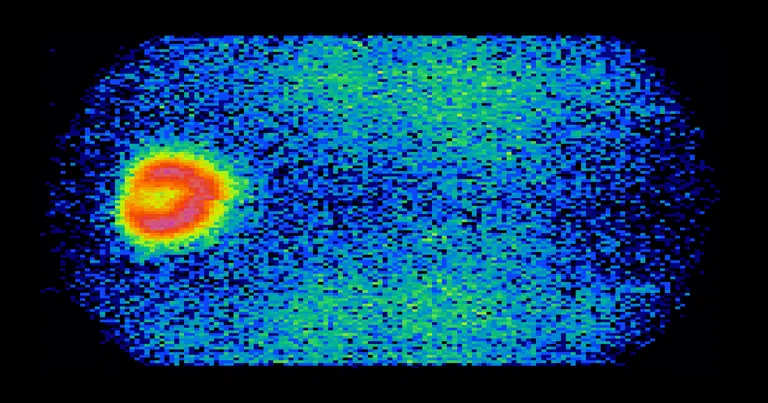 In this image from the IMAP-Ultra instrument, Earth’s magnetic environment shines brightly, with both ENA data and noise visible. Credit: NASA
David McComas, Princeton University professor and principal investigator for the mission, the first data gathered from these instruments has already provided clear and consistent ENA measurements across a vast range of energies.
“We see such clear and consistent ENA data across the factor of 10,000 in energy covered collectively by the three imagers,” he remarked. “This, plus excellent first light data from all seven of the other instruments, makes for a 10 out of 10, A-plus start to the mission.”
A New Beginning: Successful Commissioning at First Light
All 10 of IMAP’s instruments have successfully powered on, and the mission has passed its initial commissioning phase. This phase is crucial for verifying that the spacecraft’s instruments are functioning as expected before the mission enters its primary science phase.
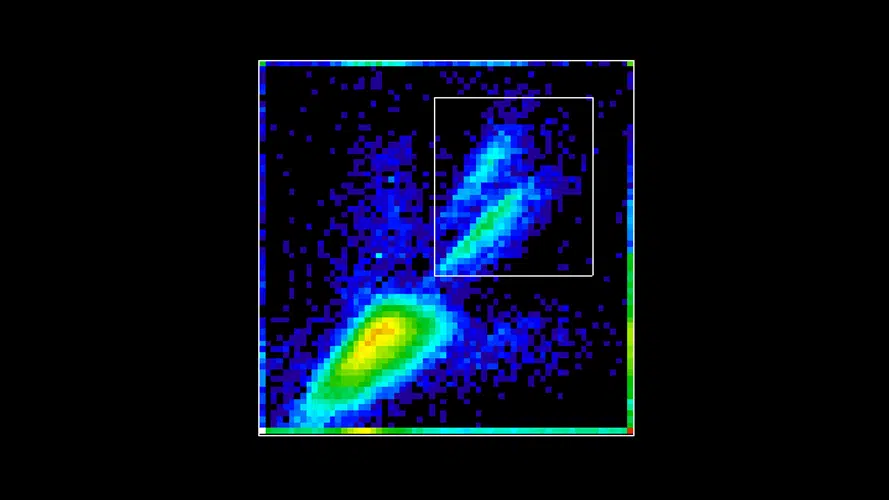 By using data from the three ENA instruments, scientists will be able to map the boundaries of the heliosphere. Credit: NASA
Brad Williams praised the performance of the instruments, noting that the early data, including solar wind measurements, is already contributing to space weather forecasts. The IMAP-Ultra instrument, which recently observed energetic neutral atoms generated by Earth’s magnetic field, is a prime example of the mission’s ability to capture important data.
These terrestrial ENAs are not the focus of the mission; however, they provide valuable context for understanding the spacecraft’s surroundings and the larger cosmic environment.
A New Dawn for Space Weather Monitoring
According to NASA, IMAP’s measurements will be integrated into the IMAP Active Link for Real-Time (I-ALiRT) system, which will provide advance warnings of space weather events. This system will offer crucial alerts to astronauts and spacecraft traveling through space, helping to protect them from harmful solar radiation.
This new NASA mission will get a whole new look at our home in space. 👀
The Interstellar Mapping and Acceleration Probe, or IMAP, will chart our heliosphere, the giant bubble encasing our solar system. The heliosphere is like Earth’s house in space: It shelters our planet from… pic.twitter.com/8jnBNq9YkI
— NASA Solar System (@NASASolarSystem) September 17, 2025
The mission is set to begin full-scale scientific operations by February 2026. Once fully operational, the spacecraft will start its primary mission of collecting data and advancing our understanding of the Sun’s influence on our solar system and beyond.