
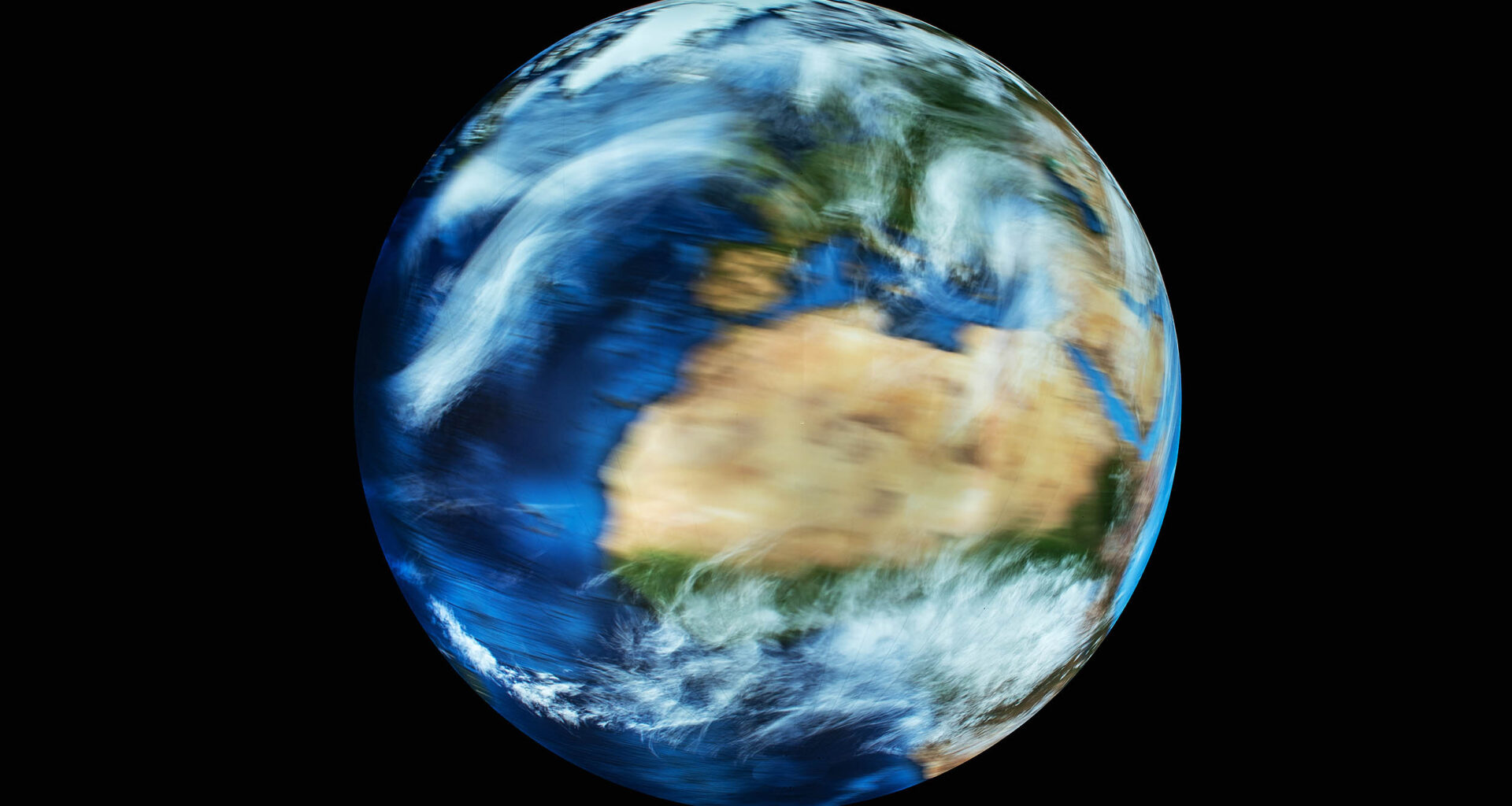
Billions of years ago, a day on Earth did not last 24 hours. New research suggests that for about one billion years, each day stayed fixed at roughly 19 hours because of a balance between the oceans, the atmosphere, and the pull of the Moon.
Normally, Earth’s spin slows very gradually as tides raised by the Moon sap rotational energy, so day length creeps upward over time.

A NASA overview estimates this process lengthens each day by roughly two thousandths of a second per century.
Earth’s rotation and day length
Earth’s rotation is constantly being nudged by different forces, and the most important of these are ocean tides that create tidal friction, a slow drag from moving water that steals spin from the planet.
Over very long timescales this drag should make the day steadily longer, like a slowing flywheel.
The work was led by Ross Mitchell, a geophysicist at the Institute of Geology and Geophysics at the Chinese Academy of Sciences (CAS).
His research focuses on how Earth’s rotation and orbital cycles recorded in rocks shape the planet’s long-term climate history.
To test whether day length really changed smoothly, Mitchell and a colleague pulled together a global compilation of dozens of ancient day length estimates from sedimentary rocks covering the past 2.5 billion years.
Many of these rocks preserve patterns linked to a method called cyclostratigraphy, which is a way of reading repeating rock layers that reflect regular changes in Earth’s orbit and spin.
Those patterns revealed that Earth’s rotation history is far from simple. Instead of a steady slowdown, the data show long plateaus where the length of one Earth day barely changed.
This was separated by periods when Earth’s days lengthened more quickly, hinting at episodes of tidal resonance – a special balance where different tidal forces cancel so the spin rate stalls.
Stuck at 19 hours
One plateau stands out in the new record. Between roughly two and one billion years ago, many independent rock records cluster around a day length of about 19 hours, while older and younger rocks point to markedly different values.
“Earth’s day length appears to have stopped its long-term increase and flatlined at about 19 hours roughly between two to one billion years ago,” said Mitchell.
The explanation lies in the tug of the Moon versus the push of the Sun. In addition to ocean tides, sunlight heats the upper atmosphere each day and raises atmospheric tides, global pressure waves in the air that can gently speed up a planet’s rotation instead of slowing it.
When Earth spun fast enough that the timing of these atmospheric tides lined up just right with the 19 hour day, their push could match the Moon’s braking effect.
At that resonant point, the opposing torques nearly canceled, so the usual slow lengthening of the day paused for an extraordinarily long stretch of time.
Tiny microbes and rising oxygen
During that same era, most of the planet’s oxygen was produced by photosynthetic microbes living in layered cyanobacterial mats, carpeting shallow seafloors as slimy communities that released oxygen during the day and consumed it at night.
The balance between how much oxygen escaped and how much was used up depended on how long daylight lasted.
In laboratory and modeling work, Judith Klatt and collaborators tested how different simulated day lengths affected oxygen release from modern microbial mats that stand in for ancient seafloor ecosystems.
They found that when Earth’s day was shorter than about 16 hours, the mats actually removed more oxygen than they added, but longer days allowed increasing amounts of oxygen to leak into the surrounding water.
If days stayed locked at about 19 hours for a billion-years, that would limit how much extra oxygen these mats could contribute, helping explain why global oxygen levels seem to have hovered at modest values through much of this interval.
Once Earth escaped resonance and the day began lengthening again toward 24 hours, the extra daylight gave photosynthetic communities more time each day to pump oxygen into the oceans and atmosphere, setting the stage for later booms in complex life.
Earth days and core wobbles
The ancient 19-hour plateau plays out over billions of years, but Earth’s rotation still changes in smaller ways on human timescales.
Atomic clocks reveal that the length of a modern day can drift by a few thousandths of a second from year to year as winds, ocean currents, and the deep interior all exchange angular momentum.
An earlier study analyzed precise measurements of Earth’s rotation between 1962 and 2012, then subtracted the effects of the atmosphere and oceans to see what remained.
The cleaned signal showed that remaining day length variations longer than a year could be largely described by just two features.
The model shows familiar variations over decade-long periods and also resolves changes that occur over spans of one to ten years.
This particular study also found a regular 5.9 year oscillation and sudden jumps that occur at the same times as sharp changes in Earth’s magnetic field. Geophysicists call these events “geomagnetic jerks,” which are brief shifts in the field produced by flows in the liquid outer core.
Earth’s rotation and day length
These links suggest that slow surges and sloshes of molten metal deep inside the planet slightly speed up or slow down Earth’s spin, subtly stretching or shrinking the day by fractions of a millisecond.
The study is described as having fundamentally changed the understanding of short-period dynamics in the Earth’s fluid core.
It also suggests that the solid lower mantle conducts electricity poorly, which limits the interaction between the moving core and the mantle and provides new insight into the deep interior.
The same planet that once spent a billion years with 19 hour days still carries that history in its rocks and microbes, and its present day heartbeat is written in millisecond wobbles driven by the core.
—–
Like what you read? Subscribe to our newsletter for engaging articles, exclusive content, and the latest updates.
Check us out on EarthSnap, a free app brought to you by Eric Ralls and Earth.com.
—–