
CRL Te Waihorotiu – night time exterior of CRL’s Te Waihorotiu Station in central Auckland showing unique Māori design
A quarter of the way through the 21st century, how’s transport planning in Tāmaki
Makaurau? Patrick Reynolds asked the question at a breakfast meeting this month put on by the Urban Room.
His answer? Much better than people seem to think.
E-buses are “a great thing for anyone who enjoys breathing”, he said. And the frequent bus network, often overlooked or ignored, is “the best in Australasia”.
But he also said that when we build infrastructure in this country we suffer from “extreme rich country behaviour”, because we’re too scared to make hard decisions.
Reynolds used to sit on the Waka Kotahi board, but when the new Government changed the name back to NZ Transport Agency it also pulled the board seat out from under him. He stood unsuccessfully for council in the recent elections.
The Urban Room promotes discussion about the ways urban planning and design can build a better city. Founder Ben van Bruggen reckons that when they had a shopfront on Quay St last year, he had a thousand conversations about what downtown needs. The main themes: the street trees are great, there should be more to do that isn’t shopping, and people feel safe.
Reynolds had a lot to say. We shouldn’t think of the CRL and the rail network as a thing on their own, he said, but as part of an evolving transit network involving rapid busways, ferries and, who knows, perhaps even light rail one day. The rapid transit map below shows services that will one day reach all parts of the city.
Auckland Transport’s new map showing how the City Rail Link will transform the rapid transit network in the city.
Just as important, though, is the much more comprehensive Frequent Transit Network. This is already “almost unimaginably good … not just in patches, but nearly everywhere”.
Throughout the city now, it has buses running at least every 15 minutes, seven days a week, from 7am to 7pm, and those buses are often electric.
Auckland’s Frequent Bus Network.
“It’s easily the most comprehensive, effective and efficient in any Australasian city … It’s been cleverly improved through near-constant evolution by some very smart, very dedicated people, and supported by wise funders and elected members.”
He gave the council a shout out for establishing a Climate Action Targeted Rate and using it to buy e-buses and improve bus services. Former mayor Phil Goff introduced that; Wayne Brown has maintained it.
The success of the Frequent Transit Network, Reynolds said, “is still something of a secret, but is starting to break through”.
“Significantly,” Reynolds said, the network means “our city is ready for the best tool to manage the scourge of traffic congestion: road pricing, known officially as Time of Use Charging”. Also called congestion charging.
To everyone who says we can’t put tolls on city roads without providing better public transport, Reynolds’ response was: Look at that map. It’s already here.
He added that public transport on its own won’t solve the problem. “For only with sticks can carrots truly work.”
His point: Driving cannot remain as incentivised as it is. That’s why those tolls are important.
And yet, Reynolds said, transport planning still has its blind spots. One of them is cycleways.
“As many people now cycle into the city as come by ferry,” he said, “but at a tiny fraction of the cost”. It’s not an argument against ferries, but it is an argument to take cycling more seriously.
“It’s the most underdeveloped transport network of all.”
And why are new transit projects like the Eastern Busway, Labour’s now-abandoned underground light rail and the now-being-planned Northwest Busway so expensive? Te Waihanga, the Infrastructure Commission, has told us infrastructure costs in New Zealand are the highest in the world.
Reynolds’ answer: “Because they are not transforming existing road space, but are on new alignments, often requiring significant land acquisition and massive new structures.”
He called this “extreme rich-country behaviour”.
“We are not having hard conversations here,” he said, “especially around climate. We are attempting to fully indulge everyone. We are trying to do it all. I see this everywhere at the moment: we seem to live in an age that believes it can avoid trade offs. Is this realistic? Have your fossil fuels and eat them too?”
Why aren’t we better at this? Why don’t we understand the good things we’ve already done? Why isn’t there more political will to keep doing better?
“Some people live largely in last century’s city,” he said. “Perhaps ignoring the new city sprouting up around them, perhaps dipping in and out of it. This is to be expected. This is how change happens.”
But others, he said, “live entirely in the old world, determinedly unchanging”, viewing anything outside the car-focused norm as ”an incomprehensible outrage, a bafflement, as something no one sensible could want”.
And it’s these people who overwhelm public debates on transport and urban progress. Stuck in a car-dependent mindset, they find cities of the 21st century “inexplicable”, so they resort to “conspiracy and culture-war framing”. They decide the problem is wokeness, which is “always described as an appalling waste of money, their money, of course. This leaves them ranting and muttering at each innovation witnessed through their windscreen.”
Some of this group, said Reynolds, are politicians. Some are in the media.
So what now? Reynolds thinks the hardest part has already been done: the essential framework for a highly functional city is in place. Now we have to make it work.
He quoted the pioneering social-democratic economist John Maynard Keynes: “The problem isn’t in the search for new ideas, it’s in getting away from the old ones.”
He also quoted the traditionalist historian Thomas Carlyle: “Go as far as you can see; when you get there, you’ll be able to see farther.”
Thanks for all the fun, Wayne
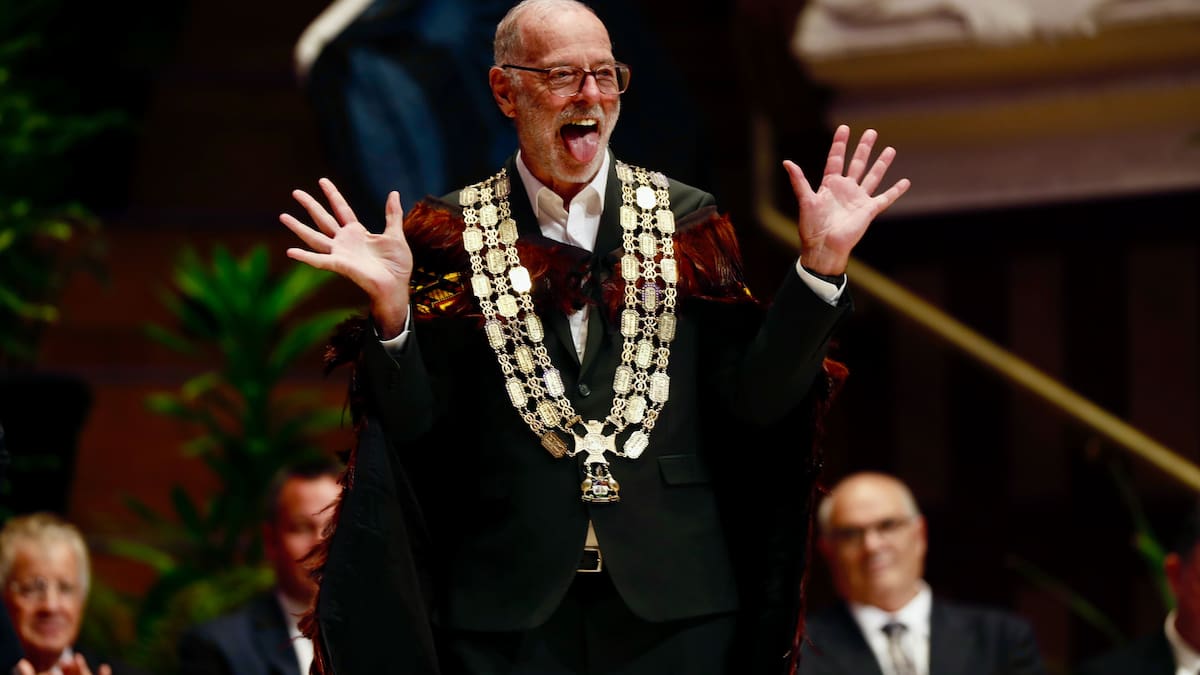
Auckland Mayor Wayne Brown with the open-air seawater pool he calls “Brownie’s Pool”, at Karanga Plaza in the Wynyard Quarter.
Mayor Wayne Brown walked into the NZME offices this week, home to the Herald and NewstalkZB. I’ve been told the first thing he said was, “Where does Simon Wilson sit? I want to punch him in the face.”
Apparently, he objected to my calling him idiotic in my column this week. I said it because he wants to turn the wharf around the Viaduct Events Centre, right next to “Browny’s Pool”, into a car park.
“I’m not an idiot,” he texted me later.
He said, “My point is, use it, any way is better than leaving it empty.”
I told him the wharf isn’t “empty”. It’s part of the open space people enjoy on the waterfront. If we want more activities there, fine, bring it on, but car parking won’t help with that. Cars will ruin it. What was he thinking?
I asked him about punching me in the face, but he didn’t answer.
I know, he was just having a bit of fun. But is it fun? I’m retiring from the Herald this week and this is my last newsletter. Many things I will miss, some I won’t.
Papatoetoe will vote again
Vi Hausia, who took a claim to the Manukau District Court over the Papatoetoe Local Board election, and won.
Papatoetoe will get a new election for its local board.
The judgment in the case I’ve been reporting on was released this week, with Judge Richard McIlraith finding “irregularities that materially affected the election result” for the Papatoetoe subdivision of the Ōtara-Papatoetoe Local Board.
McIlraith “voided” the election, which means a new one will need to be held by April 9, 2026.
The case arose when the board’s former deputy chairman, Vi Hausia, lodged a petition against the chief electoral officer, Dale Ofsoske.
Hausia alleged widespread theft of voting papers, fraudulent use of stolen voting papers and other “irregularities”.
After McIlraith released his decision, Hausia said the court had “ruled in favour of democracy and electoral integrity”. He called the decision “a reminder that democracy is not a given but a privilege”.
Auckland Council chief executive Phil Wilson told the Herald the case was an isolated incident and assured Aucklanders that council elections have delivered “robust results for many years”.
It’s not clear why he would think that. Hausia’s lawyer Simon Mitchell KC argued there was enough evidence of fraudulent voting, especially in the use of stolen voting papers, to suggest the practice may have been widespread.
When voter turnout is low, Mitchell told the court, it’s possible thousands of papers could be stolen from letterboxes with their intended recipients never being aware it had happened.
Hausia’s diligence meant this was exposed in Papatoetoe, but at this point no one knows if the problem is wider.
Nominations for candidates in the new Papatoetoe election will open on December 31 and close at midday on January 28. The vote will be conducted using the same postal ballot method.
“While the battle has been won,” said Hausia, “the war to strengthen our democracy is not over. The postal ballot voting system must end.” He’s dead right about that.
The road cone comedy
Too many cones? How much does it even matter? Photo / Jason Oxenham
Workplace Relations and Safety Minister Brooke van Velden announced this week the Government was shutting down its “road-cone hotline” because, she said, it had “met its objectives”.
To be fair, if the objective was performative populism, that is true. But if they wanted to reduce unnecessary regulations, help with road maintenance or improve safety, not so much.
As Labour’s transport spokesman Tangi Utikere noted, 93% of complaints on the hotline were about cones being used legitimately.
This hotline idea came from Simeon Brown when he was transport minister, but the incumbent, Chris Bishop, has never seemed keen. When he announced in July that there would be new rules for traffic management, he didn’t mention it. When van Velden announced its closure, Bishop was nowhere to be seen.
Auckland Mayor Wayne Brown has also been a noisy compainer about road cones, so I was curious to know how Auckland Transport’s approach to the issue compared with the Government’s. Very different, it turns out.
Tracey Berkahn, who coordinates work on the roads, told me that last month AT did a complete sweep of the local road network “looking for pieces of temporary traffic management [TTM] equipment left behind”.
They picked up more than 15,000 “redundant” cones, signs and other bits of equipment on 8000km of road. But they also left 5500 items where they found them.
Berkahn said there were three reasons for this. Some were cones protecting a hazard (perhaps originally following an emergency) but no one had ever come back to fix the hazard. Some were on private property. And about 30% were left “because a member of the community insisted on their remaining and it was unsafe for the contractor to remove the gear”.
“Some people are very attached to their cones or passionate about keeping them,” she said. The contractor trying to remove them “was sometimes the target of aggression and threats from members of the public who did not want the equipment [mainly cones] removed”.
Who knew? Some people really love the cones.
Berkahn said it’s an ongoing job and there will be another audit next year.
The ridiculous, giganticulous, secret life of Rons
Wayne Brown has called out the Government for the cost of its Rons projects. Inset / NZME
Te Waihanga, the Infrastructure Commission, has called for more transparency in infrastructure spending. Fair enough: we should be debating robustly where and how the money’s being spent, right?
After all, the Ministry of Transport says the Roads of National Significance (Rons) alone will cost an estimated $56 billion, nearly 90% of which is not budgeted. It calls the Rons programme “the most complex and expensive infrastructure programme in New Zealand’s recent history”.
Development of SH1 from Warkworth to Whangārei alone will cost $15.3b to $18.3b, which Te Waihanga says equates to 10% of the country’s entire likely infrastructure spend over the next 25 years.
Ridiculous? These numbers are giganticulous.
Will all the spending be worth it? We don’t know. Almost no financial information is available, and if you ask for it, you don’t get it.
The MoT and the NZ Transport Agency have just “released” several documents on the Rons, in response to an Official Information Act request from Greater Auckland. Almost all the information in them is redacted. Even the names of some of the documents are hidden.
The MoT does say: “The Rons projects are relatively low value for money with all BCRs [benefit cost ratios] below 3, and many below 1.” A BCR is an assessment of the net financial return: a BCR of 1 means a $1 return for every $1 spent.
The MoT won’t reveal individual BCRs for most of the roads, but it’s not hard to read in the documents a lack of official enthusiasm. “Funding the full Rons programme will require significant additional revenue and trade-offs, and will be difficult to deliver on time and on budget due to market capacity constraints,” it says.
Is this true for the Auckland Rons? What will their benefits be? Can’t tell you.
There are four Rons in Auckland, five if you include the SH1 alternative to the Brynderwyn Hills. Here’s how they break down in the OIA documents:
SH1 Warkworth to Te Hana: BCR, cost, delivery method, funding source, indicative start date, risks: all redacted. SH1 Brynderwyn Hills alternative: No BCR, cost redacted. Mill Rd stage 1, paralleling SH1 from Papakura to Drury: BCR and cost redacted. East-West Link from Penrose to Onehunga: No BCR; cost redacted. SH16 northwest alternative highway: No BCR, cost redacted.
Wayne Brown isn’t happy. He’s worked out the cost of the proposed four-lane highway from Warkworth to Whangārei (which includes three of the Rons) will be $200m to $240m per kilometre, or $200,000 to $240,000 per metre.
“This is an extraordinary cost,” he says. The Pūhoi to Warkworth highway cost only a third of that ($73m/km) and even that was “ridiculously expensive”.
“We need to look at options that are affordable,” Brown says. “The country can’t afford to build transport projects that are this expensive.”
I think he’s right, and not only because of what it does to the Government’s books. As the previous Government discovered with light rail, if you choose the most expensive way to build something, you make it likely it won’t be built. And you wreck your credibility in the process.
It’s astonishing just how rogue this whole Rons process has gone.
If project costs are kept secret, how do we have a meaningful debate about their value?
As the OIA documents reveal, if the Rons are built as planned, they will double the cost of maintenance and renewals of the entire state highway network. Projects we can’t afford to build become projects we can’t afford to maintain.
And Te Waihanga itself has pointed out that the Rons don’t even align with the draft National Infrastructure Plan. It recommends a decrease in state highway spending “mainly due to slow growth in population, income and the need to decarbonise”.
It’s the NZTA board that has to juggle this formidable growth in costs. What does it think?
Who would know? The board, which usually meets every four to six weeks, hasn’t published any minutes of its meetings since May. Why not?
Another vote of confidence: Pascoes on Pitt St
Beca House at 21 Pitt St. The business occupied it for more than a decade. Photo / Google Maps
We’re doing it because of the CRL, said Anne and David Norman, announcing their company James Pascoe Group has bought the enormous empty building on the corner of Hopetoun and Pitt streets.
Formerly the home of engineering consultancy Beca and before that of the Auckland Regional Council, it will now be redesigned as the headquarters of Whitcoulls, Farmers and the other companies owned by Pascoes.
“We believe the City Rail Link will be a game-changer, with the Karanga-a-Hape station only metres away from the building,” said David Norman. Karangahape Rd is also busy with buses.
Hundreds of staff will be relocated to the building, probably in about two years when the reno is finished. “This will encourage the use of public transport,” Norman said.
This is how a city grows.
The plan change palaver
PC120 aims to boost density in the suburb of Mt Eden, but not up on the maunga. Photo / Getty Images
Public submissions on Plan Change 120 close at 5pm today. There’s still time to get something in!
PC120 is the proposal for more high-rise around key train stations and town centres, better flood-risk planning and less density in most suburbs. Around 4500 submissions have already been received.
That number is almost twice as high as the 2400 received for Plan Change 78 in 2022, which would have allowed almost all sections to be divided in three, with three-storey dwellings built on each new section.
But it’s only half as many as the 9400 received in 2013 over the Auckland Unitary Plan, the Super City’s first big unified district plan.
“There has been a strong level of community engagement in this process,” the council’s planning and consenting boss, John Duguid, told me. It “goes to show the value communities place on shaping their local areas and Auckland’s future”.
What happens now?
“An independent hearings panel will oversee hearings on all submissions, and make recommendations to the council. The council will make decisions based on those recommendations, expected in mid-2027.”
Nothing for another 18 months. By which time the CRL will be open and we’ll have had a general election.
What now for the City Centre Masterplan?
Quay St near the Ferry Building and Commercial Bay. Photo / Auckland Council/Jay Farnworth
In that Urban Room talk (see above), Reynolds had some other things to say about Auckland today. He pointed out that Te Komititanga Square, at the confluence of the Waitematā railway station, Commercial Bay shopping mall and ferry terminals, with the downtown bus terminals nearby, has become “an actual real city square … a well-designed grand communal space that has instantly worked from the moment it opened”.
“The Edwardian edifice of the re-purposed Central Post Office is a public building that looks like a public building,” he said, with a new public use, adorning a public space. People flood this space naturally, doing everything and nothing. Te Komititanga and Waitematā station together are an object lesson in world-class civic reinvention, through the marriage of well-planned public services, infrastructure delivery and high-quality design.”
He said the “very conscious te eeo Māori branding of these important new places” was “clever and valuable”.
“Particularity is essential in public goods. Be more Auckland. Sameness plagues the contemporary built environment. What differentiates Auckland from Aakron, or Adelaide? There is nothing that can more authentically differentiate Tāmaki from other cities around the globe than foregrounding this land’s first language and culture.
“Especially as it, and the dominant colonial culture, are growing together into new shapes, each under the influence of the other.”
Reynolds praised the leadership of Mayor Len Brown, his deputy Penny Hulse, the Auckland Design Office and its boss, the “design champion” Ludo Campbell-Reid. (Brown’s successor Phil Goff abolished the ADO and sent Campbell-Reid packing during his time as mayor and it has never been reinstated.)
“I have nothing but praise for the City Centre Masterplan [CCMP], the enduring product of this set-up,” Reynolds said. “It’s a perfectly weighted document: specific enough to be useful, but general enough to be endorsed.”
The CCMP was adopted in 2012 and seems to be under attack now. Mayor Wayne Brown and his deputy, Desley Simpson, are both critical, especially of the way it moderates the number of cars on the streets.
Reynolds argued that the most tangible outcomes of the CCMP are places like Quay St and Te Komititanga, which urban design has transformed from car-centric thoroughfares into public spaces for pedestrians to enjoy. They are now the best parts of the central city.
The CCMP isn’t failing. On the contrary, where it has been implemented, it’s a great success.
He agreed the CCMP needs updating, especially as many of its proposals have not been implemented.
But he suggested the time to do that is after the CRL opens next year and has been running “for a decent period”. It would be crazy to adopt a new plan before we know how the biggest single change to the central city in decades will affect what we do there and need there.
“We’re in a weird sort of interregnum,” he said. “After the old, but before the new.”
But we already know that Tāmaki Makaurau “functions exactly as cities do everywhere across the globe. We are not special. We, too, can function outside of a car. People in quantity outside of vehicles are the key economic metric for city success.”
“Imagine,” he said. “A city.”
Simon Wilson is retiring from the Herald. This is his final weekly newsletter.