
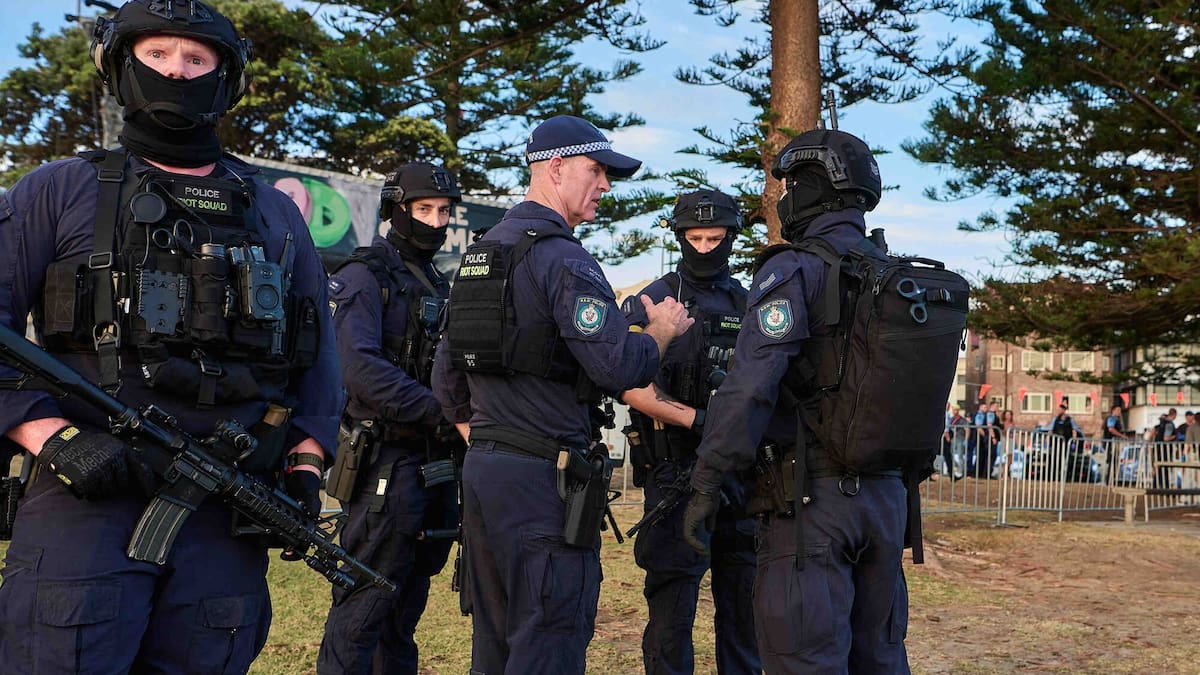
The antisemites, those who are hostile and prejudicial against the Jewish people, protested there just a couple of short months ago. Getting noticed.
They were there again last week. And the Aussie postcard turned to bloodshed.
For our family, Sunday evening highlighted just how much the world has changed. First, the text messages started coming in. Then, as we were scrambling for information, the mainstream media channels had little if anything. We kept scrambling. The news started to roll out on X, formerly Twitter, and Facebook.
The irony is that, the news medimedia that were last week banned for people under the age of 16 in Australia, were now, in the heat of the moment, the lead source of what was happening. But I was too busy trying to find out what was going on to think about that until later.
On reflection, the traditional news media will never beat the person on the spot with a cellphone on video mode. In that moment, social media was the place to be. The terrorist attack at Bondi Beach demonstrated that, in case we had any doubt.
But with such unfiltered publication comes a more direct message. The traditional media will block out the “difficult to watch” images. They’ll edit out the stupid stuff. The citizen with an iPhone knows no such censorship.
Within just a few hours it was confirmed as a terrorist attack targeting Jewish families who were attending a peaceful celebration.
As always there were heroes and villains. And all of it captured on live video feeds.
The hero was a middle-aged father of two who owns a fruit and vege shop. He didn’t look particularly fit or capable, and yet he backed himself to “jump” one of the gun-wielding attackers, wrestle the firearm off him and save lives in the process. He avoided the temptation to fire the weapon at the man who had been shooting others. It was quite remarkable self-control in the heat of the moment.
At the other end of the scale was the time it took for police to secure the bridge from where the attackers were operating. A World War II army unit would have been more effective! Then, once the attackers were neutralised, with one dead and one injured, those same cops seemed to wait forever to take the bridge. It took another bloke, this one unarmed and wearing khaki shorts and a white tee shirt, to walk to the end of the bridge, check that it was safe, and wave to the cops to give them the all-clear.
Once on the bridge, the police failed to immediately secure the surrounding area, and for a few minutes it seemed that numerous people, including members of the public, walked freely through the crime scene. A couple of bystanders took a kick at the terrorists. It looked more like Dad’s Army than Dirty Harry!
The problem for the police is that this, too, is all recorded for the public to see.
We all have mental images of how we think police would react in such a situation. We’d expect their actions to be well rehearsed, highly effective and co-ordinated. But the video gives a lie to all that. In fact, the once-feared New South Wales police force looked stunned and apprehensive.
We’ve all lived through a couple of decades of political correctness, a period where saying what we think is no longer regarded as acceptable. With that has come programmes supporting tolerance, inclusion and calls for a more accepting society.
Our own police have been in the headlines for all the wrong reasons over the last year. But I wonder if the same issues would affect them if, heaven forbid, they were faced with something similar.
New Zealand police arrest the gunman after an attack on two mosques in Christchurch on March 2019. Photo / Supplied
Let’s not forget that our cops were outstanding when called to the mosque attacks in Christchurch just six years ago. But a lot has changed since then.
Their own media approach has presented a softer side. Diversity and inclusion policies have impacted appointments and ways of operating. Softer policing techniques are used more often, and that’s okay for the majority of offences. It’s less threatening for police and the public they serve. It makes them more approachable.
And to be fair to our police, with the Police Complaints Authority hovering alongside everything they do, so they’re damned by the PCA if they go too hard and damned by the public if they’re too soft.
But when someone picks up a gun and starts shooting people, the game changes. And the role of the cops is to present a highly effective, organised and ruthless response.
We didn’t see that in the videos from Sunday night in Bondi.
And while the video recording apps on mobile phones across the beach that epitomises everything that’s good about our transtasman cousin, something else came into view. This was an attack, another one, on Jewish people. It was happening in a country whose Prime Minister had called for the recognition of an independent Palestinian state just a few months before.
Our own Government refused to make such an acknowledgment and was heavily criticised internally by the usual minorities. At the United Nations, less than three months ago, our Foreign Minister Winston Peters announced a neutral position, suggesting that Palestinian statehood could come once Hamas was out of the operational picture and a clear step-by-step plan was in place to ensure a successful transition.
Of course, that wasn’t good enough for the pro-Palestinian movement. Some attacked the minister’s home and were supported by a small group of our MPs for doing so. They are the same MPs who fake outrage at all manner of events and happenings, but who are seldom seen proposing anything constructive. They carry the once-reputable label of the New Zealand Green Party.
These people in our Parliament are not politicians. They fancy themselves as spokespeople for inclusion but they practise the politics of exclusion.
They have no skills to add value to the best interests of New Zealand. They provide no knowledge of trade, education, healthcare or finance. They have nothing to offer in respect of leadership capability or executive skills.
They don’t contribute ideas or outcomes. Instead, they seem totally committed to stopping things rather than enabling things.
They are, simply put, naive activists, protesters and interventionists who look for bandwagon causes to celebrate at the expense of common sense and the interests of the country they have been chosen to represent.
During this parliamentary term, one of those causes has been the plight of the Palestinian people. These members of our Parliament have adorned themselves in keffiyeh, chanted slogans which are offensive to our Jewish citizens and participated in protest activity.
The last time terrorism came to these shores, it was a one-off, the work of a loner. This time around it looks more organised. It’s a movement. One in which members of our own Parliament are complicit.
We should have no place in our country for those who don’t ascribe to our values; and no place in our Parliament for those activists who pursue the causes of terrorists.
As the do-gooders from the United Nations and the World Economic Forum continue their unashamed pursuit of a world without borders, championing relentless immigration as they do so, they are overlooking the fact that most of us like our countries just the way they are.
The Trump-led US has put a massive and cruel stop to illegal immigration from South America. People in the UK and Europe are starting to stand against raids on their local communities by swathes of newcomers. Many of those newcomers bring beliefs and behaviours that are not consistent with the values that most of us in the West have chosen to live by.
It’s insightful that the politicians talk about reforming gun laws instead of border laws. But it’s not about the guns. Most of us don’t want more people who do not share our values or our moral standards and who threaten our way of life. Despite the overwhelming evidence, the politicians don’t seem to get this.
The guy in the white shirt is a hero. He stood up at the time when the authorities couldn’t or wouldn’t take control of the situation. That hero is also a metaphor for where the world is heading. If the political establishment won’t fix our problems, the people will.
So what is New Zealand’s place in this mixed-up world? The more I think about it, the more I think that Winston Peters was right. It’s timely to suggest that this country’s future is as a common-sense neutralist. We don’t need to participate in other countries’ wars or import their troublemakers, and we don’t need to pronounce an opinion. We can be peacekeepers and independent observers. We should support those who support us, but, beyond that, we need take no sides.
Because terrorism’s nasty creep just got real for us, and the world’s problems just came a whole lot closer to our home. It’s no longer just reckless politicians shouting about problems on the other side of the world. Those protests invite permission to those who bring their troubles with them.
Antisemitism and terrorism are here. And we need a plan. Something needs to change.
Bruce Cotterill is a professional director, speaker and adviser to business leaders. He is the author of the book, The Best Leaders Don’t Shout, and host of the podcast, Leaders Getting Coffee. www.brucecotterill.com
Catch up on the debates that dominated the week by signing up to our Opinion newsletter – a weekly round-up of our best commentary.