
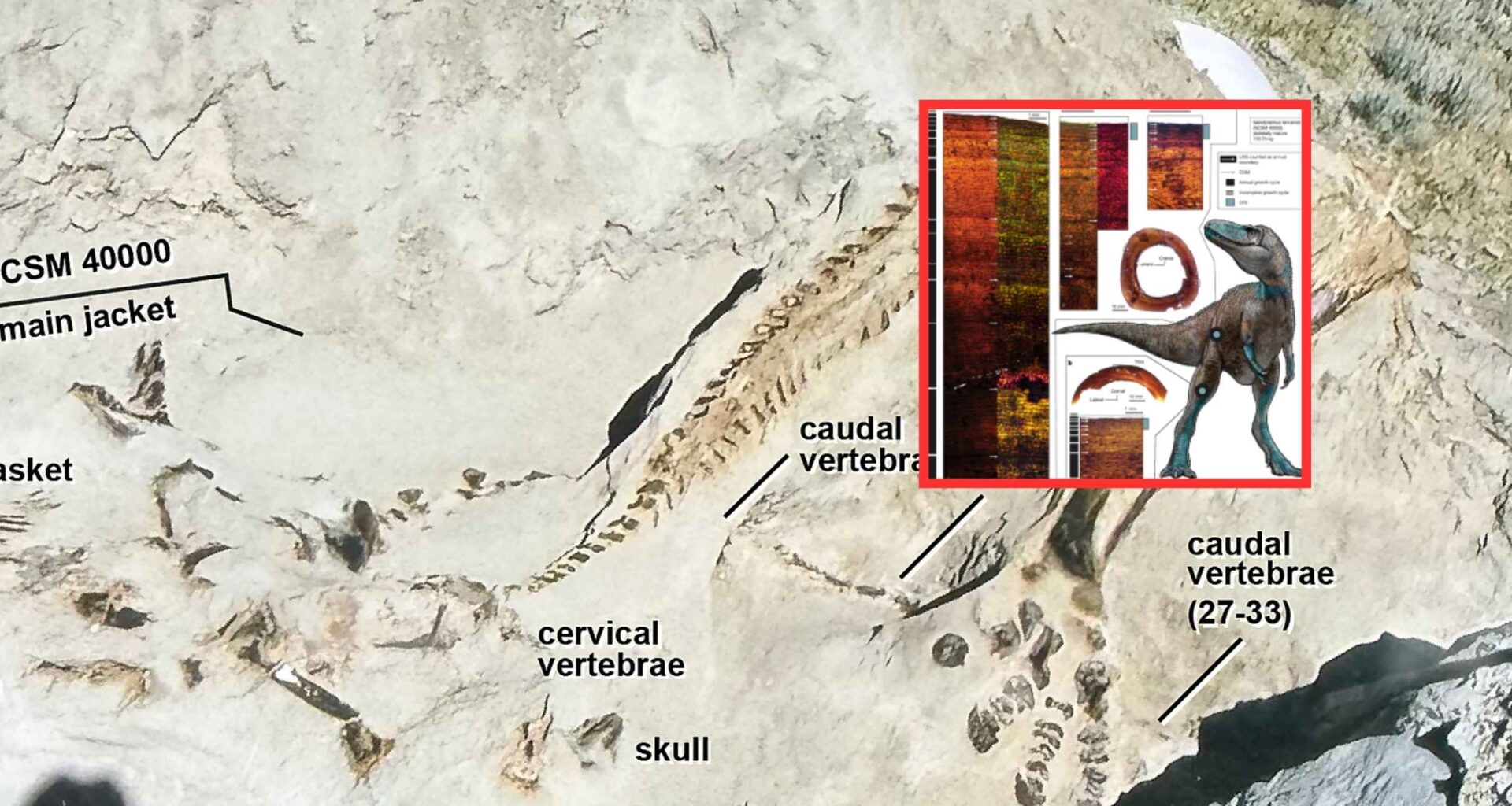
A small tyrant dinosaur once written off as a teenaged T. rex has now been confirmed as its own species. That animal, called Nanotyrannus, turns out to represent not just one form but two closely related species.
Using an almost complete skeleton from Montana rocks about 67 million years old, scientists have rewritten the growth story for Tyrannosaurus rex.

Their work shows that this creature did not grow up into a giant, which means earlier ideas about T. rex life stages need revision.
Meet Nanotyrannus
For years, many paleontologists argued that Nanotyrannus was simply what a teen T. rex looked like, long-legged and lightly built.
The new study overturns that idea by showing that a nearly complete skeleton had already finished growing.
The work was led by Lindsay Zanno, a research professor at North Carolina State University, where she studies how meat-eating dinosaurs evolved and lived.
Previous research on bone microstructure had argued that small tyrannosaur skeletons were juvenile T. rex, not a separate species.
That work supported ontogenetic niche partitioning, the idea that young and adult animals used different prey and roles as they grew.
Dinosaurs frozen in fight
The new analysis centers on the famous Dueling Dinosaurs fossil, now housed at the North Carolina Museum of Natural Sciences.
It preserves a nearly complete small tyrannosaur and a Triceratops that died together in close contact.
Those bones come from the Hell Creek Formation, a late Cretaceous rock unit in the northern Great Plains. It preserves a humid floodplain rich in dinosaur fossils.
Researchers cut thin sections from leg bones and looked for growth rings, layers that form when an animal slows growth each year.
They also tracked which back bones had fused into solid columns and concluded that the individual was around 20 years old at death.
Anatomical checks showed that the animal’s forelimbs were proportionally larger than those of T. rex despite its smaller body.
It also carried more teeth in the jaws, fewer tail bones, and nerve routes in the skull that do not appear in T. rex.
Nanotyrannus and T. rex
To see how far these differences went, the team compared more than 200 tyrannosaur fossils from late Cretaceous rocks across North America.
Within that sample, one skeleton once tagged as a teen T. rex instead matched Nanotyrannus and was named N. lethaeus after the river Lethe.
Nanotyrannus and T. rex both belong to tyrannosauroids, a broader group of meat-eating theropod dinosaurs.
The new work places Nanotyrannus just outside the classic T. rex family tree, marking it as a close cousin rather than a direct member.
Because many small tyrannosaur skeletons fed into growth models for T. rex, earlier ideas about its diet, speed, and behavior now need fresh testing.
For Nanotyrannus to be a juvenile T. rex, it would need to defy everything we know about vertebrate growth.
Crowded Cretaceous neighborhood
With Nanotyrannus now recognized as a hunter in its own right, late Cretaceous western North America held at least two large meat-eaters.
One report describes Nanotyrannus as 18 feet long and 1,500 pounds, and T. rex at about 40 feet and 15,000 pounds.
These size differences likely meant very different hunting styles, with T. rex using crushing power and Nanotyrannus better suited for chasing nimble prey.
That kind of pairing suggests that giant and mid-sized hunters could divide the menu rather than fighting over every carcass.
Earlier models had imagined teenage T. rex filling the mid-sized predator role between small raptors and full-grown tyrants.
Now Nanotyrannus holds that position, which changes how scientists picture food webs in the last million years before the asteroid strike.
In ecology, alpha diversity, the number of species in one region, helps show how many predators shared a landscape.
The new work suggests that tyrannosaur alpha diversity near the very end of the Cretaceous was higher than many scientists once expected.
Science that keeps changing
These new results push paleobiology, the study of ancient life and behavior, to rethink how predators shared space near the end of dinosaur time. This discovery paints a richer, more competitive picture of the last days of the dinosaurs.
These results open a new chapter in how scientists understand the late Cretaceous. Recognizing two species of Nanotyrannus adds complexity to a time once thought to be ruled by a single dominant predator.
The clash preserved in the Dueling Dinosaurs fossil now stands as a vivid marker of that crowded ecosystem, where powerful hunters filled different roles in the final days before the extinction event.
The study is published in Nature.
—–
Like what you read? Subscribe to our newsletter for engaging articles, exclusive content, and the latest updates.
Check us out on EarthSnap, a free app brought to you by Eric Ralls and Earth.com.
—–