
Comment: Walking quietly, I try to keep my breathing under control while keeping up with Roy. He’s 13 years older than me and I’m abashed that he’s way fitter – too much time sitting at my desk writing submissions, I reflect. Ahead, the dog abruptly stills and stiffens. We creep closer to get a view around the bush in front of us. Eighty meters away, goats are unconcernedly grazing on the side of the track.
“You take the white one, I’ll take the black billy”, Roy whispers.
We fire almost simultaneously. Goats erupt from the vegetation, and we knock another couple over in the melee as they disperse into the thick vegetation.
This is a regular activity. In the past five years we have culled 1054 goats and a considerable number of deer and pigs from this 600ha block of regenerating native forest in the Marlborough Sounds. During this period, the property also paid to participate in a larger landscape-scale aerial control operation spanning numerous private landowners and the Department of Conservation. That operation culled an additional 500 goats plus pigs and deer from the property.
While there are still animals on the property, we can see success. For the first time we are seeing Kohekohe seedlings coming up and browse damage on other broadleaf species is no longer as universal.
Walking hundreds of kilometres across these hills, rifle in hand, has given me plenty of time to ponder the nationwide issue of booming ungulate numbers. Booming they are. Barely a week goes by that there’s not a news story about out-of-control animal numbers.
People want to quantify the problem but coming up with overall numbers isn’t easy. I’d be hard pressed to estimate the remaining number of ungulates on this 600ha block. Estimating these populations nationally is next to impossible. However, from a nationwide scientific study, DoC can convincingly state that between 2012 and 2018 ungulate numbers increased significantly and spread markedly, but more granular detail is difficult.
What are ungulates, and why are they here?
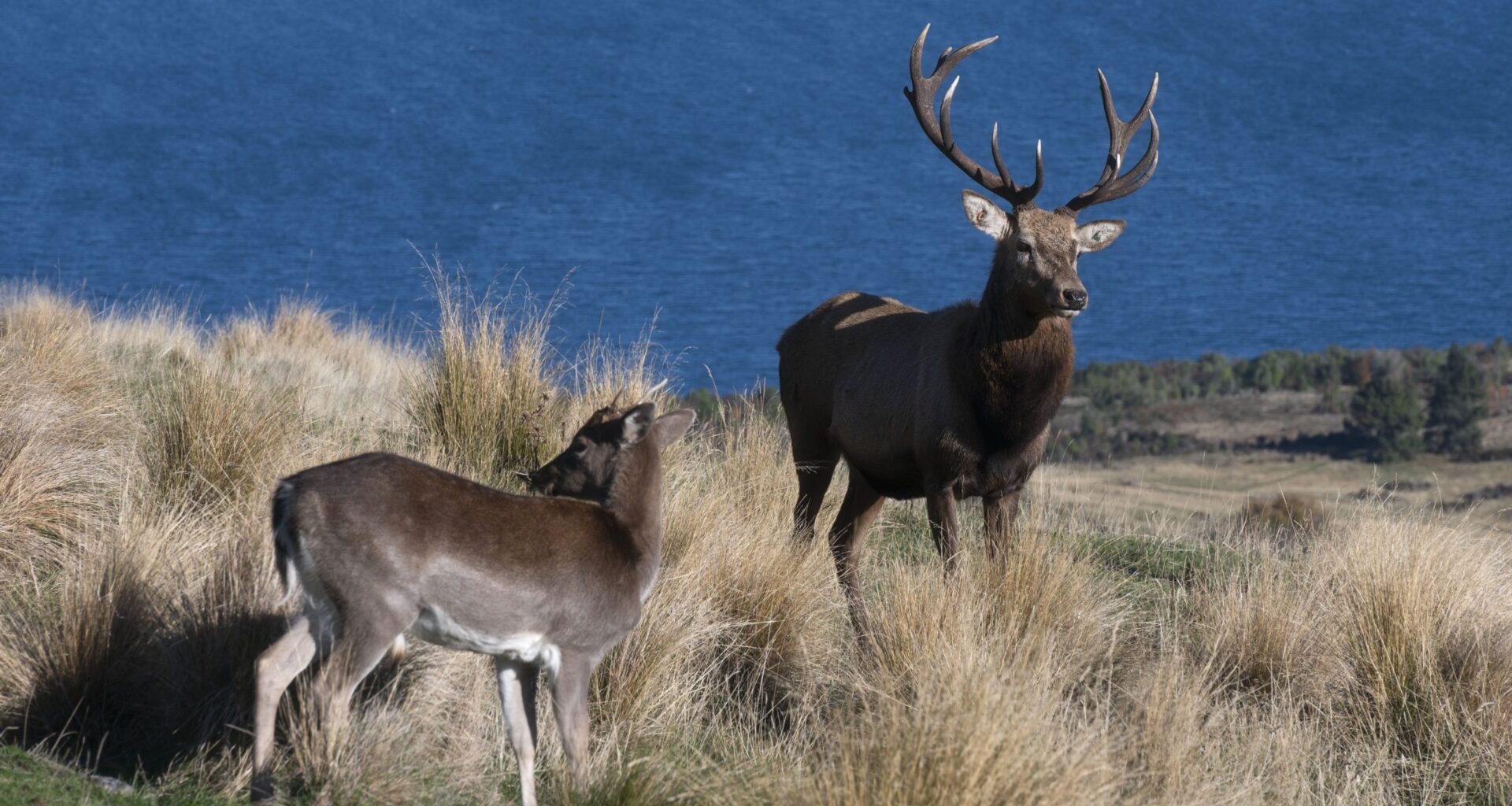
‘Ungulate’ is the simple term for any mammal with hooves. In the Aotearoa New Zealand context, this refers to a rogue’s gallery of introduced pests including seven species of deer (red, fallow, sika, rusa, wapiti, white tail and sambar), goats, pigs, tahr and chamois.
None of these animals are native. They were introduced, starting in the late 1700s, by Captain Cook (pigs and goats) and continuing with a vengeance in the late 19th and early 20th centuries by acclimatisation societies to establish a familiar European landscape with animals for sport.

Start your day informed. Make room for newsroom’s top stories. Direct to your inbox daily.
A problem is that our native ecosystems, which evolved for 80 million years in the absence of browsing mammals, were (and are) defenceless. These introduced animals found an endless, predator-free buffet.
The myth of balance
Forest & Bird warned about the dangers of high ungulate numbers damaging forests as early as the 1920s, beginning a century of tension between conservationists and hunters. This tension is most apparent in conversations about animal numbers with hunters seeking a balance between the presence of these animals and conservation goals, and conservationists focused on ecological integrity and forest health.
Achieving a balance between ungulates and the environment seems reasonable. Yet it is problematic. This is because there is no balance when you step in the shoes of mother nature; achieving a balance here and there accumulates and has ultimately resulted in severe degradation of our natural environment.
So why are their numbers booming now?
Decades ago, government-funded professional cullers held populations in check. Later a commercial helicopter venison recovery industry further reduced numbers in many areas. But for the past 25 years government control has been minimal, and commercial aerial venison recovery is no longer profitable in most situations.
With mild winters (worsened by climate change), abundant food, and no natural predators, these animals breed prolifically. Goats, for example, can have twins or triplets twice a year. To reduce numbers where food is plentiful, we need to remove 25-30 percent of the population per year, just to stop the population from growing.
The ecological and economic damage
The impact of these animals is total, stretching from the mountain tops to the farm fence.
For our native forests, this is not just a few nibbled leaves; it is ecosystem collapse. Ungulates are picky eaters. They target the most palatable, ‘ice-cream’ species first. These include broadleaf, five-finger (whauwhaupaku), kohekohe, and the seedlings of giants like tōtara, rātā, and rimu.
They create what ecologists call a bovine forest. The old-growth trees remain (for now), but the entire understorey – the next generation of forest – is eaten, along with fallen leaves from mature trees. The forest floor becomes a mown lawn of unpalatable ferns, grasses, or bare, compacted soil.
This destruction has flow-on effects (a trophic cascade). When you remove the understorey, you remove the home for insects, lizards, and ground-nesting birds. It reduces the ability of forests to absorb rainfall and contributes to downstream erosion and sediment loads.
For farmers this is not just a conservation issue; it’s a primary production crisis. Deer and pigs pour out of the bush onto farmland, consuming vast quantities of high-value pasture and silage, directly competing with stock. Feral deer are a significant vector for bovine tuberculosis, posing a constant, expensive threat to our cattle and dairy herds and undermining our national disease-control efforts. Pigs root up paddocks, while deer and goats damage fences, costing farmers thousands in repairs and lost time.
Myths and spin
Recreational hunters argue that they can manage animal numbers. We value their contribution, but the evidence is clear: recreational hunters cannot solve this problem on a national scale.
If recreational hunting could do this, it would have happened already. There are more recreational hunters than any previous time in NZ’s history. It is much easier to learn how to hunt and where to go hunting. There are TV programmes and YouTube instructional videos. Technology like GPS mapping and better optics make hunting easier and safer. Yet despite this, animal numbers are still on the rise.
Why? Pest control requires maximising the kill. This means targeting all animals, especially the breeding females (hinds, nannies). In contrast, many recreational hunters are seeking a trophy (a mature stag or billy) and will often pass up numerous animals, so they don’t scare off a possible trophy head. To allow a forest to recover (as we’re seeing with our kohekohe), ungulate numbers must be reduced to very low numbers and kept there. Recreational hunting can rarely achieve this level of sustained pressure. It can usefully ‘harvest’ the interest but not cull the ‘principal’.
Hunters routinely claim access is a barrier. Comments on a Facebook post about the South Westland article say things like:
“Leave it to the hunters”, and “Encourage hunter access”, and “Plenty of hunters would do it for free costing DoC and the taxpayer nothing”.
If access was truly the barrier, we wouldn’t have burgeoning ungulate issues on the conservation estate where access is free and open. On private land, access is not as straightforward as people clamouring for access hope. Allowing hunters on to private land is essentially an issue of trust. A friend who bought a forestry block in Marlborough was told by the vendor that he had a trusted mate that had been doing pest control on the block and had a key for the gate. My friend decided to allow this guy to continue to hunt the block. My friend had a phone call one afternoon from the guy who said:
“Look, I thought I’d better call you. My son and a few of his mates went hunting at your place. They had a fire on the vehicle track to cook up some food, and it got a bit out of control. It’s no worries though. They put it out. But I thought I’d better let you know in case you freak out next time you’re there.”
Now, if you happen to be a pine forest owner, you are very nervous of fire. Suffice to say in response, my friend had the gate lock changed as he felt he couldn’t trust the guy or the people he was passing the key on to. Stories like this quickly get around landowners making trust harder to build. I think this trust issue is perhaps even greater for forestry blocks where no one is living on site.
Another refrain is that these animals are free food for poor families. But this meat isn’t free; the cost is just externalised. Sure, it is free meat for the hunter, or the recipient of meat but our forests, soils, and native birds pay the price for having these animals available. The idea that carcasses left out on the hill are somehow wasted is also wrong. These carcasses contribute nutrients to the forest in the same way putting blood and bone on the vege patch is beneficial.
Recovering carcasses from control operations in some places makes sense. In others it is prohibitively expensive, and it would be more cost effective to buy venison from a farm and give it away. The primary objective of conservation is not meat recovery. It is ecosystem protection. We must not allow our irreplaceable forests – and the kiwi, kākā, and wētā within them – to be destroyed simply because we cannot eat the pests that are killing them.
Legislating the problem
This tension between conservation and hunting is perfectly captured in our own legislation. On the one hand, the conservation legislation requires us to protect native species and halt their decline. On the other, we have the Game Animal Council Act 2013.
This Act was a political compromise that formally established the Game Animal Council (GAC), a government-funded hunting-lobby body. Peter Dunne of the now defunct United Future Party made it part of his coalition negotiation to reward the hunting lobby for helping get him re-elected. The Game Animal Council’s purpose is to ‘manage’ certain ungulates (deer, tahr, chamois, pigs) as a ‘resource’ for hunters.
This creates a schizophrenic, contradictory national policy. How can an animal be both a pest under the Wild Animal Control Act and a valued resource to be managed for sport?
The most egregious outcome of this is the ‘herds of special interest’ (HOSI). The GAC can designate specific herds, and DoC is then legally required to ‘manage’ them for hunting. There is currently consultation underway on draft management plans for a Wapiti HOSI in Fiordland and a Sika HOSI in the Kaweka and Kaimanawa Forest Parks. These are the first cabs off the rank and plans are afoot for a HOSI for Whitetail Deer on Rakiura Stewart Island and Himalayan Tahr in Aoraki Mt Cook, and Westland National Parks.
This is part of a deliberate effort by the hunting lobby to normalise these pests on the conservation estate, much as Fish & Game has normalised introduced trout and salmon – despite their devastating impact on native fish (galaxiids). The hunting lobby is rebranding these pests as ‘valued introduced species’, and a natural part of the landscape.
They are not. They are the destroyers of our landscape. Our true heritage is the kohekohe seedling, the thriving understorey, and the sound of native birds that return when these pests are controlled to a level that they are not impeding natural forest processes.
So, what’s wrong with herds of special interest?
The main concern is the precedent they set. HOSI erode our conservation legislation – essentially farming pest animals on the conservation estate. The upshot of allowing these to go ahead is that control of ungulates elsewhere will become more difficult. Hunters will exclaim, ‘They are protected here, so why should you be controlling them there?’
We may not be as concerned about HOSI were it not for the ongoing failure of the Himalayan Tahr Control Plan. Developed in 1993, this statutory plan was intended to cap the tahr population at 10,000 animals and prevent their spread beyond a designated feral range. However, these limits have never been achieved. Due to persistent resistance to culling from hunting lobby groups, the population was allowed to balloon to more than three times the maximum allowed under the plan (reaching nearly 35,000 in 2019). Despite recent control efforts, the population remains well above the legal limit, and range expansion into exclusion zones is an ongoing crisis.
The Tahr Control Plan differs from HOSI in that DoC is responsible for administering it, whereas hunters administer HOSI, and DoC oversees the monitoring. However, we are not confident that this is an improvement. Instead, it keeps the government agency charged with controlling these pests at arm’s length.
A Wapiti or Sika HOSI might be more palatable if the draft herd management plans gave us any confidence. However, they are more akin to herd management aspirations than a plan and are ludicrously light on detail. The draft plans contain no mention of how browsing animal limits will be calculated or what sort of monitoring regime will take place to determine this. Instead, they defer this critical detail to an ‘annual operational plan’. This means the actual number of pests allowed to browse our native forests will be decided year-by-year, largely outside of the public consultation process that the Herd Management Plan requires.
The draft plans contain little in the way of accountability and there is massive scope for fudging. They will conceivably be able to say they are achieving the goals of the plan while the health of the forest does not improve.
A risk that recreational hunters don’t seem to appreciate yet is that herds of special interest make their free food no longer free. Hunters will need to pay some sort of fee to hunt them as these herds are supposed to cover much of their operating costs from the hunter users.
What needs to happen?
In recent years Forest & Bird, along with farming and forestry groups, has been calling for increased ungulate control. We would like to see a national action plan for ungulate control that spans all land tenures, coordinating efforts between DoC, iwi, regional councils, landowners, and other stakeholders. Leadership for this plan should probably be shared between DoC and the Ministry for Primary Industries, given the problem is not just on the conservation estate.
Just as we have national plans for wilding pines and wallabies, we need a cohesive strategy for deer, goats, and pigs. We see a national ungulate plan similarly being an enabler for regional control efforts, which could be from regional to catchment scale depending on the landowner matrix, animal presence and geography.
This doesn’t require new legislation as the Wild Animal Control Act already allows for it, but it requires ministerial direction and funding. Funding could be contestable and require contributions from landowners. We think most landowners would be happy to contribute if they were confident they weren’t going to experience immediate re-invasion from a neighbour.
We should reject the herds of special interest. It is an ecological dead end that prioritises introduced pests over our unique natural heritage. The applications for Wapiti and Sika HOSI status should be declined.
Finally, we must adequately resource DoC and other agencies to implement effective, sustained control operations (including professional methods where required) to achieve ecological targets. We cannot rely solely on the appreciated but variable efforts of recreational hunters to protect our most vulnerable landscapes.
It is time to put our nature first. If you agree, join the chorus of voices calling for getting on top of runaway ungulate numbers. Our true heritage is not the trophy on the wall, but the kohekohe seedling on the forest floor.