
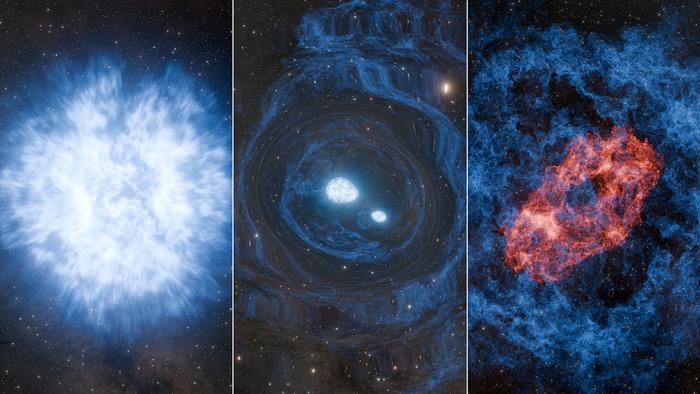
The three stages of a theoretical superkilonova are imagined in this artist’s concept. A rapidly spinning massive star’s collapse creates two small neutron stars (one of which has less mass than our Sun), which immediately inspiral and merge, generating a heavy metal-rich kilonova. Credit: Caltech/K. Miller and R. Hurt (IPAC)
A novel astronomical event, termed a “superkilonova,” is proposed to explain the coincident detection of gravitational waves (S250818k), indicating a subsolar-mass neutron star merger, and an electromagnetic transient (AT2025ulz) displaying hybrid kilonova-supernova characteristics.
The electromagnetic transient (AT2025ulz) initially exhibited kilonova-like properties, including a red glow and signatures of heavy elements for 72 hours, before transitioning to a brightening, bluer phase with hydrogen and helium spectral lines characteristic of a Type IIb stripped-envelope supernova.
The proposed superkilonova mechanism posits that a rapidly spinning massive star’s core collapses to form two low-mass neutron stars, which immediately merge within the concurrent supernova explosion, generating both gravitational waves and heavy elements.
This hypothesis, while acknowledging the statistical possibility of a chance coincidence, offers a potential explanation for the formation of subsolar-mass neutron stars and the synthesis of heavy elements, advocating for an expanded definition of “superkilonova” to include core-collapse supernovae that conceal an internal kilonova-like event.
After detecting a strange combination of signals in the summer of 2025, astronomers believe they may have captured the first evidence of a unique phenomenon previously theorized, but never observed: a superkilonova.
Supernovae are a commonly observed astrophysical phenomenon — a giant explosion at the end of a star’s life cycle. They occur when a supermassive star runs out of fuel and its core collapses, or when a white dwarf in a binary system steals enough material from its companion to trigger a thermonuclear blast. When these massive stars explode, they can leave behind an ultradense core known as a neutron star — a stellar leftover so compact that a single teaspoon of its material would weigh a billion tons.
A less commonly seen event is the kilonova. Only one kilonova — the historic GW170817 event of 2017 — has ever been observed. These violent collisions occur when two neutron stars (those supernova leftovers) or a neutron star and a black hole merge, sending gravitational waves rippling through the universe and creating heavy elements like gold and platinum, which screen blue light, resulting in a distinct red glow.
A new study published in The Astrophysical Journal Letters presents the case for a strange, never-before-seen hybrid: a combination supernova-kilonova, aptly named a superkilonova. The research, led by Mansi Kasliwal, professor of astronomy and director of Caltech’s Palomar Observatory, suggests that a massive star collapsed in a supernova that birthed two neutron stars, which then immediately spiraled together and merged in a kilonova.
“We do not know with certainty that we found a superkilonova, but the event nevertheless is eye-opening,” Kasliwal said in a press release.
Mixed signals
The discovery began on August 18, 2025, when the LIGO and Virgo gravitational-wave detectors registered a signal, designated S250818k, from a source 1.3 billion light-years away. The LIGO-Virgo-KAGRA collaboration (the international team that runs the gravitational wave detectors) sent out a notice to the scientific community: They had detected gravitational waves originating from what appeared to be the merging of two neutron stars, at least one of which was unusually small.
The data indicated the merging objects had a combined mass of approximately 0.87 solar masses (one solar mass is the mass of our Sun). The paper states that there is a 99 percent chance that one of the neutron stars was less than one solar mass. Standard stellar evolution dictates that neutron stars — the ultradense remains of collapsed massive stars — should not be lighter than roughly 1.2 solar masses. Finding objects this small suggests an entirely different formation pathway than the one currently understood by science. One theory presented in the paper is that such objects could form in neutron-rich environments like those created by the collapse of a rapidly spinning star.
Immediately after the announcement, telescopes and instruments around the world began looking in the direction of S250818k. Only a few hours passed when scientists at the Zwicky Transit Facility (ZTF) at Palomar Observatory identified a rapidly fading red object, designated AT2025ulz, coming from roughly the same location as the gravitational wave’s origin.
Kilonova or supernova?
For the first 72 hours, the transient behaved exactly like a kilonova: the ruby-red glow indicated the presence of heavy elements like gold and platinum. Astronomers believed they were witnessing the second-ever kilonova, and for good reason. A kilonova would have triggered a gravitational wave detection just like S250818k and would glow red just like AT2025ulz.
However, on the fourth day, the object’s behavior changed unexpectedly. Instead of fading, AT2025ulz began to brighten and shift toward the blue end of the spectrum. Follow-up spectroscopy from the W. M. Keck Observatory in Hawaiʻi revealed the clear signatures of hydrogen and helium — the diagnostic markers of a Type IIb “stripped-envelope” supernova.
A stripped-envelope supernova occurs when a massive star sheds its outer hydrogen-rich shell before exploding, typically through stellar winds or, in the case of a Type IIb, by losing material to a nearby companion star in a binary system. In a Type IIb explosion, a tiny fraction of hydrogen remains, creating a short-lived signal before the helium-rich interior dominates the light.
“At first, for about three days, the eruption looked just like the first kilonova in 2017. Everybody was intensely trying to observe and analyze it, but then it started to look more like a supernova, and some astronomers lost interest. Not us,” Kasliwal said in the press release.
At this point, many astronomers dismissed AT2025ulz as a standard supernova, arguing the link to the gravitational wave signal was a mere coincidence. Because supernovae do not typically generate detectable gravitational waves, a plain Type IIb event would have no physical connection to S250818k.
Why not both?
Even the authors admit they “cannot statistically rule out chance coincidence.” However, they believe another explanation is possible. The spatial and temporal overlap was strange enough to warrant a deeper investigation. “We undertake due diligence analysis to explore the possible association between [AT2025ulz] and S250818k,” the authors state.
To explain the coincidence of the neutron star merger and an explosion, the researchers propose a hypothesis involving the collapse of a rapidly spinning massive star — the exact sort of environment that could create a subsolar mass neutron star. In this scenario, the star’s core does not collapse into a single neutron star as expected. Instead, the intense rotational forces cause the core to split into two tiny, subsolar mass neutron stars.
According to the study, these newly formed baby neutron stars would spiral together and crash almost immediately after their birth, emitting gravitational waves and producing heavy elements. Because this occurs within the immediate aftermath of the star’s collapse, the resulting kilonova is obscured by the much larger supernova explosion, creating a hybrid event.
Putting the super in superkilonova
The term superkilonova was not invented for this event, but the researchers propose a broadening of its definition. Originally, the term was coined to describe a theoretical model where a massive, rapidly spinning star collapses directly into a black hole. In that original theory, the super referred to the overwhelming volume of heavy metals produced by the massive disk of material around the new black hole, potentially churning out several solar masses of gold and platinum.
In this new report, Kasliwal and team suggest expanding the term to include any core-collapse supernova that hides a kilonova-like event inside its blast. This new definition focuses on the hybrid nature of the event: a supernova that births a pair of neutron stars that then crash into each other to create a secondary kilonova signal.
Questions remain
The research team stresses that while their superkilonova model fits the data, the case is not yet closed. The event’s distance and the complexity of the overlapping signals make it difficult to definitively rule out a chance coincidence between two unrelated events.
However, the implications are significant. If superkilonovae are real, they provide a mechanism for the creation of low-mass neutron stars and explain how some of the universe’s heaviest elements are forged.
“Future kilonovae events may not look like GW170817 and may be mistaken for supernovae,” Kasliwal noted. The team looks toward upcoming missions, including NASA’s Nancy Roman Space Telescope and the UVEX satellite, to catch more of these unique events in action.
“Establishing a firmer association between S250818k and AT2025ulz requires more detailed theoretical modeling and sensitive late-time observations,” the authors state in the study. “Future detections of subsolar neutron star mergers would conclusively resolve this tantalizing multimessenger association.”