
January 3, 2026: Jupiter and the Full Wolf Moon shine together during an all-night display, with Saturn visible after sunset.
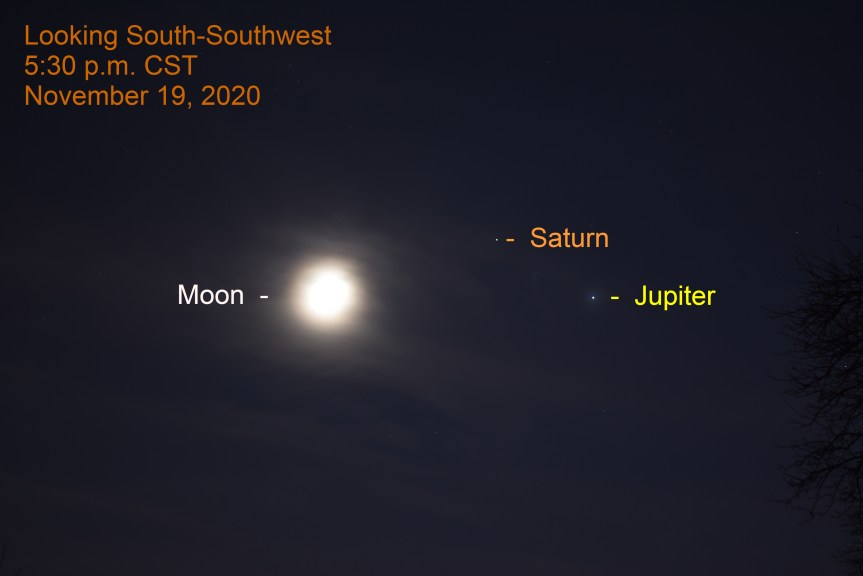 2020, November 19: The crescent moon is 5,4° to the lower left of Saturn, while Jupiter is 3.3° to the lower right of the Ringed Wonder.
by Jeffrey L. Hunt
Chicago, Illinois: Sunrise, 7:18 a.m. CST; Sunset, 4:32 p.m. CST. Times are calculated by the US Naval Observatory’s MICA computer program. Check local sources for sunrise and sunset times.
Before Sunrise
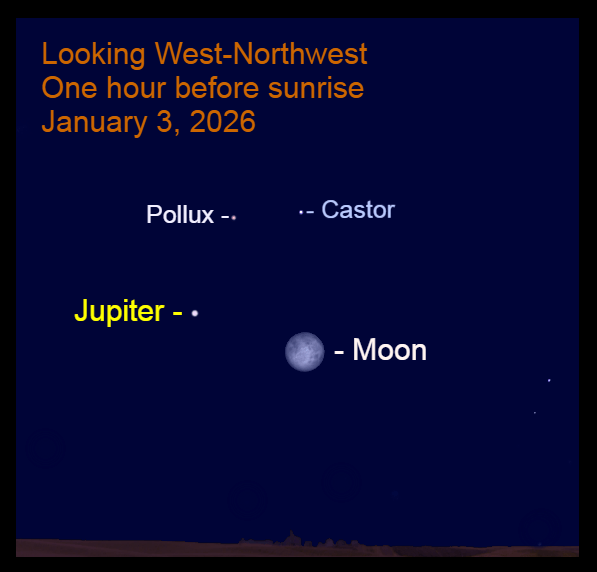 Chart Caption – 2026, January 3: An hour before sunrise, Jupiter, Moon, and the Gemini Twins are low in the west-northwest.
Jupiter and the moon dominate the sky during their nearly all-night westward journey, while Saturn is visible after sunset.
Before sunrise, bright Jupiter and the Full (Wolf) moon are low in the west-northwest. The moon is opposite the sun and reaches the Full phase at 4:30 a.m. Central Time. This marks the first bright Full moon of the season.
An hour before sunrise, Jupiter stands nearly 20° above the west-northwest horizon and 7.9° to the lunar orb’s upper left. The planet is 6.9° to Pollux’s lower left, one of the Gemini Twins.
Compare the moon’s position this morning with its location after sunset. Notice that the moon sets far toward the northwest — well north along the horizon from the sun’s summer solstice setting point. The lunar orb is near its most northerly orbital extreme, an event that recurs every 18.6 years.
After Sunset
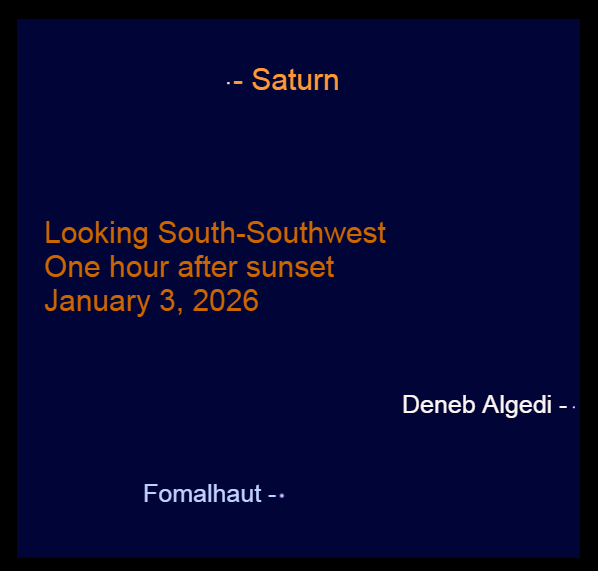 Chart Caption – 2026, January 3: An hour after sunset, Saturn is nearly 45° above the south-southwest horizon.
After sundown, Saturn is in the south-southwest, nearly halfway from the horizon to overhead. While noticeably dimmer than Jupiter, it matches the brightness of Fomalhaut — the mouth of the Southern Fish — about 30° to Saturn’s lower right.
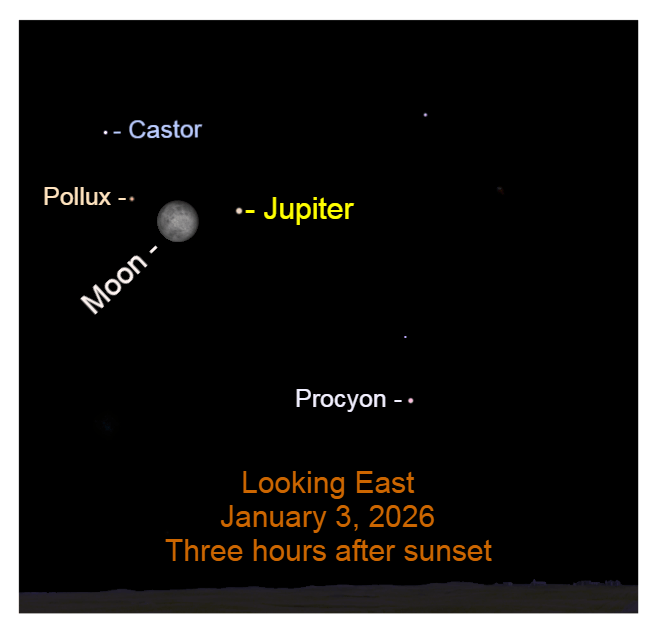 Chart Caption – 2026, January 3: Three hours after sunset, the bright moon is nearly between Jupiter and Pollux in the east-northeast.
Farther eastward, Jupiter, the moon, and Gemini rise into the east-northeast sky. Wait until they climb higher above horizon obstructions. Three hours after sunset, the trio stands nearly 30° above the horizon, with the moon nearly between Jupiter and Pollux.
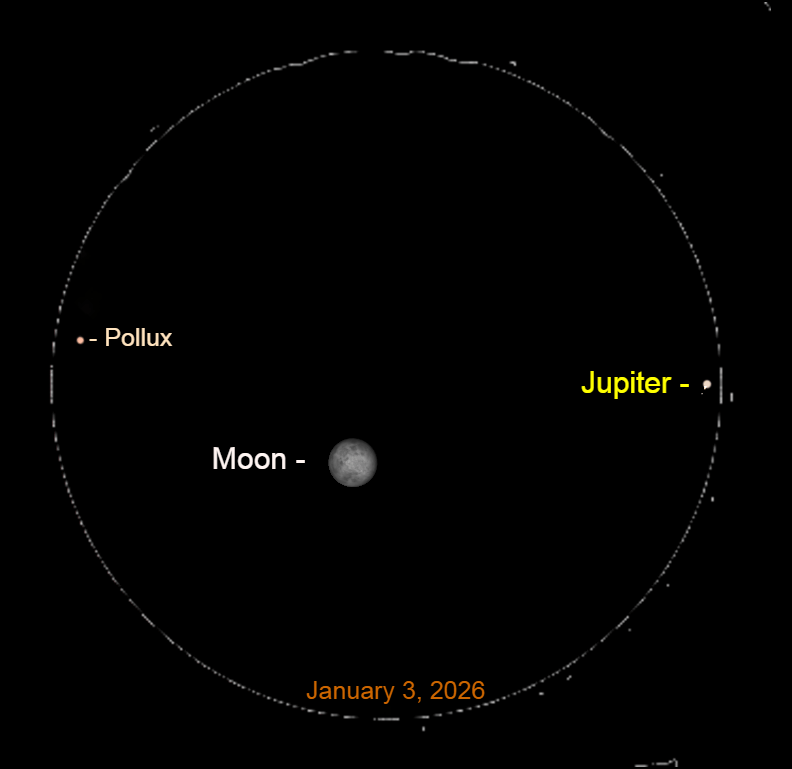 Chart Caption – 2026, January 3: A binocular view of Jupiter, Moon, and Gemini’s Pollux.
The three objects fit tightly into the same binocular field of view.
During Jupiter’s apparition, the moon passes near Jupiter and Pollux during each lunation.
As the night progresses, Saturn sets before midnight, while Jupiter and the moon remain visible nearly all night. By tomorrow morning, they again appear low in the west-northwest.
Look for Jupiter and Pollux as the moon moves between them during the early evening hours. Find Saturn shortly after sunset.
LATEST ARTICLES
 2026, January 3: Jupiter and the Full Wolf Moon Dominate the Night Sky
January 3, 2026: Jupiter and the Full Wolf Moon shine together during an all-night display, with Saturn visible after sunset.
 2026, January 2-4: Full Wolf Moon Approaches and Passes Jupiter and Gemini
January 2-4, 2026: The Full Wolf moon passes bright Jupiter near Pollux in Gemini. Learn when and where to look during early evening hours.
 2026, January 1: New Year’s Sky Guide: Moon, Jupiter, Saturn, and Planets
January 1, 2026: As the New Year begins, Jupiter, Saturn and Moon dominate the evening sky, while Orion’s Betelgeuse rises at sunset. This almanac details where and when to look with directions and separations.
 2025, December 31: Sirius at New Year: Finding the Brightest Star in the Night Sky
December 31, 2025: As New Year approaches, Sirius shines high in the southern sky. Learn when and where to find the brightest star of the night.
 2025, December 30: See Jupiter, Saturn, and Moon Tonight
December 30, 2025: Track the moon, Jupiter, Saturn, and the visible planets with this Solar System Almanac. Precise sky positions, angular separations, and observing guidance for late December.
Like this:
Like Loading…
Related