
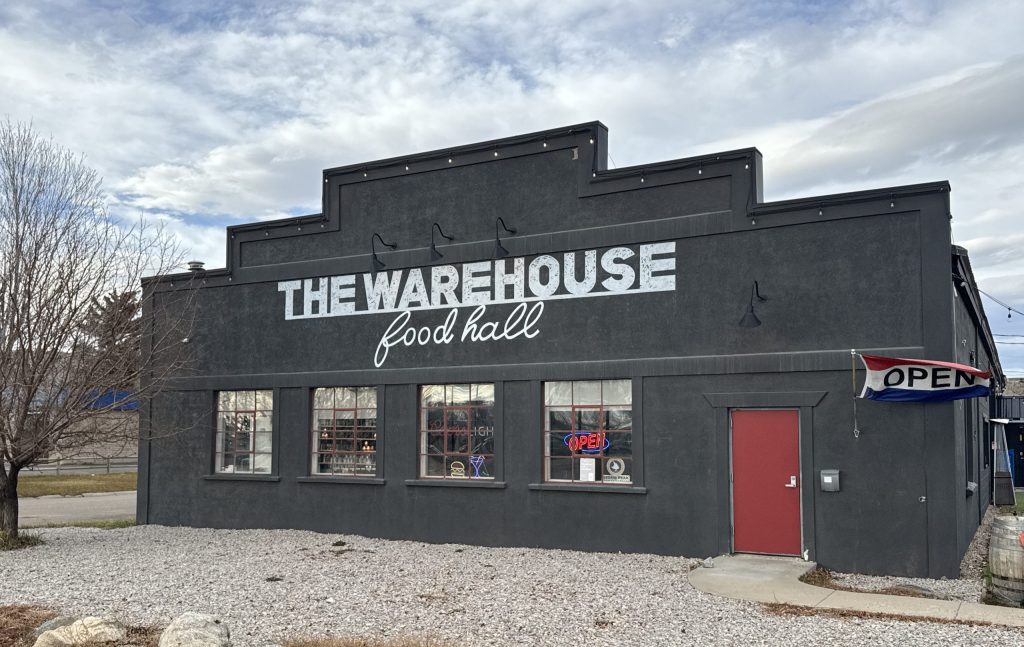
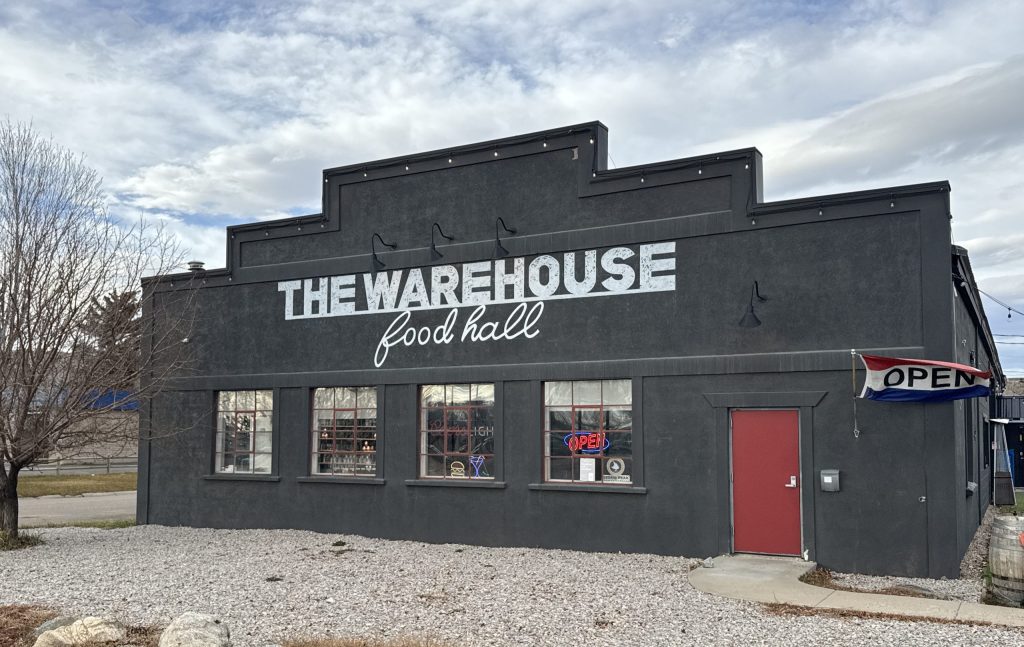
 The Warehouse Food Hall in Craig closed Dec. 21 following an announcement on Facebook on Dec. 19.
John Camponeschi/Craig Daily Press
When The Warehouse Food Hall opened in Craig, the vision was not to simply add another restaurant to the city’s dining scene but to create a place where ideas could be tested, entrepreneurs could grow and the community could gather under one roof.
That vision, shared by owner Amanda Montgomery and her husband, became a defining feature of The Warehouse until last week, when its closure was announced through Facebook on Dec. 19.
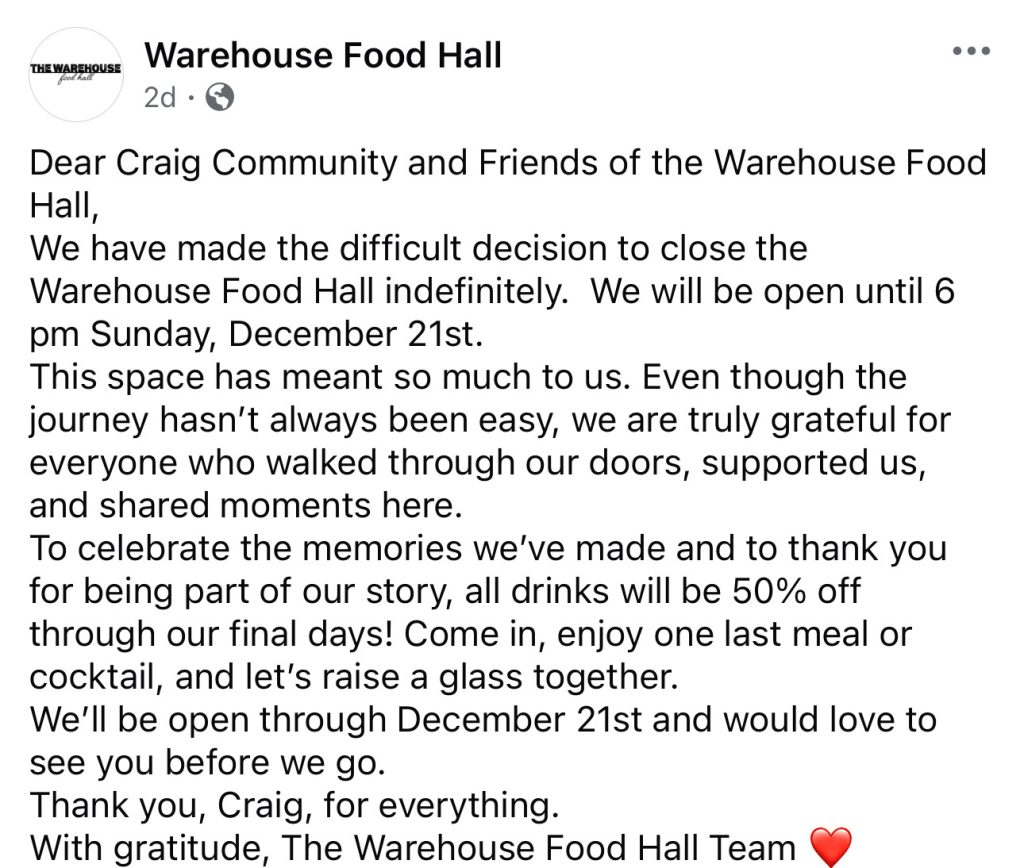 The Warehouse Food Hall’s closure announcement, posted on Dec. 19, thanked the community for its support over the years.Facebook screenshot
The Warehouse Food Hall’s last day of operation, according to the post, was Dec. 21.
Following the announcement, Montgomery said that she hopes the focus will remain on what the space represents for the community, rather than the fact that its doors are shutting.
“My husband and I have been long-term investors here in Craig and the entire Yampa Valley for about 13 years,” Montgomery said. “I was passionate about entrepreneurs and I was passionate about providing a place, a small food-truck-size space, where entrepreneurs could test out their business ideas.”
The Warehouse originated as part of an Opportunity Zone investment, a federal program designed to encourage long-term private investment in economically challenged areas. Montgomery said the concept fit naturally with her background in real estate and business support through Four Points Funding in Steamboat Springs.
The idea was to create something similar to an indoor food truck park or mall food court with a bar, allowing multiple vendors to operate independently while sharing space, overhead and culinary momentum.
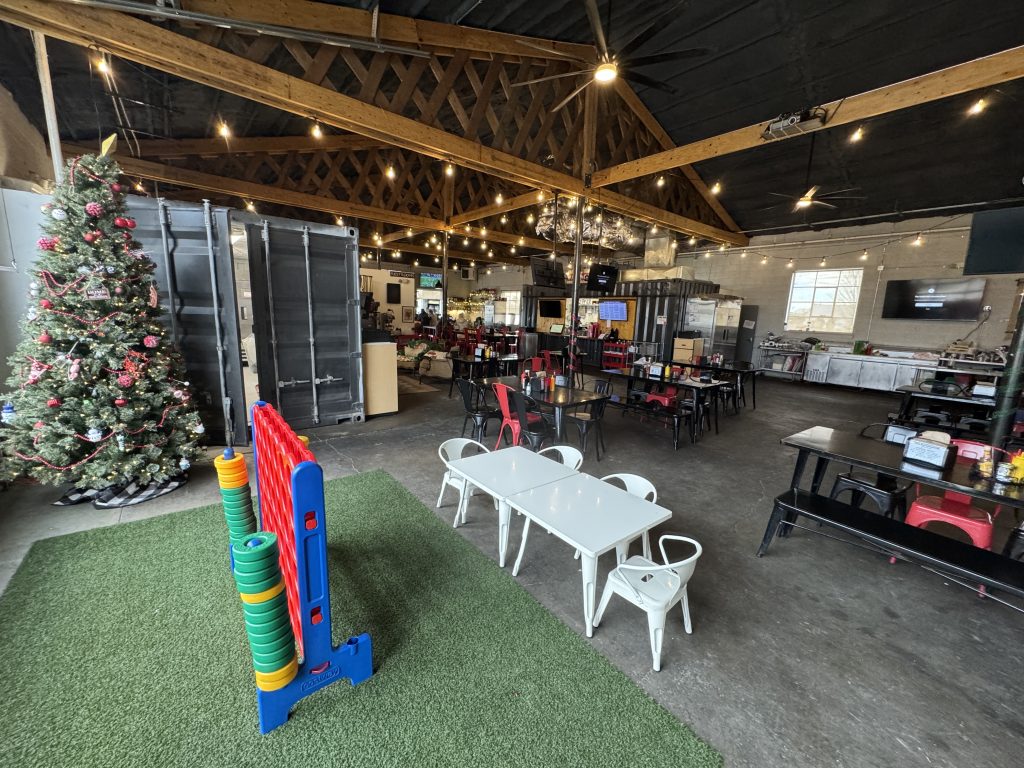 The Warehouse gave vendors an opportunity to try out food concepts using a lower-cost, lower-risk model.John Camponeschi/Craig Daily Press
“That was the goal,” Montgomery said. “Letting every entrepreneur set up their own place.”
Over time, however, the structure of the Opportunity Zone model proved to be a poor match for the reality of running a food hall in Craig. Montgomery said the pressure to generate returns for investors did not align with the slower growth and community-first approach she envisioned.
About two years ago, she bought the project out of the Opportunity Zone fund and began operating it personally.
“I personally really do love this project,” she said. “But there was just too much pressure to make dividends for investors, and that did not mesh well with this project.”
What emerged instead was a space that functioned as both a testing ground and a gathering place. Vendors rented booths for modest monthly rates and covered a portion of utilities. Some stayed briefly, while others found success and moved on.
“We call them our graduates,” Montgomery said of the businesses that went on to operate independently outside of the space.
Among the most notable was Aroi Tai, which built a strong following at The Warehouse before deciding to move into its own separate location. Other vendors used the space to determine whether Craig was the right market for them, sometimes deciding it was not.
Saffron Indian Restaurant was an example of a business that tested the market in Craig, only to decide that its concept did not match the community’s desires.
“That was also its purpose,” Montgomery said. “Try it out and decide.”
Beyond food, The Warehouse became a hub for events and informal community connection. Montgomery said she rarely turned down a request to host a gathering, fundraiser or art display.
“Anytime anyone ever asked, ‘Can we have a party here? Can we host an event here? Can we display the art for the high school?’ the answer was ‘absolutely’,” she said.
The venue hosted after-prom events, live music fundraisers and family movie nights in addition to dancing. It became a place where people celebrated milestones and simply spent time together.
“I loved being a part of it,” Montgomery said. “Food brings people together. Drinks bring people together.”
Vendor Sasha Otero said The Warehouse played a critical role in helping her move from employee to small business owner. She also explained that her space, and the other businesses within The Warehouse, struggled to survive with decreasing amounts of local traffic.
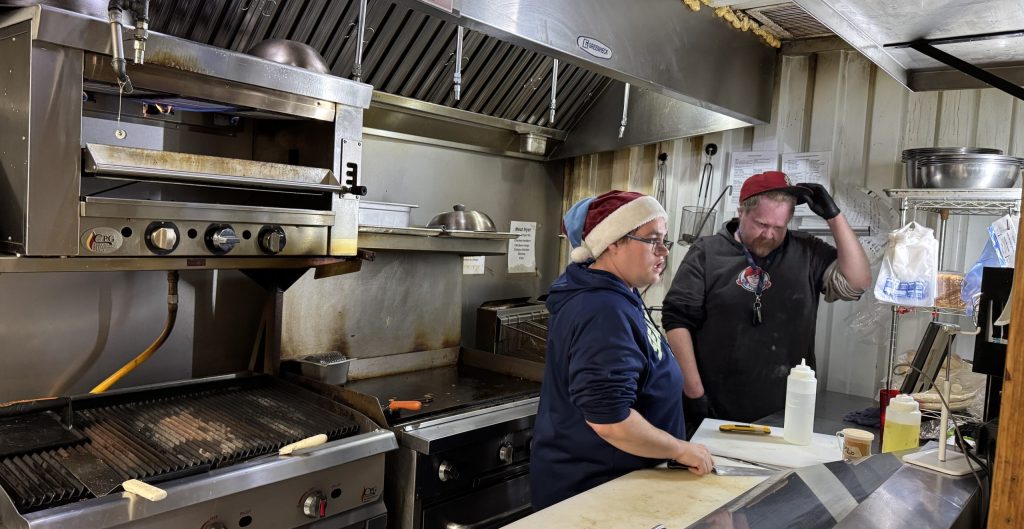 Pasta Delight owner Sasha Otero, left, stands alongside Nick Lighthizer in one of The Warehouse’s kitchens on Dec. 21. The food hall closed its doors after several years of operation. Otero is now on the hunt for another location to continue her business. John Camponeschi/Craig Daily Press
Otero, owner of Pasta Delight, said she worked at The Warehouse for about three years before opening her own food business there 19 months ago. She said she used her tax refund to launch her business before gradually reinvesting earnings back into equipment and supplies.
Otero said she grossed about $60,000 over the past year.
“That is something to be proud of,” she said.
Otero said she was not surprised to learn earlier this month that The Warehouse would close.
“Without local traffic flow, a building is not going to make it,” she said. “I know fewer than 10 locals who frequent our building on a regular basis.”
While summer travelers helped at times, Otero said day-to-day traffic has waned over the course of her time at The Warehouse. Rising food costs, she explained, also added to the challenge.
“Food is so expensive,” she said. “The amount of waste we have because we do not have enough people coming in and out makes it really hard.”
Otero is now on the hunt for another location to continue Pasta Delight.
Montgomery said that giving back to the community was always a priority, and that she worked to ensure that the Warehouse paid above minimum wage when possible while also donating to local causes, including cancer-related organizations.
Despite those successes, Montgomery said the challenges of operating food-based businesses grew increasingly difficult. She explained that labor shortages, as well as competition for employees from Steamboat Springs and rising costs, were factors that created a perfect storm for The Warehouse.
“Labor costs are high,” she said. “It was important to pay more than minimum wage, and food costs right now are pretty out of control.”
She said the business intentionally kept menu prices lower than industry-standard margins to remain accessible, but inflation made that increasingly unsustainable.
“We did not even hit the standard percentages we were supposed to hit because we wanted to keep prices lower,” Montgomery said. “Food costs have gone up so significantly that it is very hard to provide affordable food right now.”
Those pressures were compounded by the demands of the food hall model itself. Vendors came and went, which Montgomery said sometimes frustrated customers seeking consistency. She also said that the concept worked against the business at times, especially when she took over operating the grill to ensure there was always a reliable option available.
“I am not a chef by training,” she said. “Being able to consistently find good workers who could prepare food the same way was our challenge.”
Ultimately, Montgomery said the decision to close was less about profit and more about time and focus. With multiple projects underway, including redevelopment work on the former Baker House property known as the Golden Cavvy, she said The Warehouse required a level of daily commitment she could not sustain.
“It needs someone who is only committed to that as their job,” she said. “Someone who really has a lot more experience in food service specifically.”
Breda Brazelton, who said that she worked at The Warehouse for a year as assistant manager, supervisor and bartender, described the closing announcement as a “jolt” to her and to the community.
“We are grateful for the support the community has shown us here,” she said. “The community had a place to go, and it makes me sad that we are closing and they will no longer have that.”
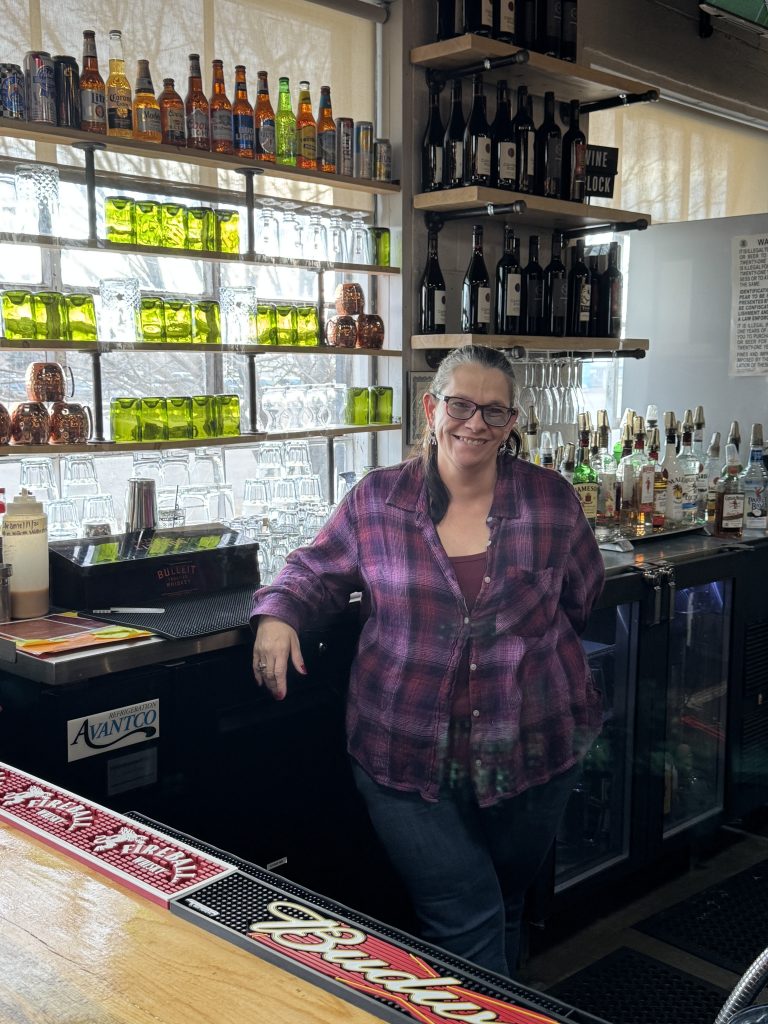 Brenda Brazelton, who served as an assistant manager, supervisor and bartender at The Warehouse, said the closure announcement came as a “jolt.”John Camponeschi/Craig Daily Press
The Warehouse is currently listed for sale as a turnkey operation, including furniture, fixtures, equipment and the liquor license. Montgomery said the space could continue as a food hall or be reimagined entirely.
“I still see the potential in it,” she said. “I wanted it to be a place where people felt comfortable hanging out. We hit that a few times, and when we did it felt really good.”
Montgomery described the decision to close as bittersweet. She said she is grateful for the memories created there, and is hopeful that someone else will carry the concept forward in some form.
“I love that place and I am very sad to see it close,” she said. “I really hope that somebody reopens it with the potential that it has.”