

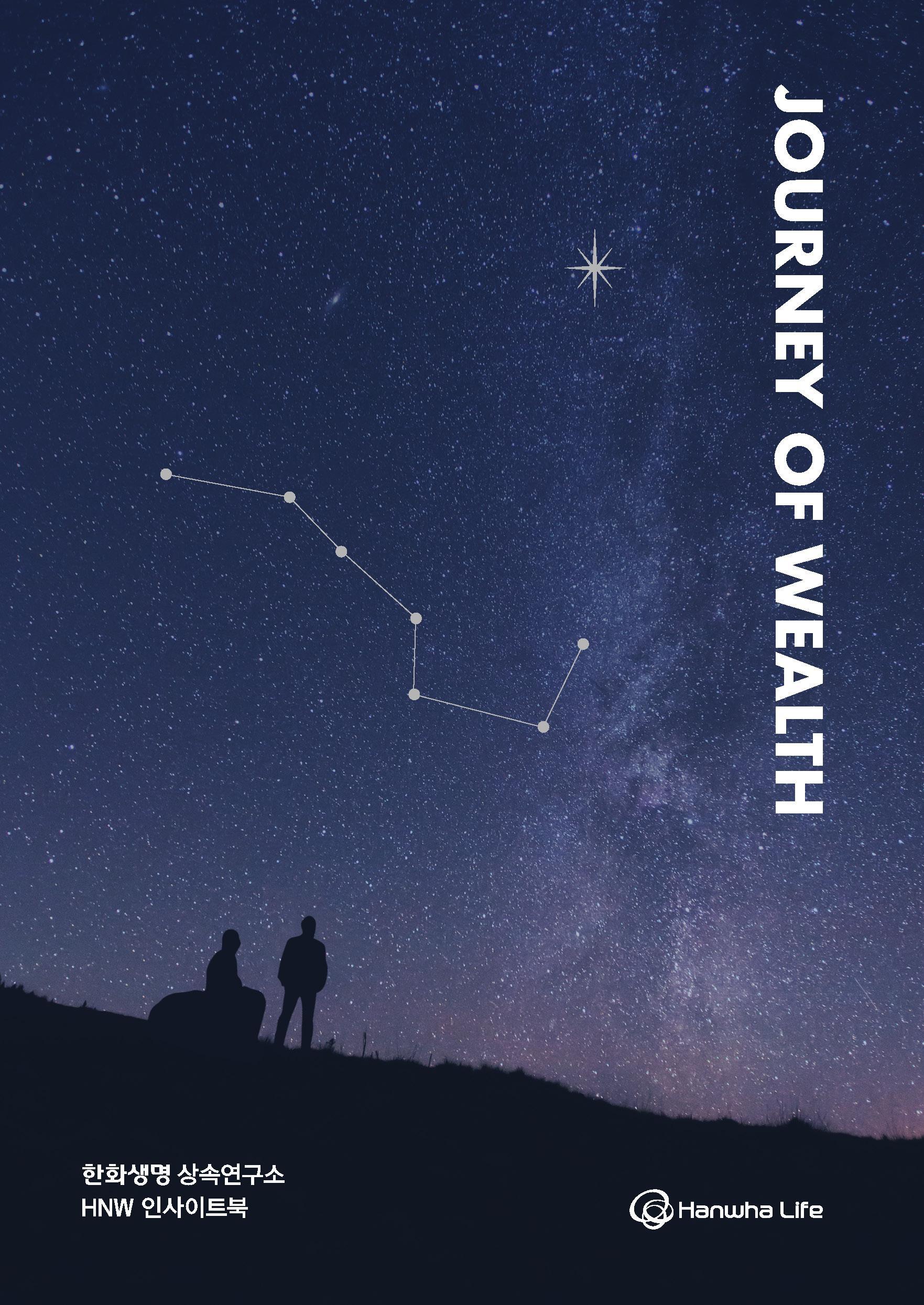
Cover of ‘Journey of Wealth 2025,’ a report published by Hanwha Life’s Inheritance Solution Institute / Courtesy of Hanwha Life
High net worth individuals broadly share concerns that they are insufficiently prepared for inheritance and gifting, but sharp generational differences emerge over what drives conflict in asset transfers, according to a report published Wednesday by Hanwha Life’s Inheritance Solution Institute.
Wealthy respondents in their 30s and 40s identified asset allocation as the primary source of tension, while those in their 60s and 70s focused more on the timing of wealth transfers. The report also revealed contrasting views on family business succession.
The institute released “Journey of Wealth 2025,” its first in-depth study tracing the full life cycle of wealth, from accumulation to transfer through inheritance and gifting, viewed through a life-stage perspective.
The study noted that Korea’s rapid economic growth has produced distinct generational experiences among grandparents, parents and children, resulting in fundamentally different attitudes toward wealth.
Focusing on high net worth individuals in their 30s and 40s and those in their 60s and 70s — both pivotal age ranges for wealth transfer — the report moves beyond tax planning to examine broader questions of how wealth should be created, preserved and passed on.
To enhance the objectivity and depth of its analysis, the institute conducted an online survey of more than 1,000 wealthy individuals nationwide, complemented by in-depth one-on-one interviews with 20 participants.
The findings revealed widespread anxiety over inadequate preparation for inheritance and gifting, alongside clear generational divides. While younger respondents emphasized asset allocation, older respondents placed greater weight on transfer timing and called for long-term, family-specific guidance.
Similar gaps were observed in family business succession. Older owners expressed concerns about successors’ readiness, while younger respondents highlighted their own capabilities, particularly the ability to develop strategies to adapt to market changes.
Among those in their 30s and 40s who chose not to take over family businesses, the most common reason cited was the desire to pursue a different career path, with most expressing satisfaction at independently shaping their futures.
“As Korea shifts from an era of wealth accumulation to one centered on wealth transfer, ‘Journey of Wealth 2025’ closely examines generational differences in perceptions and concerns surrounding asset succession,” Hanwha Life co-CEOs Kwon Hyuk-woong and Lee Kyung-keun said in a joint foreword.
“The report aims to help bridge the understanding gap between generations that pass on wealth and those that receive it. The institute will continue to provide insights and solutions as a long-term partner throughout clients’ life journeys.”
Established in 2024, Hanwha Life’s Inheritance Solution Institute provides customized professional consulting on inheritance, gifting and investment for high net worth clients, while also facilitating networking opportunities. The institute plans to continue identifying emerging areas of interest among wealthy clients and to publish the “Journey of Wealth” report annually.