
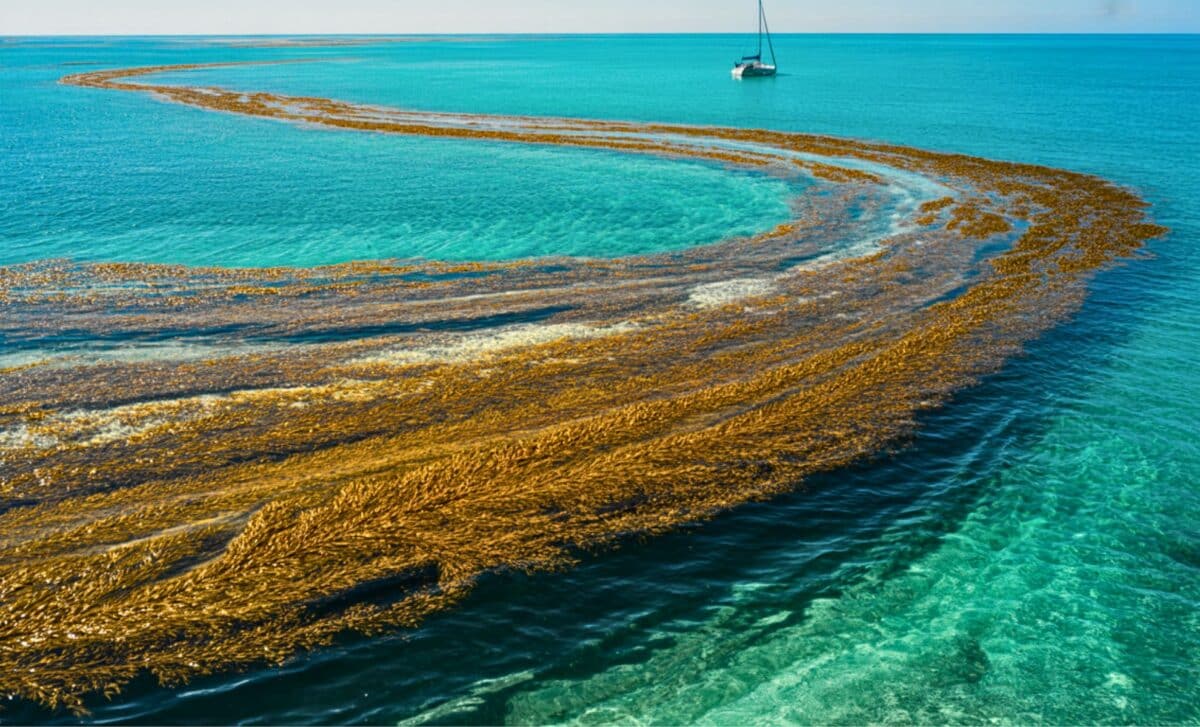
Every year, millions of tourists flock to the Caribbean and Gulf of Mexico expecting pristine beaches. Increasingly, they’re greeted instead by piles of rotting seaweed that stretch for miles, giving off the pungent odor of sulfur and cloaking the coastline in thick brown mats. This is the impact of the Great Atlantic Sargassum Belt — a rapidly growing floating mass of seaweed that now spans over 5,000 miles across the Atlantic Ocean.
In recent years, the bloom has intensified, disrupting ecosystems, damaging economies, and raising new public health concerns. In 2025, scientists observed a record-breaking volume of over 38 million metric tons of floating Sargassum — a genus of brown macroalgae — in the Atlantic basin. The bloom is no longer seasonal or scattered. It has become a recurring event with far-reaching implications.
Once limited to the Sargasso Sea, this drifting seaweed now blankets coastlines from West Africa to the Yucatán Peninsula, overwhelming resorts, smothering coral reefs, and causing millions of dollars in cleanup costs. But what’s driving the expansion goes far beyond surface observations. New scientific discoveries point to a complex system fueled by land-based pollution, ocean currents, and biological feedback loops — a combination that may keep this phenomenon growing for years to come.
The World’s Largest Seaweed Bloom Just Keeps Growing
The Great Atlantic Sargassum Belt, now visible from space, first emerged in its current form in 2011. Since then, it has returned nearly every year, growing in both size and frequency. Satellite data from the University of South Florida’s Sargassum Watch System confirmed that May 2025 marked the largest extent yet — a biomass far exceeding historical norms.
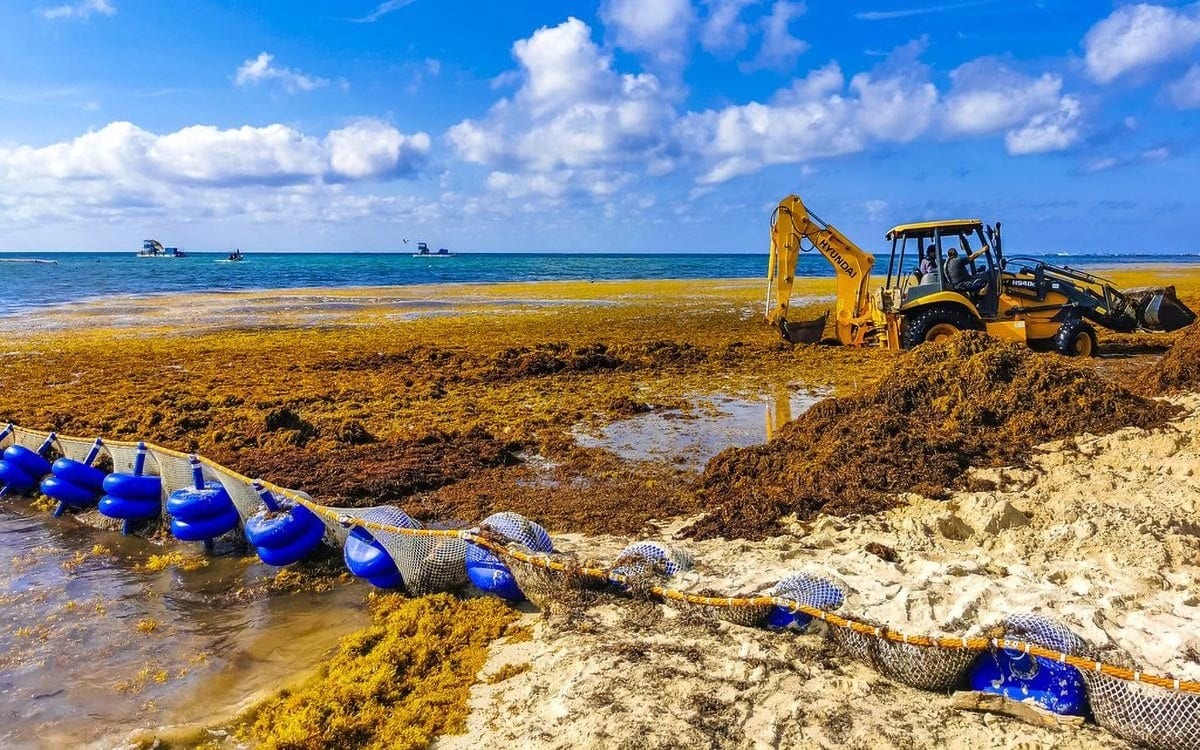 Playa del Carmen, a popular vacation destination on Mexico’s Yucatán Peninsula, faces significant Sargassum strandings during summer months, as do other Caribbean coastlines. To maintain beach access for swimmers, the brown algae must be regularly cleared using machinery. Credit: Arkadij Schell
Researchers at Florida Atlantic University’s Harbor Branch Oceanographic Institute found that nutrient levels within the algae have shifted dramatically over the past four decades. Nitrogen levels in Sargassum samples have increased by over 50%, suggesting strong ties to agricultural runoff, sewage discharge, and deforestation-driven nutrient flows from the Amazon River. These inputs have created a nitrogen-rich marine environment where the algae can thrive well beyond its traditional limits.
A 2025 review published in Harmful Algae mapped these patterns by combining satellite imagery, field observations, and chemical analysis. The findings showed clear connections between land-based nutrient pollution and the rise of massive offshore seaweed blooms, underscoring how runoff from far inland can trigger changes across entire ocean basins.
Nutrient Symbiosis Drives Explosive Seaweed Growth
The real turning point in understanding this event came from a 2025 study in Nature Geoscience, led by researchers at the Max Planck Institute for Chemistry. Using coral core samples from the Caribbean, scientists identified a powerful feedback mechanism at the microbial level.
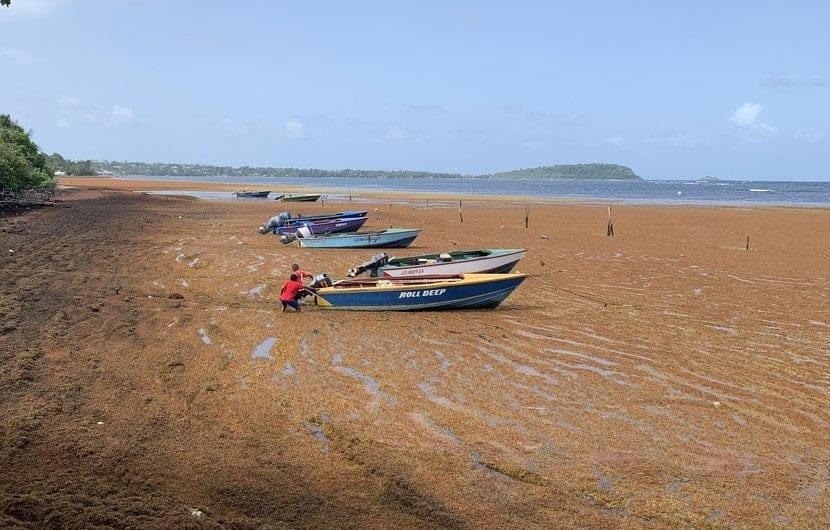 In Soubise, Grenada, two boys fight through thick Sargassum carpet to beach their boat. Such scenes are increasingly common since 2011, when summer algae blooms exploded across the Atlantic. The cause is that winds drive phosphorus-rich deep water to the surface. Credit: Jonathan Jung /MPIC
Deepwater upwelling near the equator brings phosphorus-rich water to the surface. This nutrient influx promotes the growth of nitrogen-fixing cyanobacteria that live directly on the surface of the Sargassum algae. These microbes convert atmospheric nitrogen into a usable form for the seaweed — enabling it to grow in parts of the Atlantic that were once too nutrient-poor to support it.
Nitrogen isotope analysis in coral layers showed that rates of nitrogen fixation increased dramatically beginning in 2011, tracking closely with the expansion of the Sargassum bloom. The combination of excess phosphorus and microbial nitrogen production gives the algae a powerful advantage in the open ocean, even far from river plumes or coastal sources.
This discovery reshapes how researchers think about Sargassum blooms. The seaweed is no longer merely responding to pollution; it has developed biological partnerships that amplify and sustain its own growth cycle.
Plastic Pollution and Bacteria Add a Dangerous Twist
The complexity of this phenomenon doesn’t end with nutrients. In 2023, a team at Florida Atlantic University uncovered another disturbing layer: the role of microplastics and bacteria in fueling the bloom. Researchers found that Sargassum mats trap large amounts of floating plastic, which in turn become breeding grounds for Vibrio bacteria — a genus that includes strains harmful to both humans and marine animals.
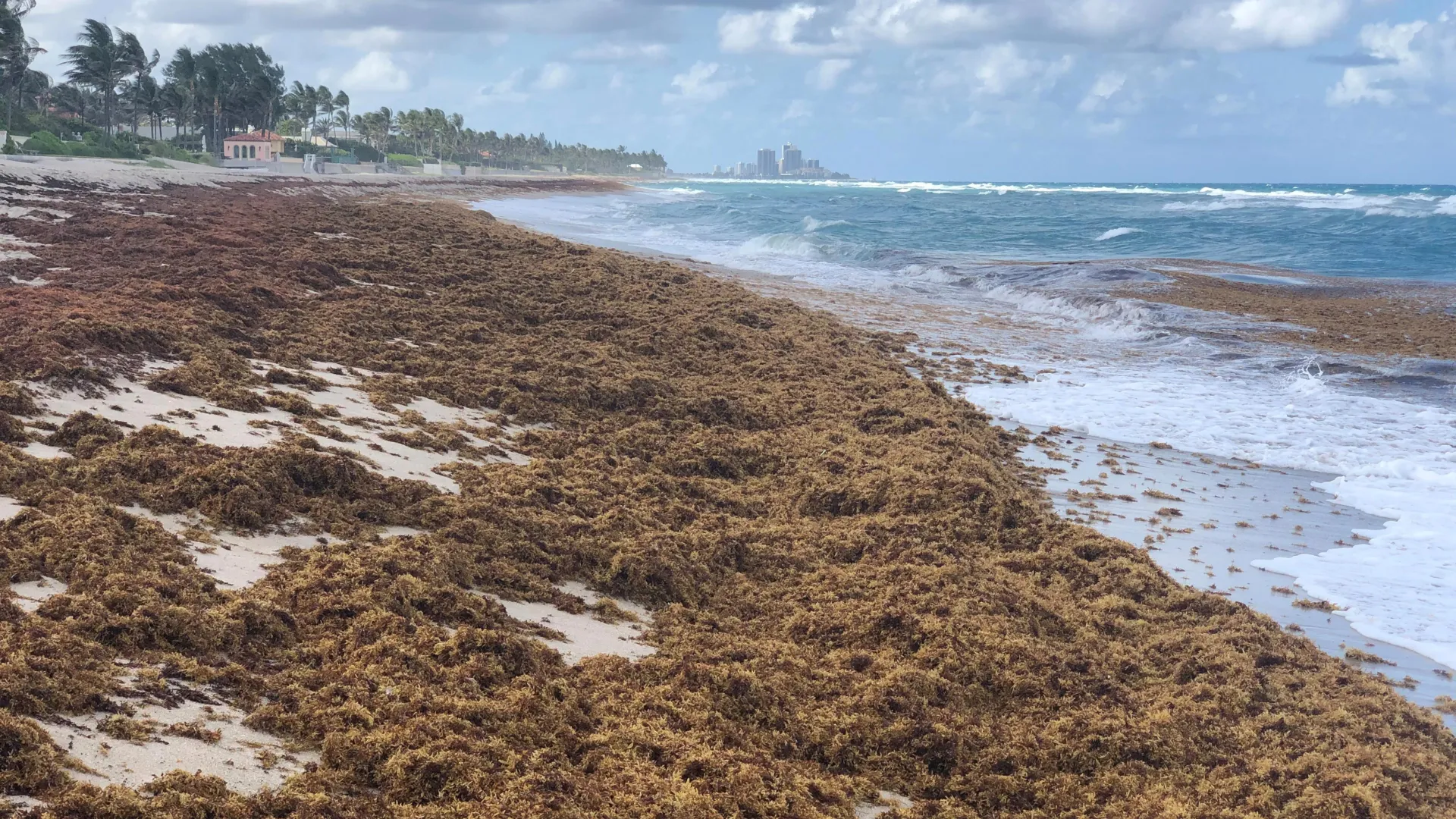 Sargassum on a beach in Palm Beach County in 2021. Credit: Brian Lapointe, FAU Harbor Branch
Some of these bacteria carry genes linked to cholera and intestinal illnesses, forming sticky biofilms on plastic surfaces embedded within the seaweed. These microbes not only pose a health risk but also contribute to the nutrient environment around the algae through excreted waste, creating what researchers described as a potential “pathogen storm” — a biochemical feedback system that further enriches the water and promotes bloom conditions.
This feedback loop — in which bacteria colonize plastic, release nutrients, and support seaweed growth — may be a critical, underappreciated force behind the increasing intensity of Atlantic Sargassum events.
Seaweed Invasion Transforms Coasts and Economies
On shore, the impacts are immediate and costly. Piles of decomposing Sargassum release hydrogen sulfide gas, which smells like rotten eggs and can cause headaches, breathing irritation, and nausea. In tourist destinations such as Barbados, Playa del Carmen, and parts of Florida, the bloom has forced hotels and municipalities to spend millions of dollars each season clearing beaches — only to have the seaweed return weeks later.
In extreme cases, the floating algae have clogged the intake systems of power plants and water treatment facilities, creating operational risks and service disruptions. As ScienceDaily reports, a similar bloom in Florida in 1991 prompted the temporary shutdown of a nuclear plant after it blocked its cooling system.
Meanwhile, fisheries and coastal wildlife are feeling the pressure. Large mats block sunlight from reaching coral reefs, reduce oxygen levels, and create hypoxic zones that kill fish, smother seagrass, and disrupt the delicate balance of shallow ecosystems.
For many Caribbean nations, the Sargassum bloom is now a recurring crisis, timed with predictable seasonal arrivals — but increasingly unpredictable in scale.
What Comes Next for the Great Atlantic Sargassum Belt?
The driving forces behind the bloom — phosphorus from deepwater upwelling, microbial nitrogen fixation, and land-based nutrient pollution — are all magnified by larger climate and ocean trends. As ocean temperatures rise and circulation patterns shift, the upwelling zones feeding these blooms may become even more active.
Researchers are working to build predictive models by integrating satellite tracking with isotope records from coral cores, helping forecast where and when future strandings will occur. But mitigation remains difficult, especially with nutrient pollution on the rise and no large-scale removal or reuse strategy yet proven effective.
Efforts to convert the seaweed into biofuel, fertilizer, or packaging have been hindered by its high arsenic content and heavy metal absorption, along with logistical and regulatory challenges. Without coordinated international solutions, the bloom may continue expanding in both scale and impact.
From space, it looks like a drifting forest. On land, it smells like decay. And across the Atlantic, it’s reshaping life on the coast — one season at a time.