
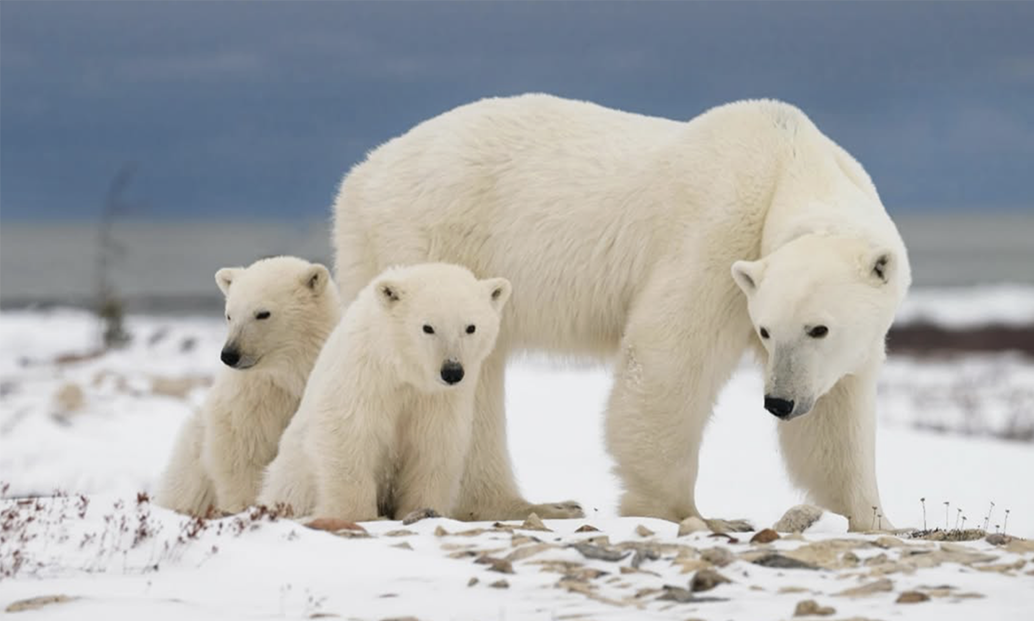
 Polar bear family, Churchill, Hudson Bay – © Bob Smith
Churchill, Canada
In the midst of the barren vastness of the tundra, scientists have witnessed a moment that made even seasoned polar bear researchers pause. Near the small town of Churchill in northeastern Manitoba, a mother polar bear was spotted with two cubs – but only one of them was her own.
The second cub had been adopted. An extremely rare event.
According to the researchers, this is only the 13th documented case of cub adoption within the Western Hudson Bay population. The extraordinary family constellation was discovered during a scientific observation carried out by teams from Polar Bears International and Environment and Climate Change Canada.
“When we received confirmation, I was deeply moved emotionally,” says Alysa McCall of Polar Bears International. “But above all, there was hope. It shows how strong the maternal instincts of these animals are – and why polar bears continue to fascinate us.”
From a pair to a trio
Back in spring, researchers observed the mother bear leaving her denning area in Wapusk National Park – at that time with only one cub. Months later, in autumn, came the surprise: the family had grown.
Two of the animals were fitted with GPS collars, but the second cub was not. For the scientists, this was a clear sign that the cub could not be her biological offspring. The data left no doubt – it was an adoption.
“In more than 45 years of research, we have identified over 4,600 individual polar bears and hundreds of litters,” explains researcher Evan Richardson from Environment and Climate Change Canada. “And yet cases like this are extremely rare.”
Why a polar bear mother adopts
The mother is estimated to be around five years old, while both cubs are about ten to eleven months old. Why she took in a foreign, apparently motherless cub cannot be said with certainty. Evan Richardson, a polar bear researcher at Environment and Climate Change Canada, suspects an instinctive response: “Polar bears are extraordinarily caring mothers. We believe she simply could not leave behind a calling cub.”
For the adopted cub, this decision may have been life-saving. Without a mother, polar bear cubs have little chance of survival. While only about half of all cubs reach adulthood, alone in the tundra the chance would have been close to zero.
A rare glimmer of hope and a small Christmas miracle
What happened to the cub’s biological mother remains unclear. Genetic samples are now expected to provide possible clues. What is certain, however, is that in times of climate change, shrinking sea ice, and growing challenges for the species, this adoption is more than a biological curiosity.
“The bears need every bit of help they can get,” says Richardson. “If a female can take in another cub and successfully raise it, that is a gain for the entire population.”
A small act of care – and a powerful sign of hope. In the icy wilderness around Churchill, this rare encounter reminds us that even under the harshest conditions, compassion and survival can sometimes go hand in hand.
Marcel Schütz, PolarJournal